If you are preparing for the NCLEX, you have probably heard one piece of advice repeated more than any other: do practice questions. But there is a critical difference between doing practice questions and doing them effectively. The students who pass the NCLEX often on the first attempt are not simply the ones who answer the most questions. They are the ones who study the rationales.
NCLEX practice questions with rationales are the single most powerful tool in your exam preparation arsenal. Rationales explain not just why the correct answer is right, but why every other option is wrong. That distinction is the foundation of the clinical reasoning the NCLEX is explicitly designed to test. This guide covers how to use practice questions with rationales strategically, where to find the best free and paid PDF resources, and how to make every question count.
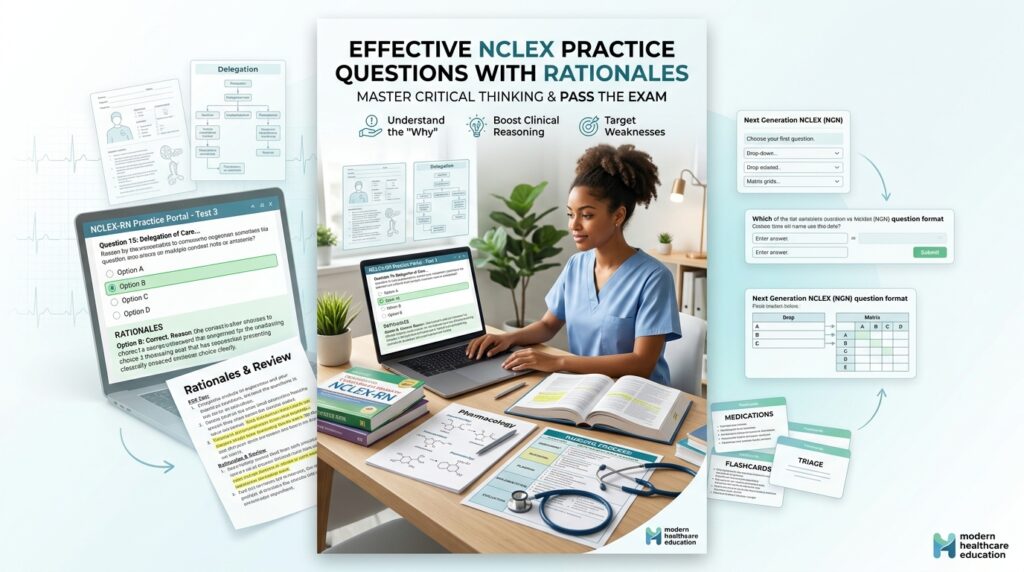
What Are NCLEX Practice Questions With Rationales?
A standard practice question gives you a clinical scenario, four or more answer options, and tells you which answer is correct. A practice question with rationales goes further it provides a detailed explanation for every answer option, explaining the clinical reasoning behind why each choice is correct, partially correct, or incorrect.
For NCLEX preparation, this distinction is everything. The NCLEX does not simply test whether you have memorized facts. It tests whether you can apply nursing knowledge to real clinical scenarios, prioritize interventions safely, and make sound judgments under pressure. Rationale-based study builds exactly those skills, because it forces you to understand the clinical logic behind each decision, not just recognize the right answer.
💡 Key Insight: Research on NCLEX outcomes consistently shows that students who regularly review question rationales including for questions they answered correctly demonstrate stronger clinical reasoning and significantly higher first-attempt pass rates than those who only check their score.
Why Rationales Are More Important Than Your Score
Most nursing students approach practice questions backwards. They complete a set of 25 questions, check their score, feel good if it is above 65%, and move on. This approach wastes most of the learning opportunity embedded in each question.
Your score tells you how well you performed on that specific set of questions at that specific moment. The rationale tells you why and that why is what you carry into the actual exam. A student who scores 70% and carefully studies every rationale learns far more than a student who scores 80% and skips straight to the next question set.
The Correct Way to Review a Practice Question
- Answer the question without looking at resources. Commit to your answer before reviewing.
- Read the rationale for the correct answer first understand the clinical reasoning fully.
- Read the rationale for every incorrect option understand exactly why each is wrong.
- If you answered incorrectly, identify the specific knowledge gap: Was it content you did not know? A prioritization error? A misread of the question stem?
- Flag content gaps for targeted revision. Do not just move on note the topic and schedule a focused review session.
- If you answered correctly but were not confident, treat it the same as an incorrect answer. Lucky guesses do not build clinical reasoning.
📋 Pro Tip: Keep a running ‘question journal’ a simple document where you record every topic area where you missed questions or felt uncertain. This becomes your personalized weak-area revision list in the days before your exam.
Understanding the NCLEX Test Blueprint
Before diving into practice questions, every nursing student should understand what the NCLEX is actually testing. The exam is structured around four major Client Needs categories. Knowing this helps you prioritize your question practice strategically.
| NCLEX Client Needs Category |
% of Questions (RN) |
Key Sub-Topics |
| Safe & Effective Care Environment |
~38% |
Safety, infection control, delegation |
| Health Promotion & Maintenance |
~9% |
Lifespan development, screening, prevention |
| Psychosocial Integrity |
~9% |
Mental health, therapeutic communication, coping |
| Physiological Integrity |
~44% |
Basic care, pharmacology, reduction of risk, physiology |
Physiological Integrity accounts for nearly half of all NCLEX questions and includes the pharmacology and physiological adaptation sub-categories that students find most challenging. Safe and Effective Care Environment covering management of care, delegation, and safety is the other dominant category. Together, these two areas represent over 80% of your exam. Your practice question strategy should reflect this weighting.
Best Free and Paid NCLEX Practice Question Resources With Rationales
Not all practice question resources are created equal. The best resources provide detailed, clinically accurate rationales written at the level of complexity the real NCLEX requires. Here is a comprehensive overview of the most trusted options, including where to find free PDF sets.
| Resource |
Free / Paid |
Question Format |
Best For |
| UWorld NCLEX |
Paid |
NCLEX-RN/PN, NGN |
Deep rationale learning |
| Kaplan NCLEX Prep |
Paid |
NCLEX-RN/PN |
Decision tree strategy |
| NCSBN Learning Ext. |
Paid (official) |
NGN Next Gen format |
Official practice closest to real exam |
| RegisteredNurseRN.com |
Free |
Standard multiple choice |
Quick topic-based drills |
| Nurseslabs.com |
Free / Premium |
Standard + SATA |
Printable PDF sets by topic |
| Quizlet NCLEX Sets |
Free |
Flashcard / quiz |
Rapid recall, mobile review |
| Mark Klimek Audio |
Free |
Audio + mnemonics |
Priority / delegation concepts |
How to Find Free NCLEX Practice Questions With Rationales PDF
Several reputable nursing education websites offer free downloadable PDF question sets with full rationales. These are particularly useful for offline study, printing for group review sessions, or supplementing a paid question bank.
- com: Offers topic-specific PDF practice sets covering major body systems, pharmacology, and specialty areas including maternal-newborn and psychiatric nursing. Rationales are detailed and NCLEX-aligned.
- com: Free question sets organized by topic with answer keys and rationales. Covers fundamentals, med-surg, pharmacology, and more.
- org: The official NCLEX developer publishes sample questions including Next Generation NCLEX (NGN) case studies. These are the closest available representation of actual exam content.
- com (formerly NRSNG): Offers a library of free questions with rationales alongside their paid subscription content.
- Quizlet: Numerous community-created NCLEX question sets with rationales are freely accessible. Quality varies — prioritize sets created by verified nursing educators.
⚠️ Quality Warning: Not all free PDF resources are clinically accurate or current. Always cross-reference rationales against your nursing textbook or a trusted paid resource when a rationale seems unclear or inconsistent with what you have studied.
Sample NCLEX Practice Questions With Rationales
Here are five sample questions across high-yield NCLEX topic areas. Study both the correct answer and the rationale for each incorrect option this is exactly how you should approach every question in your practice sets.
Question 1 Cardiovascular / Priority
A nurse is caring for a client who has just returned from a cardiac catheterization via the right femoral artery. Which assessment finding requires the nurse’s immediate intervention?
- The client reports mild discomfort at the insertion site
- The client’s blood pressure is 118/74 mmHg
- The right pedal pulse is absent on assessment
- The client asks to use the bedpan
Correct Answer: C Absent right pedal pulse
Rationale: Absence of a pedal pulse following femoral artery catheterization indicates potential arterial occlusion or thrombosis a limb-threatening emergency requiring immediate notification of the provider. Mild discomfort at the insertion site (A) is an expected finding and does not require immediate action. The blood pressure of 118/74 (B) is within normal limits. A request to use the bedpan (D) is expected since the client must remain supine with the leg extended; it is addressed but is not the priority.
Question 2 Pharmacology / Safety
A nurse is preparing to administer digoxin 0.125 mg orally to a client with heart failure. Before administering the medication, which assessment is the nurse’s priority?
- Measure the client’s blood pressure
- Assess the client’s apical pulse for one full minute
- Review the client’s most recent potassium level
- Ask the client about visual disturbances
Correct Answer: B — Apical pulse for one full minute
Rationale: Digoxin is a high-alert cardiac glycoside. The nurse must assess the apical pulse for a full 60 seconds before administration and withhold the dose if the pulse is below 60 bpm in adults, notifying the provider. While hypokalemia (C) increases digoxin toxicity risk and is an important ongoing assessment, the immediate pre-administration priority is the apical pulse check. Blood pressure (A) is relevant but not the priority for digoxin specifically. Visual disturbances (D) are a sign of digoxin toxicity important to assess, but not the pre-administration priority.
Question 3 — Delegation / Management of Care
A charge nurse on a medical-surgical unit is delegating tasks to the nursing team. Which task is most appropriate to delegate to an unlicensed assistive personnel (UAP)?
- Perform an initial head-to-toe assessment on a newly admitted client
- Teach a diabetic client how to self-administer insulin
- Ambulate a post-operative client who is stable on day two
- Evaluate a client’s response to a pain management intervention
Correct Answer: C — Ambulate a stable post-operative client
Rationale: Ambulation of a stable post-operative client is a task within the UAP’s scope of practice — it involves a predictable outcome in a stable client. Initial assessment (A), patient teaching (B), and evaluation of care outcomes (D) are all components of the nursing process that require the clinical judgment of a licensed nurse and cannot be delegated to UAP under any circumstances.
Question 4 — Fluid & Electrolytes
A nurse is reviewing laboratory results for a client receiving furosemide (Lasix). Which finding indicates a complication associated with this medication that requires the nurse to notify the provider?
- Serum sodium 138 mEq/L
- Serum potassium 2.9 mEq/L
- Urine output 80 mL/hr
- Blood pressure 124/78 mmHg
Correct Answer: B Serum potassium 2.9 mEq/L
Rationale: Furosemide is a loop diuretic that causes potassium wasting. A serum potassium of 2.9 mEq/L is below the normal range of 3.5 to 5.0 mEq/L, indicating hypokalemia — a potentially life-threatening complication that increases the risk of cardiac dysrhythmias. The provider must be notified and potassium replacement initiated. Sodium (A) is within normal limits. Urine output of 80 mL/hr (C) is adequate, indicating the medication is working appropriately. Blood pressure (D) is normal.
Question 5 — Airway / Priority (ABCs)
A nurse receives a hand-off report and must prioritize care for four clients. Which client should the nurse assess first?
- A client with a fractured femur reporting pain of 7 out of 10
- A client post-appendectomy requesting breakfast on day two
- A client with COPD who has an oxygen saturation of 84% on room air
- A client with type 2 diabetes whose blood glucose is 210 mg/dL
Correct Answer: C COPD client with SpO2 of 84%
Rationale: Using the ABCs framework, airway and breathing are always the first priority. An oxygen saturation of 84% represents a life-threatening respiratory emergency requiring immediate assessment and intervention. Pain management (A) is important but the client is stable. A post-operative client requesting breakfast (B) is a routine, non-urgent need. A blood glucose of 210 mg/dL (D) in a diabetic client requires monitoring and possible intervention, but it does not represent an immediate threat to life in the way that severe hypoxia does.
Also read on Drugs every nursing student must know
How to Build Your Own Practice Question PDF Study System
Downloading a PDF of practice questions is only the beginning. The students who get the most out of practice question resources are those who approach them systematically rather than randomly. Here is a practical framework for building your own rationale-based study system.
Step 1: Organize by NCLEX Category
Rather than working through question sets in the order they appear, organize your practice by NCLEX category. Spend the first two weeks of dedicated NCLEX prep completing question sets by body system and building your baseline performance data by topic.
Step 2: Track Your Performance Rigorously
Create a simple spreadsheet tracking your score by topic area across every practice session. After two weeks, your data will clearly show which NCLEX categories are your weakest these receive the majority of your remaining prep time.
Step 3: Alternate Question Formats
The Next Generation NCLEX (NGN) introduced new question formats that go beyond standard multiple choice. Ensure your practice includes select-all-that-apply (SATA), ordered response, hot spot, matrix questions, and NGN case studies. PDF resources vary in their coverage of alternate formats supplement free PDFs with an NGN-specific question bank.
Step 4: Timed Practice Simulations
At least once per week, complete a full timed simulation of 75 to 100 questions without pausing to look anything up. This builds the exam stamina and time-management skills that are distinct from content knowledge but equally important on test day.
⏱️ Timing Tip: The NCLEX allows approximately 1.5 minutes per question. Students who practice under timed conditions consistently perform better on the actual exam because they have built the mental pace required they are not caught off-guard by the clock.
Next Generation NCLEX (NGN): What You Need to Know
The NCLEX was updated in April 2023 to include Next Generation NCLEX (NGN) question formats designed to test clinical judgment more rigorously. If you are sitting the NCLEX today, your practice question resources must include NGN content.
NGN Question Types to Practice
- Enhanced Hot Spot: Highlight or select specific parts of a clinical document (lab results, chart notes) that indicate a client’s condition.
- Matrix Multiple Choice: Evaluate multiple findings for a single client across a table format more complex than standard SATA.
- Extended Drag-and-Drop: Order nursing actions, rank findings by priority, or categorize assessment data.
- Bow-Tie Questions: Identify a client condition, the nursing actions to address it, and the parameters to evaluate the outcome all in a single integrated item.
- Trend Questions: Analyze multiple sets of clinical data across time to identify a deteriorating or improving condition.
NGN questions are worth more than standard questions on the NCLEX adaptive scoring model. Students who are unprepared for these formats often find them significantly more difficult under timed conditions. Use the NCSBN Learning Extension or UWorld’s NGN-specific content to build familiarity with these formats before exam day.
Conclusion: Make Every Question Count
NCLEX practice questions with rationales PDF resources are among the most valuable tools available to nursing students — but only when used with the right strategy. Doing questions for the sake of accumulating a high number is not preparation. Understanding why each answer is right or wrong, tracking your performance systematically, and using that data to guide your revision that is preparation.
Start with the free PDF resources listed in this guide to build your baseline. Invest in a high-quality paid question bank like UWorld or Kaplan for the depth of rationale your NCLEX preparation ultimately requires. Practice NGN formats early and consistently. And above all, read every rationale every single time.
The NCLEX is testing your ability to think like a safe, competent nurse. Rationale-based practice is how you build that thinking. Use every question as a learning opportunity, not just a test and walk into your exam prepared for whatever clinical scenario the adaptive algorithm sends your way.
FAQ
Where can I find free NCLEX practice questions with rationales PDF?
Nurseslabs.com, RegisteredNurseRN.com, and the official NCSBN website all offer free NCLEX practice question PDFs with rationales. The NCSBN Learning Extension also provides official sample questions including NGN formats, which are the closest available representation of the actual exam.
How many NCLEX practice questions should I do per day?
Most NCLEX prep programs recommend completing 75 to 150 practice questions per day during your dedicated study period, with equal time spent reviewing rationales. Quality of review matters more than raw volume 75 questions reviewed thoroughly will prepare you better than 200 questions answered and immediately forgotten.
Do NCLEX practice questions with rationales help you pass?
Yes rationale-based practice is one of the most evidence-supported strategies for NCLEX success. Rationales build the clinical reasoning skills the exam is specifically designed to test. Students who consistently review rationales demonstrate measurably stronger performance on clinical judgment questions compared to those who focus only on their answer scores.
What is the best NCLEX practice question resource?
UWorld is widely considered the gold standard by nursing educators and students for the depth and clinical accuracy of its rationales and its close alignment with NCLEX-level difficulty. The NCSBN Learning Extension is the only official resource from the NCLEX developer and is highly recommended for NGN format familiarity. For free options, Nurseslabs.com offers the most comprehensive free PDF question sets with detailed rationales.









 Evan John