Exam season in nursing school is one of the most high-stakes periods of your academic life. The content is vast, the stakes are real, and the margin for under-preparation is thin. Many nursing students struggle not because they lack intelligence or dedication, but because they lack a clear, structured system for revision. That is exactly what a nursing exam revision checklist provides.
A revision checklist transforms the overwhelming task of exam preparation into a manageable, step-by-step process. It tells you what to study, when to study it, and how to confirm that your preparation is actually complete. Whether you are preparing for a mid-term, a final, or the NCLEX licensing exam, this comprehensive guide gives you a complete nursing exam revision checklist you can use immediately.
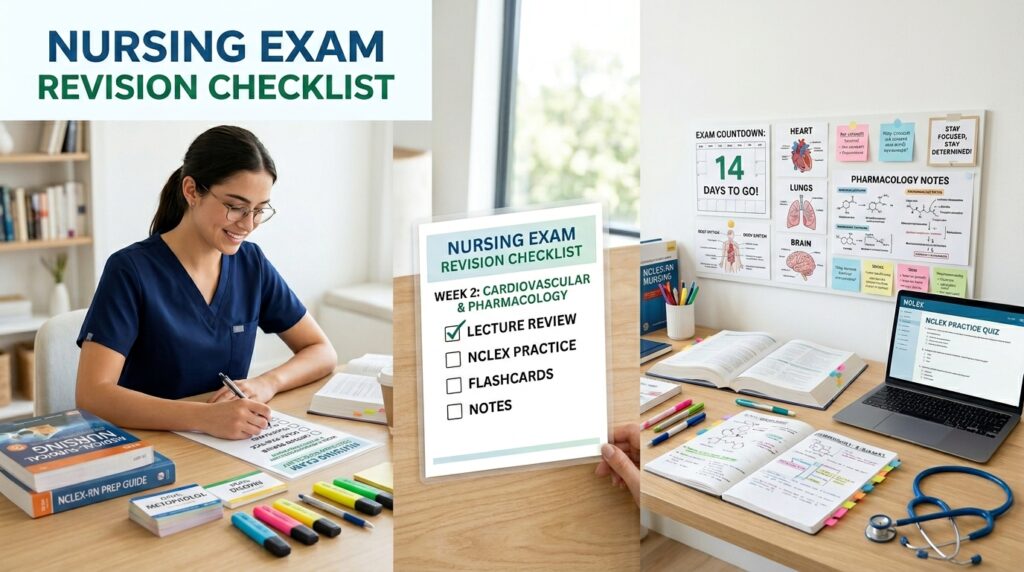
Why Every Nursing Student Needs a Revision Checklist
The human brain is not wired to manage large volumes of unstructured information efficiently. When nursing students sit down to revise without a plan, they typically gravitate toward the topics they already know well a phenomenon called the fluency illusion. The material feels familiar, so it feels like productive studying. In rerrrality, you are reinforcing existing knowledge while your weak areas remain dangerously unprepared.
A revision checklist solves this problem by forcing you to take a complete inventory of everything that could appear on the exam, then systematically work through each item. It also provides a visible record of your progress which reduces anxiety, builds confidence, and helps you make smarter decisions about where to focus your remaining time.
💡 Pro Tip: Print your checklist and keep it on your desk throughout your revision period. Physically checking off completed items creates a small but consistent sense of accomplishment that keeps motivation high across long study sessions.
Part 1: Pre-Revision Setup Checklist
Before you open a single textbook, complete this setup phase. Students who skip this step often discover two days before the exam that they missed an entire topic. The setup phase takes 30 to 60 minutes but saves many hours of panic later.
Gather and Organize Your Materials
- Collect all lecture notes, PowerPoint slides, and handouts for every topic covered since the last exam.
- Identify and bookmark the relevant chapters in your core nursing textbooks.
- Locate your previous quiz and assignment results these reveal content your instructor has already tested and is likely to test again.
- Download or access your school’s official exam blueprint or learning objectives if available.
- Set up your study space: clean desk, good lighting, water, and all materials within reach before you begin.
Create Your Topic Inventory
- List every topic that could appear on the exam use your syllabus, learning objectives, and lecture titles as your guide.
- Rate your confidence level for each topic: Strong (know it well), Shaky (understand it but not confident), or Weak (need significant review).
- Assign priority to Shaky and Weak topics these receive the most revision time.
- Estimate how many study sessions each topic needs based on its complexity and your current confidence level.
- Block out your available study days on a calendar and assign topics to each session.
📋 Checklist Tip: Use a traffic light system: green for Strong, yellow for Shaky, red for Weak. Update the colors as your revision progresses. On exam day, scan your list if everything is green or yellow, you are well prepared.
Part 2: Content Revision Checklist by Topic Area
This section gives you the master topic checklist covering the core areas tested in most nursing school exams and on the NCLEX. Use this as your foundation and add any specific topics from your course syllabus.
| Body Systems |
Core Nursing Concepts |
Clinical Skills |
| ☐ Cardiovascular |
☐ Fluid & Electrolytes |
☐ Patient Assessment |
| ☐ Respiratory |
☐ Acid-Base Balance |
☐ Medication Administration |
| ☐ Neurological |
☐ Infection Control |
☐ IV Therapy & Lines |
| ☐ Renal / Urinary |
☐ Pain Management |
☐ Wound Care |
| ☐ Gastrointestinal |
☐ Nursing Process (ADPIE) |
☐ Vital Signs & Monitoring |
| ☐ Endocrine |
☐ Patient Safety |
☐ Delegation & Scope |
| ☐ Musculoskeletal |
☐ Therapeutic Communication |
☐ Pre/Post-Op Care |
| ☐ Reproductive |
☐ Health Education |
☐ Emergency Response |
| ☐ Immune / Oncology |
☐ Ethics & Legal |
☐ Documentation |
Work through this table systematically. Do not move on to the next topic until you can explain the current one out loud without looking at your notes. This verbal self-testing is one of the most reliable indicators that content has moved from short-term to long-term memory.
Part 3: Pharmacology Revision Checklist
Pharmacology deserves its own section in any nursing exam revision checklist because it is consistently one of the most heavily tested and most feared areas in nursing school. The volume of drugs and drug classes can feel impossible to manage without a system.
For Each Drug Class, Confirm You Can Answer:
- What is the mechanism of action how does this drug work in the body?
- What conditions or diseases is this drug class used to treat?
- What are the most common and most dangerous adverse effects?
- What are the key nursing assessments required before administering this drug?
- What are the contraindications when should this drug never be given?
- What patient education is required before discharge?
- What are the critical safety considerations, such as antidotes or monitoring parameters?
High-Priority Drug Classes to Revise
- Cardiovascular: Beta-blockers, ACE inhibitors, anticoagulants (heparin, warfarin), diuretics, antiarrhythmics
- Respiratory: Bronchodilators (salbutamol), corticosteroids, antihistamines
- Neurological: Analgesics, opioids, anticonvulsants, antidepressants, antipsychotics
- Endocrine: Insulin types and administration, oral hypoglycaemics, thyroid medications
- Infectious Disease: Antibiotic classes, antifungals, antivirals mechanisms and resistance considerations
- GI: Antiemetics, antacids, proton pump inhibitors, laxatives
- High-Alert Medications: Insulin, heparin, digoxin, potassium chloride, chemotherapy agents
⚠️ Exam Warning: High-alert medications particularly insulin, heparin, and digoxin appear on almost every nursing exam and NCLEX. Know their toxicity signs, antidotes, and nursing priorities cold before you sit any exam.
Part 4: Clinical Reasoning and NCLEX-Style Revision Checklist
Modern nursing exams, especially the NCLEX, do not simply test whether you know a fact they test whether you can apply that knowledge to make safe clinical decisions. This section of your revision checklist focuses on the higher-order thinking skills that exams are designed to assess.
Clinical Reasoning Revision Checklist
- For each major condition, can you identify the priority nursing assessment what does the nurse check first?
- Can you distinguish expected findings from findings that require immediate intervention?
- Do you understand how to apply Maslow’s Hierarchy of Needs to prioritize nursing interventions?
- Can you correctly apply the ABCs framework (Airway, Breathing, Circulation) to triage decisions?
- Do you understand delegation rules what can be delegated to a nursing assistant and what must the RN perform?
- Can you identify safety risks in a clinical scenario fall risks, medication errors, infection control breaches?
- Do you understand the nursing process (ADPIE) and can you apply it to a patient scenario?
- Can you identify therapeutic versus non-therapeutic communication techniques?
Practice Question Revision Targets
- Complete a minimum of 50 practice questions per day in the week before the exam.
- Review the rationale for every question — especially the ones you answered correctly.
- Track your performance by topic area to identify and address weak areas.
- Practice at least 20 alternate-format questions: select-all-that-apply, ordered response, hot spot.
- Simulate timed exam conditions at least once during your revision period.
Part 5: The 10-Day Countdown Revision Plan
Knowing what to study is only half the battle knowing when to study each element is equally important. Use this 10-day countdown as your master revision schedule framework.
| Timeframe |
Revision Focus |
| 10–14 Days Out |
Full topic audit identify every subject on the exam syllabus. Map out what you know, what is shaky, and what you have not touched. |
| 7–9 Days Out |
Systematic content review work through each topic using your notes, concept maps, and textbook summaries. One major topic per day. |
| 4–6 Days Out |
Practice questions 50 to 75 NCLEX-style questions per day. Review every rationale carefully, including questions you answered correctly. |
| 2–3 Days Out |
Targeted weak-area review use your question bank performance data to identify your weakest topics. Re-study those areas specifically. |
| Day Before |
Light review only flashcards, one-page summaries, audio notes. No new material. Sleep by 10 PM. |
| Exam Morning |
30-minute max review. Eat a proper breakfast. Arrive early. Trust your preparation. |
This countdown is designed to be adapted, not followed rigidly. If you are three days out and realize you have a significant gap in a high-weight topic, adjust your plan accordingly. The checklist framework gives you the flexibility to respond to your actual preparation status rather than blindly following a schedule.
Part 6: Exam-Day Preparation Checklist
The 24 hours before your exam and the morning of the exam are not neutral they actively affect your performance. Students who manage this window well walk in calmer, think more clearly, and retrieve information more effectively.
The Night Before
- Complete only light revision flashcards, summary sheets, or audio notes. No new material after 8 PM.
- Lay out everything you need for the exam: ID, stationery, any permitted materials.
- Confirm the exam time, location, and any specific instructions from your instructor.
- Eat a proper evening meal your brain uses glucose for cognitive function.
- Avoid caffeine after 4 PM to protect sleep quality.
- Aim for 7 to 8 hours of sleep. Sleep consolidates everything you studied during the revision period.
Exam Morning
- Wake up with enough time to avoid rushing feeling rushed activates stress responses that impair recall.
- Eat a balanced breakfast: protein, complex carbohydrates, and water.
- Do a maximum 30-minute light review summary notes only. No deep studying.
- Arrive at the exam venue at least 15 minutes early.
- Avoid discussing the exam with anxious classmates in the minutes before it begins their anxiety is contagious.
- Before you begin writing, take three slow, deep breaths. This activates the parasympathetic nervous system and reduces acute anxiety.
Part 7: Post-Exam Reflection Checklist
Most nursing students treat the exam as the finish line. High-performing students treat it as a data point. A brief post-exam reflection done after you have had time to decompress, not immediately after helps you continuously improve your revision process.
- Which topics felt well-prepared and which felt weak when you were answering questions?
- Were there any topic areas you did not revise that appeared on the exam?
- Did you run out of time? If so, which question types took the longest?
- Were there any recurring question themes (prioritization, medication safety, delegation) that you need to strengthen?
- What would you change about your revision timeline and daily schedule for the next exam?
- Update your master topic list with new weak areas to address before the next exam or NCLEX preparation.
📊 Growth Mindset: Every nursing exam whether you pass or fall short contains valuable diagnostic information about where your knowledge is strong and where it needs work. Students who use this data systematically improve with every cycle.
Bonus: Tools and Resources to Support Your Revision
A checklist is only as powerful as the study methods you pair it with. Here are the most effective tools nursing students use to work through their revision checklists efficiently.
- Anki (Spaced Repetition Flashcards): Build one card per checklist item and let the algorithm schedule your reviews. Ideal for pharmacology and lab values.
- UWorld or Kaplan Question Banks: Use these for your daily practice question targets. Both provide detailed rationales and performance analytics by topic.
- NurseInTheMaking or Simple Nursing (YouTube): Visual explainers for complex pathophysiology. Watch one video per weak topic as a supplement to your notes.
- Picmonic: Mnemonics and visual storytelling for medications, diseases, and nursing concepts. Especially useful for visual learners.
- Google Docs or Notion: Build a digital version of your revision checklist that you can access from any device and update in real time.
- A Printed Checklist: Pin a physical copy to your study wall. The act of physically ticking off completed items reinforces progress in a way that digital tools do not fully replicate.
Also read on Drugs every nursing student must know
Conclusion: Check Every Box, Walk in Confident
Exam success in nursing school is rarely the result of last-minute brilliance. It is the result of systematic preparation knowing what you need to know, organizing your time to cover it thoroughly, and testing yourself rigorously until you can retrieve information accurately under pressure.
This nursing exam revision checklist gives you the structure to do exactly that. Use the pre-revision setup to build your study plan. Work through the content and pharmacology checklists systematically. Apply the 10-day countdown to manage your time. Protect your exam day with the preparation checklist. And use the post-exam reflection to get smarter with every cycle.
Nursing school is demanding by design the patients you will care for deserve nothing less than a thoroughly prepared, clinically competent nurse. Start your revision checklist today, check every box with intention, and walk into that exam room knowing you have done the work.
Frequently Asked Questions
What should be included in a nursing exam revision checklist?
A complete nursing exam revision checklist should include a topic inventory covering all body systems and core nursing concepts, a pharmacology review section, clinical reasoning practice targets, a countdown study schedule, an exam-day preparation list, and a post-exam reflection section.
How far in advance should I start revising for a nursing exam?
Begin your structured revision at least 10 to 14 days before the exam. This gives you enough time to cover all topics systematically, complete a substantial volume of practice questions, and target your weak areas before the final days of review.
How do I use a revision checklist for the NCLEX?
For NCLEX preparation, use the topic checklist to confirm coverage of all eight NCLEX client needs categories. Prioritize clinical judgment, pharmacology, and safety sections. Supplement your checklist with a high-quality question bank and aim to complete 75 to 150 practice questions daily during your dedicated prep period.
What is the most important thing to revise before a nursing exam?
Priority nursing interventions, pharmacology for high-alert medications, fluid and electrolyte imbalances, and NCLEX-style clinical reasoning are consistently the highest-yield areas in nursing exams. Always review your specific course learning objectives to align your revision with what your instructor has signaled as most important.









 Evan John