💡 Whether you’re a first-year nursing student or preparing your capstone project, mastering the PICOT questions in nursing format is one of the most valuable skills you can build. This guide breaks it down step by step with a free template and real examples you can use today.
If you’ve ever stared at a blank page wondering how to frame a clinical research question, you’re not alone. Most nursing students find PICOT questions intimidating at first not because the concept is complicated, but because no one shows them a clear, practical method.
By the end of this post, you’ll know exactly what PICOT means, how to write one correctly, what a strong PICOT question looks like across different clinical scenarios, and the mistakes that cost students marks every semester.
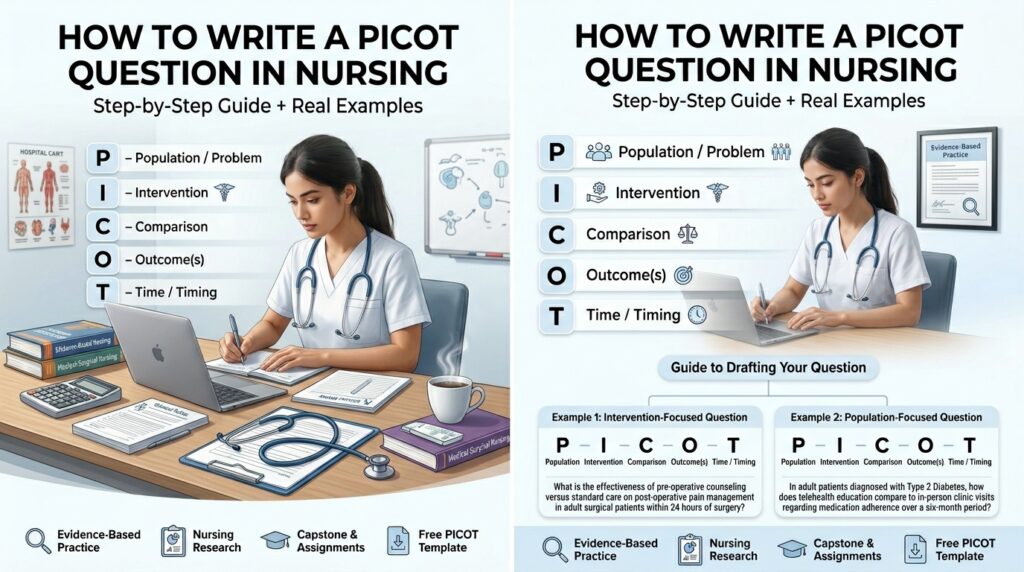
What Is a PICOT Question? (The Concept Explained Simply)
A PICOT question is a structured clinical research question used in evidence-based practice (EBP). It provides a systematic framework for identifying a clinical problem, proposing an intervention, comparing it to an alternative, and defining measurable outcomes over a specific time period.
The acronym stands for:
| Letter |
Stands For |
What It Means |
Example |
| P |
Population / Patient |
Who is your patient or group? |
Adult ICU patients with ventilator-associated pneumonia |
| I |
Intervention |
What treatment or action are you testing? |
Daily oral chlorhexidine rinsing |
| C |
Comparison |
What is the alternative or current standard? |
Standard oral care without chlorhexidine |
| O |
Outcome |
What result are you hoping to achieve or measure? |
Reduced incidence of pneumonia within 30 days |
| T |
Time |
Over what time frame? (optional but recommended) |
Over a 30-day hospital stay |
PICOT questions are used primarily in:
- Nursing research and literature reviews
- Capstone projects and dissertations
- Clinical practice improvement proposals
- Evidence-based care plan development
- Quality improvement (QI) initiatives
🎯 Why does PICOT matter? Because vague clinical questions lead to vague research and vague research leads to poor patient outcomes. A well-constructed PICOT question narrows your literature search, improves the quality of evidence you find, and strengthens every argument in your paper.
The 5 Types of PICOT Questions in Nursing
Not all PICOT questions are the same. The type you use depends on what clinical question you’re trying to answer:
1. Therapy / Intervention Questions
Used when comparing treatments or nursing interventions.
“In adult patients with chronic back pain (P), does physiotherapy (I) compared to pain medication alone (C) result in better mobility and reduced pain scores (O) within 8 weeks (T)?”
2. Diagnosis Questions
Used when evaluating the accuracy of a diagnostic test or procedure.
“In elderly patients presenting with confusion (P), is the use of the CAM tool (I) compared to clinical observation alone (C) more accurate in diagnosing delirium (O) within 24 hours of admission (T)?”
3. Prognosis / Prediction Questions
Used when examining likely patient outcomes over time.
“In patients who have suffered a first-time ischaemic stroke (P), how does early physical rehabilitation (I) compared to delayed rehabilitation (C) affect functional independence (O) at 6 months post-discharge (T)?”
4. Etiology / Harm Questions
Used when investigating causes of a condition or risk factors for harm.
“In postoperative adult patients (P), does prolonged urinary catheterisation beyond 24 hours (I) compared to removal within 24 hours (C) increase the risk of catheter-associated urinary tract infections (O) within 72 hours (T)?”
5. Meaning Questions (Qualitative)
Used in qualitative nursing research to explore patient experience.
“How do newly diagnosed breast cancer patients (P) experience nurse-led psychological support (I) compared to no formal support (C) in terms of emotional wellbeing and coping (O) during the first 3 months of treatment (T)?”
How to Write a PICOT Question: Step-by-Step
Follow these six steps every time you construct a PICOT question from scratch.
Step 1: Identify the Clinical Problem
Start with a real clinical scenario. Don’t begin with keywords begin with a situation. Ask yourself: “What is the nursing problem I am seeing in practice, and what am I curious about?”
Example scenario: Patients in your ward are frequently readmitted within 30 days of discharge. You suspect this is linked to inadequate patient education before discharge.
Step 2: Define Your Population (P)
Be as specific as possible. Age group, condition, setting, and demographics all help narrow your question and your literature search.
- Too vague: “patients”
- Better: “adult patients over 65 admitted for heart failure”
Step 3: Choose Your Intervention (I)
What nursing action, treatment, programme, or tool are you proposing or investigating? Make it concrete and clinically measurable.
- Too vague: “better education”
- Better: “a structured 30-minute nurse-led discharge education session using the teach-back method”
Step 4: Identify the Comparison (C)
In many PICOT questions, C is the current standard of care, no intervention, or an alternative treatment. In qualitative or prognosis questions, C may sometimes be omitted.
Step 5: Define the Outcome (O)
What are you measuring? Outcomes should be specific, observable, and measurable. Avoid vague outcomes like “better health” instead use “reduced 30-day hospital readmission rates” or “HbA1c levels below 7%.”
Step 6: Set the Time Frame (T)
Specify over what period the outcome will be measured. This helps focus your literature search and strengthens your methodology section. Common time frames: 30 days, 3 months, 6 months, 1 year.
Also read on NCLEX Practice Questions With Rationales PDF: The Complete Study Guide
5 PICOT Question Examples (With Full Breakdowns)
The following examples cover the most common clinical areas nursing students are assigned. Each one is written in both table format and full-sentence format.
Example 1 — Diabetes Management
| PICOT Element |
Content |
| P |
Adult patients (18+) newly diagnosed with Type 2 diabetes |
| I |
Structured diabetes self-management education (DSME) programme |
| C |
Standard physician consultations with no formal education programme |
| O |
Improved HbA1c levels and medication adherence rates |
| T |
Six months after enrolment in the programme |
Full PICOT Question: “In adult patients newly diagnosed with Type 2 diabetes (P), does participation in a structured diabetes self-management education programme (I) compared to standard physician consultations alone (C) result in improved HbA1c levels and better medication adherence (O) within six months of enrolment (T)?”
Example 2 — Pressure Ulcer Prevention
P: Adult patients over 65 admitted to long-term care with limited mobility I: Two-hourly repositioning protocol by nursing staff C: Standard repositioning without a scheduled protocol O: Reduced incidence of stage II or higher pressure ulcers T: During a 90-day admission period
“In elderly patients over 65 with limited mobility in long-term care (P), does a scheduled two-hourly repositioning protocol (I), compared to unscheduled repositioning (C), reduce the incidence of Stage II or higher pressure ulcers (O) over a 90-day admission period (T)?”
Example 3 Mental Health Nursing
P: Adult patients hospitalised for acute depression I: Nurse-led mindfulness-based stress reduction sessions C: Medication and standard psychiatric counselling only O: Reduction in PHQ-9 depression scores T: Over an 8-week inpatient programme
“In adult patients hospitalised for acute depression (P), does nurse-led mindfulness-based stress reduction (I), compared to medication and standard counselling alone (C), reduce PHQ-9 depression scores (O) over an 8-week inpatient programme (T)?”
Example 4 — Paediatric Nursing
P: Children aged 5–12 receiving intravenous cannulation I: Topical anaesthetic cream (EMLA) applied 60 minutes prior C: No topical anaesthetic applied O: Reduced self-reported pain scores and procedural distress T: At the time of cannulation
“In children aged 5–12 undergoing IV cannulation (P), does pre-application of EMLA cream 60 minutes before the procedure (I), compared to no topical anaesthetic (C), reduce self-reported pain scores and distress behaviours (O) at the time of insertion (T)?”
Example 5 — Community / Public Health Nursing
P: Adults aged 40–65 with hypertension in a community setting I: Monthly nurse-led blood pressure monitoring clinics C: Annual GP review only O: Better blood pressure control (systolic below 130 mmHg) T: Over 12 months
“In community-dwelling adults aged 40–65 with hypertension (P), does participation in monthly nurse-led BP monitoring clinics (I), compared to annual GP review only (C), result in better sustained blood pressure control (O) over a 12-month period (T)?”
The PICOT Question Template (Fill-in-the-Blank)
Use this formula for any intervention-type PICOT question. It is the most commonly required format in nursing assignments:
📋 PICOT TEMPLATE
“In [population/patient group] (P), does [intervention] (I), compared to [comparison/alternative] (C), result in [measurable outcome] (O) within/over [time period] (T)?”
For a qualitative (meaning) question, use this adapted version:
“How do [population] (P) experience [phenomenon/intervention] (I) compared to [alternative experience or no intervention] (C) in terms of [outcome/meaning] (O) during [time period or context] (T)?”
⚡ Pro Tip: Once you’ve filled in the template, read the full sentence aloud. If it sounds awkward, your elements may be too vague. Tighten the population and make your outcome measurable.
Common Mistakes When Writing PICOT Questions (And How to Fix Them)
These are the errors nursing markers flag most often. Avoid them and you’ll be ahead of the majority of your cohort.
❌ Mistake 1: Making the Population Too Broad
Weak: “patients with diabetes” Stronger: “adults aged 50–70 with poorly controlled Type 2 diabetes (HbA1c above 8%) in a primary care setting”
A broad population makes your literature search unmanageable. Specific populations lead to specific, high-quality evidence.
❌ Mistake 2: Vague or Unmeasurable Outcomes
Weak: “better patient outcomes” or “improved quality of life” Stronger: “reduced systolic blood pressure to below 130 mmHg” or “PHQ-9 score reduction of 5 or more points”
Your outcome must be something you can measure. If you cannot measure it, you cannot evaluate whether the intervention worked.
❌ Mistake 3: Confusing Intervention and Comparison
Some students accidentally write the same thing for both I and C. The intervention is what you are proposing or testing. The comparison is what currently happens or the alternative. They must be clearly different.
❌ Mistake 4: Omitting the Time Frame
T is technically optional in the PICOT framework, but in academic nursing assignments it is almost always expected. Without a time frame, your question has no clinical anchor and your literature search will return results from every era and setting.
❌ Mistake 5: Turning the PICOT Question into a Statement
Wrong: “PICOT questions should be used in nursing research to improve outcomes.” Right: It must always be phrased as a question ending with a question mark.
❌ Mistake 6: Writing Multiple Outcomes
Stick to one primary, measurable outcome per PICOT question. Multiple outcomes dilute your research focus and make your literature review nearly impossible to structure. You can address secondary outcomes in the body of your paper — not in the PICOT question itself.
✅ Quick Checklist Before You Submit: ✅ Specific population? ✅ Concrete intervention? ✅ Clear comparison? ✅ Measurable outcome? ✅ Time frame included? ✅ Phrased as a question? If you can tick all six, your PICOT question is ready.
Struggling With Your Nursing Assignment?
Writing a PICOT question is just the beginning. If you’re finding it hard to structure your full literature review, care plan, capstone, or research paper our nursing assignment experts are here to help.
✅ 100% original, plagiarism-free work
✅ Written by qualified nurses and nursing academics
✅ Delivered before your deadline — guaranteed
✅ Free unlimited revisions until you’re 100% satisfied
✅ Strict confidentiality — your details are never shared
🎓 Get Expert Nursing Help Now → order here
📥 Not ready to order yet? Download our free PICOT Question Worksheet → [LEAD MAGNET LINK] and use it alongside this guide to build your question in under 15 minutes.
Final Thoughts
A strong PICOT question is the foundation of every great nursing research paper. It focuses your search, clarifies your argument, and shows your marker that you understand evidence-based practice at a clinical level.
Remember the formula: specific population, clear intervention, honest comparison, measurable outcome, defined time frame. Get those five elements right and you’ll find that the rest of your assignment writes itself.
If this guide helped you, bookmark it for your next assignment and share it with a classmate who’s still staring at a blank page.









 Evan John