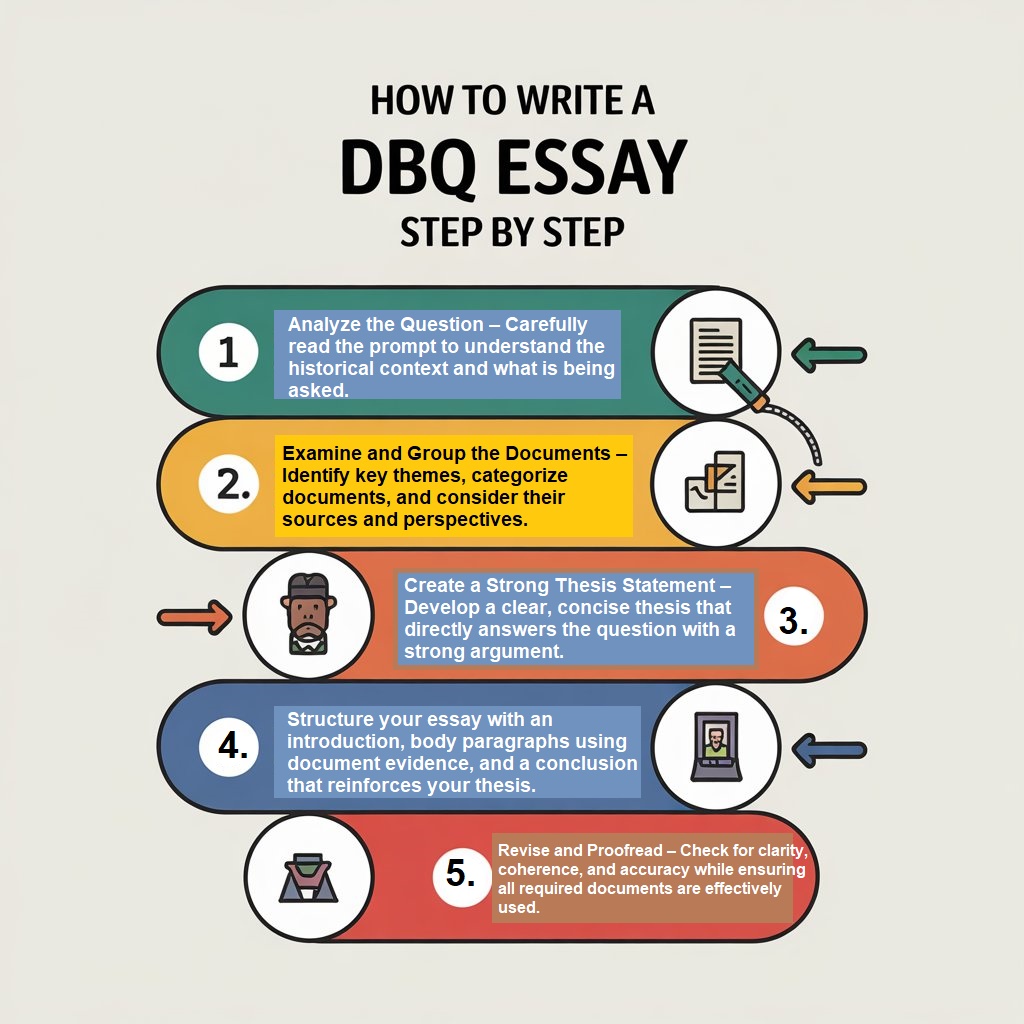
When writing a DBQ essay, you must interpret primary and secondary sources, develop a thesis, and support it with evidence, all within a limited time. Let’s break down the DBQ essay-writing process into clear, manageable steps. Whether preparing for an AP History exam or another assessment, becoming proficient in DBQs will boost your analytical and Read More
Chat with our experts to get the best quote. Make the payment via online banking, debit/credit cards or through paypal. Recieve an order confirmation number.
Sit back and relax. Your well written, properly referenced research paper will be mailed to your inbox, before deadline. Download the paper. Revise and Submit.
When writing a DBQ essay, you must interpret primary and secondary sources, develop a thesis, and support it with evidence, all within a limited time.
Let’s break down the DBQ essay-writing processinto clear, manageable steps. Whether preparing for an AP History exam or another assessment, becoming proficient in DBQs will boost your analytical and writing skills.
What is a DBQ Essay
A DBQ (Document-Based Question) essay is a type of academic writing commonly assigned in AP History exams and other history courses. Students must analyze primary and secondary sources such as speeches, letters, maps, and newspaper articles to construct a well-supported argument responding to a historical prompt.
Unlike traditional essays, a DBQ emphasizes critical thinking, source evaluation, and historical synthesis, combining provided documents with prior knowledge. Typically, students work with a minimum of 3 and a maximum of 16 sources, extracting key information, identifying perspectives, and forming a thesis that directly addresses the question. Understanding the DBQ format develops essential skills in argumentation, historical analysis, and evidence-based writing, making it a valuable academic exercise beyond history exams.
How to Write a DBQ Essay Step by Step
A Document-Based Question (DBQ) essay is a key component of history exams, particularly in Advanced Placement (AP) courses such as AP U.S. History, AP World History, and AP European History.
A DBQ requires students to analyze a set of historical documents and use them as evidence to construct a well-supported argument in response to a given prompt. A strong DBQ essay requires careful planning, document analysis, and clear, structured writing. This guide will take you through each step of the process in detail.
Step 1: Understanding the Prompt
Before beginning document analysis or writing, it is crucial to understand the question being asked fully. Carefully read the prompt and identify the key components:
Period & Topic – Determine the historical context and subject matter.
Task Words – Identify action words such as:
“Analyze” – Break down and examine different components.
“Evaluate” – Judge the significance or effectiveness of a historical event.
“Compare” or “Contrast” – Identify similarities and differences.
“Assess the extent” – Determine the degree to which something is true.
Argument Focus – Clarify what stance needs to be taken and what evidence is required.
Step 2: Analyze the Documents
The DBQ will include a collection of historical documents, which can include:
Excerpts from letters, speeches, or legal documents
Political cartoons, charts, or maps
News articles, personal diaries, or government reports
For each document, consider the following aspects:
Author & Perspective – Identify the creator of the document and their potential biases.
Historical Context – Determine what was happening when the document was produced.
Purpose & Intended Audience – Consider why the document was created and for whom.
Main Idea – Identify the document’s central message and how it relates to the prompt.
Grouping Documents
After analyzing each document, look for patterns or themes to help structure the argument. Grouping documents with similar perspectives or topics allows for a more organized and coherent response.
Step 3: Develop a Strong Thesis Statement
A thesis statement should answer the prompt and present a structured argument. A strong thesis must:
Take a clear position (agree, disagree, or nuanced stance).
Address multiple aspects of the prompt.
Provide a roadmap for the rest of the essay.
The thesis should not merely restate the question but articulate a specific argument supported by historical evidence.
Step 4: Plan Your Essay Structure
Once the thesis is established, outlining the essay ensures clarity and logical progression. A DBQ typically follows a five-paragraph structure, though adjustments may be made as needed.
1. Introduction
The introduction should provide a foundation for the argument. It must include:
Contextualization: A brief description of relevant background events leading up to the topic (typically covering the previous 50-100 years).
Thesis Statement: A concise statement that directly answers the prompt.
Body Paragraphs
Each body paragraph should
Begin with a topic sentence that supports the thesis.
Use at least two or three documents as evidence.
Include analysis of the documents rather than simple summaries.
Explain how each document supports the argument.
Integrate outside historical evidence that is not included in the documents.
Document Analysis Techniques To strengthen the argument, each document should be analyzed using at least one of the following techniques:
Historical Context – Identify the broader events that influenced the document.
Intended Audience – Determine who the document was meant for and how that affects its message.
Purpose – Explain why the document was created and what its objective was.
Point of View – Assess the author’s perspective and potential biases.
This method is often called HIPP Analysis (Historical Context, Intended Audience, Purpose, and Point of View).
Conclusion
The conclusion should:
Restate the thesis in different words.
Summarize the main points.
Explain the broader historical significance of how the topic connects to later historical developments.
Step 5: Write and Cite Documents Properly
When writing the essay, ensure that:
Documents are referred to using (Doc 1), (Doc 2), etc., rather than quoting extensively.
Each document is analyzed rather than summarized.
Historical evidence beyond the documents is incorporated to demonstrate a broader understanding of the topic.
Proper citation and analysis help to strengthen the argument and maintain historical accuracy.
Step 6: Revise & Proofread
After writing, reviewing the essay for clarity, structure, and accuracy is essential. Check for:
Thesis Clarity – Ensure the thesis is strong and consistent throughout the essay.
Effective Document Use – Confirm that at least six documents are used meaningfully.
Outside Evidence – Verify that at least one additional piece of historical knowledge has been included.
Grammar and Coherence – Ensure that sentences flow logically and avoid grammatical errors.
Creating a well-structured outline is crucial for writing a successful DBQ essay. The DBQ essay is a common assignment in history courses, particularly in AP U.S. History, AP European History, and AP World History. Below is a standard outline to help you organize your essay effectively:
Introduction
Contextualization (1-2 sentences)
Provide historical context for the topic. Briefly explain the broader historical events, trends, or themes relevant to the question.
Example: “In the late 19th century, industrialization transformed societies worldwide, leading to significant economic and social changes.”
Thesis Statement (1-2 sentences)
Answer the prompt with a defensible claim. Your thesis should address all parts of the question and provide a roadmap for your essay.
Example: “While industrialization brought economic growth and technological advancements, it also exacerbated social inequalities and labor exploitation, as evidenced by the working conditions in factories and the rise of labor movements.”
Body Paragraphs
Each body paragraph should focus on a specific argument or theme that supports your thesis. Use the analysis of the HIPP (Historical Context, Intended Audience, Purpose, Point of View) to analyze documents effectively.
Body Paragraph 1: First Argument
Topic Sentence: Introduce the first point supporting your thesis.
Document Evidence: Use at least one document to support your argument.
Example: “Document 1, a photograph of child laborers, highlights the harsh working conditions faced by workers during industrialization.”
HIPP Analysis: Analyze the document (e.g., “The purpose of this photograph was to expose the exploitation of children and advocate for labor reforms.”)
Outside Evidence: Include additional historical evidence not found in the documents to strengthen your argument.
Link to Thesis: Explain how this evidence supports your thesis.
Body Paragraph 2: Second Argument
Topic Sentence: Introduce the second point supporting your thesis.
Document Evidence: Use another document to support your argument.
Example: “Document 3, a speech by a labor union leader, emphasizes the growing demand for workers’ rights and better wages.”
HIPP Analysis: Analyze the document (e.g., “The point of view of the union leader reflects the collective frustration of workers and their push for reform.”)
Outside Evidence: Provide additional historical context or evidence.
Link to Thesis: Connect this evidence back to your thesis.
Body Paragraph 3: Counterargument or Complexity
Acknowledge Counterarguments: Address an alternative perspective or complexity in the topic.
Example: “While industrialization did create economic opportunities, it disproportionately benefited factory owners and widened the wealth gap.”
Document Evidence: Use a document to support this perspective.
Rebuttal: Refute the counterargument or explain how it fits into your thesis.
Link to Thesis: Reinforce your thesis by showing how this complexity supports your argument.
Conclusion
Restate Thesis: Summarize your main argument in different words.
Synthesis: Connect your argument to a broader historical context, another period, or a related theme.
Example: “The social and economic changes brought by industrialization in the 19th century mirror the challenges faced during the digital revolution of the 21st century, as both periods saw significant technological advancements and debates over labor rights.”
Final Thought: End with a strong closing statement that leaves a lasting impression.
A DBQ (Document-Based Question) essay typically has five to six paragraphs, but this can vary depending on the length and complexity of the response. The general structure is as follows:
A DBQ (Document-Based Question) essay typically ranges from 4 to 6 paragraphs and 500 to 800 words and follows a clear structure. It begins with an introduction providing historical context and a strong thesis statement. The body paragraphs (usually 3–4) analyze the provided documents, using them as evidence to support the argument while incorporating outside knowledge.
Each paragraph should focus on a specific point, ensuring a strong connection to the thesis. Instead of summarizing the documents, you should analyze their purpose, perspective, and historical significance. The essay concludes with a final paragraph that restates the thesis, summarizes key arguments, and explains the broader historical impact. For AP history exams, using at least six documents and including one piece of outside evidence to strengthen the argument is essential. Strong analysis, clear organization, and well-supported claims are key to a high-scoring DBQ essay.
Final Thought
By analyzing documents carefully, developing a strong thesis, and structuring your argument effectively, you’ll be well-prepared to impress your examiners and pass the DBQ essay.
Practice is key to honing your skills by working through past prompts and refining your critical thinking ability under time constraints. With a solid strategy and a bit of confidence, you’ll be on your way to acing any DBQ essay that comes your way!
DBQ Essay Writing – FAQ
A DBQ (Document-Based Question) essay is a type of academic writing often used in history and social studies. It requires analyzing historical documents and using them as evidence to build a well-argued response to a specific question.
Begin by carefully reading the prompt and understanding its context. Then, examine the documents for perspective and bias, develop a strong thesis, outline your ideas, and write a structured essay with an introduction, body, and conclusion.
Documents serve as your primary evidence. They help you support your thesis and show your understanding of the historical context. These may include letters, maps, speeches, images, or historians’ interpretations.
Start with an introduction that includes your thesis. Follow with body paragraphs that focus on individual points, supported by document evidence and analysis. End with a conclusion that reinforces your argument.
Yes, outside knowledge can provide helpful context. Just ensure that your primary evidence comes from the provided documents and that any additional information is accurate and relevant.
When analyzing, consider the author’s perspective, purpose, historical context, and any bias. Discuss how the document supports or challenges your thesis—don’t simply summarize it.
Acknowledge other perspectives using the documents, then explain why your thesis is stronger. This enhances the depth and credibility of your analysis.
Restate your thesis in a new way and summarize your key points. Highlight the broader historical significance of your argument without introducing new evidence.
Practice analyzing documents and constructing arguments. Review feedback from teachers, study successful samples, and focus on organizing your thoughts logically.
Read your essay aloud to catch awkward phrasing or errors. Check grammar, clarity, and logical flow. You can also ask someone else to review your work.









 Evan John