Somewhere around the first week of a dissertation, most students hit the same wall: it doesn’t feel like one project, it feels like ten. There’s reading to do, a topic to narrow down, a methodology to figure out, data to collect, chapters to draft, references to manage, and a deadline sitting quietly in the background the whole time.
The biggest mistake at this stage is treating the dissertation as one enormous task. Looked at that way, it’s genuinely overwhelming , there’s no obvious place to start, and no way to tell if you’re making progress.
The more workable approach is to treat a dissertation as a series of smaller, connected projects, each with its own clear steps. That’s what dissertation planning actually is, and it’s the difference between staring at a blank document and knowing exactly what to open your laptop and work on today.
Get the Dissertation Planner
What Is a Dissertation Plan?
A dissertation plan is simply a roadmap. It sets out what needs to be done, roughly when it needs to be done, what resources or sources you’ll need, which chapters require attention, which research tasks are still outstanding, when drafts should be reviewed, when editing should happen, and when the final version needs to be ready.
It does not need to be an elaborate project-management system with dozens of linked spreadsheets. For most students, a plan is more useful when it’s simple enough to actually check and update every week a clear list of stages, a rough timeline, and a way to track what’s done and what’s next.
How to Plan a Dissertation Step by Step
Step 1: Understand Your University’s Requirements
Before planning anything, check your university’s specific guidelines. Requirements vary significantly between institutions and disciplines, so it’s worth confirming the details early rather than assuming.
- Dissertation guidelines and handbook
- Word count requirements
- Submission deadline
- Required structure
- Referencing style
- Formatting requirements
- Ethical approval requirements, where applicable
- Your supervisor’s specific expectations
Step 2: Choose and Refine Your Research Topic
A broad interest is a starting point, not a topic. Part of planning is narrowing that interest into something manageable enough to actually research within your timeframe.
For example, a broad starting point like “Social Media and Mental Health” is difficult to research well. A more focused version “The Relationship Between Social Media Use and Perceived Stress Among University Students” gives you a clear population, a clear focus, and a realistic scope.
A manageable topic makes every later planning decision easier, from your literature search to your methodology.
Step 3: Develop a Clear Research Question
A focused research question keeps your entire dissertation anchored. Without one, it’s easy to drift into reading and writing that doesn’t actually serve your argument.
It helps to think of the process as a chain: Topic → Problem → Research Question → Objectives. Using the earlier example, the topic (social media and student wellbeing) points to a problem (rising reported stress among students), which leads to a research question (“To what extent is social media use associated with perceived stress among university students?”), which then shapes your specific objectives.
Also read How to Write Dissertation Introduction
Step 4: Break the Dissertation Into Chapters
Most dissertations include some combination of a title page, abstract, introduction, literature review, methodology, results or findings, discussion, conclusion, references, and appendices.
It’s worth being clear here: dissertation structures vary depending on your university, discipline, and methodology. Some programs combine results and discussion; others separate them. Always confirm the expected structure with your department rather than assuming a single universal format applies.
Step 5: Create a Literature Review Plan
A literature review isn’t a collection of random articles summarized one after another it’s a synthesis. Planning it in advance makes that synthesis much easier to produce.
- Identify the major themes relevant to your topic.
- Search academic databases systematically.
- Save relevant sources as you find them.
- Group sources by theme rather than by author.
- Compare findings across sources within each theme.
- Identify disagreements and gaps in the existing research.
- Build an outline based on themes, not individual studies.
- Begin writing from that outline.
Step 6: Plan Your Methodology
Before you can collect any data, you need to understand what your methodology actually requires. This depends heavily on your research question and discipline, but generally involves decisions about:
- Research approach (qualitative, quantitative, or mixed methods)
- Research design
- Population and sample
- Sampling method
- Data collection tools
- Data collection procedure
- Data analysis approach
- Ethical considerations
Step 7: Create a Dissertation Timeline
The most reliable way to build a timeline is to work backward from your final deadline. Here’s an example structure you can adapt:
| Weeks 1–2 |
Topic and research question |
| Weeks 3–4 |
Proposal and initial literature search |
| Weeks 5–8 |
Literature review |
| Weeks 9–10 |
Methodology preparation |
| Weeks 11–13 |
Data collection |
| Weeks 14–15 |
Data analysis |
| Weeks 16–18 |
Drafting |
| Weeks 19–20 |
Editing and referencing |
| Week 21 |
Final review |
| Week 22 |
Submission preparation |
This is only an example. Adjust it to match your actual deadline and your university’s specific requirements a shorter timeline will need to compress these stages, while a longer one gives you more room, particularly around data collection and editing.

How to Break a Dissertation Into Small Tasks
“Write the dissertation” is not a task, it’s a description of the entire project. Tasks that vague are almost impossible to start, because there’s no clear first action.
Breaking each stage into smaller, specific tasks makes progress measurable. For the literature review, for example, instead of one item on your list that says “write literature review,” you’d have something closer to this:
- Search databases
- Identify keywords
- Collect relevant studies
- Read abstracts
- Save useful sources
- Group studies by theme
- Identify disagreements
- Identify research gaps
- Build outline
- Draft sections
- Add citations
- Revise
Also read How Long Is a Dissertation
Each of these is something you can realistically finish in a single sitting, which means you can actually see yourself moving forward something “write the dissertation” never lets you feel.
How to Create a Weekly Dissertation Routine
A simple weekly rhythm helps prevent the common pattern of doing nothing for days and then panicking. Here’s one example structure:
| Monday |
Research and reading |
| Tuesday |
Organize notes |
| Wednesday |
Writing |
| Thursday |
Research and evidence gathering |
| Friday |
Editing and referencing |
| Weekend |
Review progress and plan the next week |
Adapt this to your own schedule, work commitments, and energy levels the specific days matter far less than having some kind of recurring rhythm you can return to each week.
Create a Dissertation Research Tracker
One of the most common regrets students report is losing track of a useful source and having to search for it again weeks later. A simple research tracker prevents this. For each source, it helps to record:
- Author
- Year
- Article or book title
- Research question addressed
- Methodology used
- Key findings
- Relevant argument
- Research limitations
- Research gap identified
- Useful quotation
- Citation details
- Dissertation chapter where the source may be used
Keeping this updated as you read means that by the time you’re drafting, most of the groundwork is already done you’re organizing existing notes rather than starting from scratch.
Common Dissertation Planning Mistakes
1. Starting without a clear research question
Problem: Beginning research and writing before the research question is settled.
Why it matters: It leads to unfocused reading and drafts that wander without a clear argument.
Better approach: Spend real time refining the question before moving into full-scale research.
2. Choosing a topic that is too broad
Problem: Selecting a topic that could realistically fill several books rather than one dissertation.
Why it matters: Broad topics make every later stage literature review, methodology, analysis harder to manage.
Better approach: Narrow the topic to a specific population, context, or relationship before proceeding.
3. Underestimating the literature review
Problem: Treating the literature review as a quick summary task near the start.
Why it matters: It’s usually one of the most time-consuming sections and shapes the rest of the dissertation.
Better approach: Allocate a realistic, dedicated block of time and plan it in stages, as outlined above.
4. Not creating a timeline
Problem: Working without any sense of how much time each stage should take.
Why it matters: Without a timeline, it’s easy to spend too long on early stages and run out of time later.
Better approach: Build a backward-planned timeline from the deadline, even a rough one.
5. Trying to write everything at once
Problem: Attempting to produce a polished draft of an entire chapter in one sitting.
Why it matters: It leads to stalling, since a full chapter is a large, vague target.
Better approach: Draft in small task-sized sections, as covered in the task-breakdown section above.
6. Failing to track sources
Problem: Reading widely without recording details in an organized way.
Why it matters: It leads to hours lost re-finding sources and quotations later.
Better approach: Use a research tracker from the beginning, not just once writing starts.
7. Leaving referencing until the last minute
Problem: Treating citations and the reference list as a final step before submission.
Why it matters: It creates unnecessary last-minute stress and increases the risk of errors.
Better approach: Add citations as you write, and keep the reference list updated throughout.
8. Forgetting to schedule editing time
Problem: Planning only up to the final draft, with no dedicated time for revision.
Why it matters: A first draft is rarely submission-ready, and editing well takes real time.
Better approach: Build editing and proofreading into the timeline as its own stage, not an afterthought.
How to Know If Your Dissertation Plan Is Working
A good test of any plan is whether it lets you answer a few simple questions at any point in the process:
- What am I working on this week?
- What chapter am I currently developing?
- What research tasks remain?
- What sources do I still need?
- What is my next writing task?
- What deadline is approaching?
- Have I allowed enough time for editing?
- Am I following my university’s requirements?
If you can’t answer most of these at a glance, the plan needs adjusting. A good dissertation plan should also stay flexible — research rarely goes exactly as expected, and it’s normal to update the plan as your topic, methodology, or timeline shifts.
When Should You Start Planning Your Dissertation?
Ideally, planning begins before extensive writing around topic selection, the proposal stage, and your early research, so the timeline and structure are in place from the start.
That said, if you’re reading this partway through your dissertation, it’s not too late. A plan can still be built now: map out what’s already done, identify what stages remain, and create a timeline from today’s date to your deadline. Many students discover structured planning only after realizing how much easier it makes the process there’s no disadvantage to starting later than you’d have liked.
Meet the Dissertation Planner
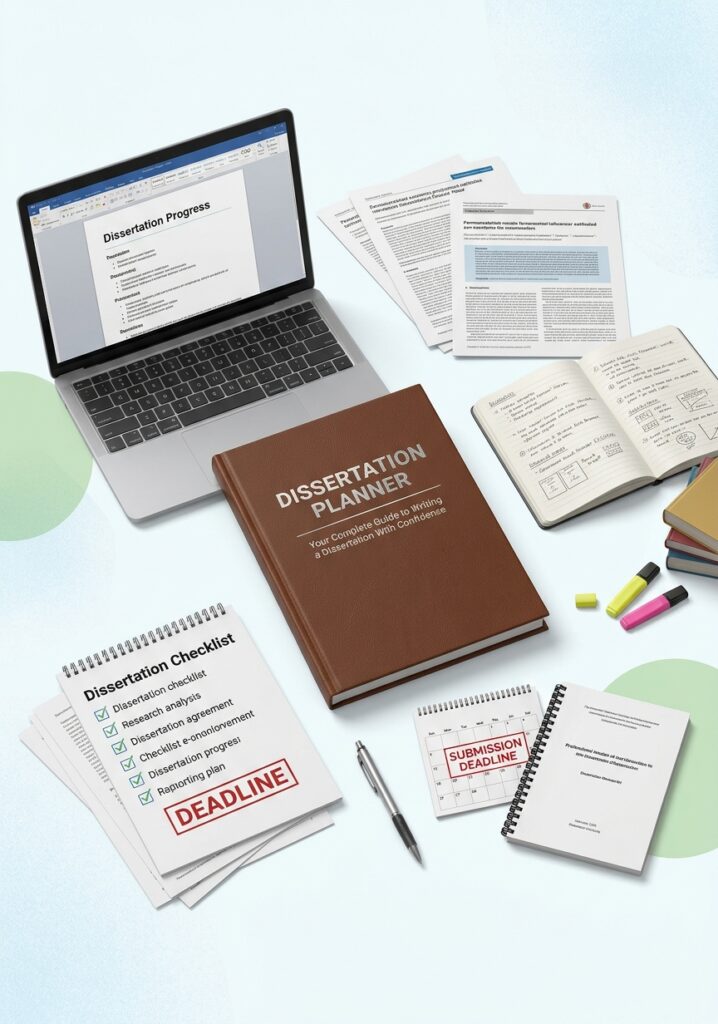
After working through the steps above, some students find it useful to have a dedicated resource that brings the planning process together in one place. That’s the purpose behind Dissertation Planner: Your Complete Guide to Writing a Dissertation With Confidence.
It’s designed as a practical planning companion rather than a general dissertation-writing textbook, built around the same kind of structured thinking covered in this article: setting goals, building timelines, organizing research, planning chapters, tracking writing progress, structuring the literature review, keeping citations and references in order, and preparing for final submission.
The aim is to give students a consistent place to plan and track their dissertation from the early stages through to submission, rather than juggling separate notes, spreadsheets, and reminders.
Who Should Use a Dissertation Planner?
- Undergraduate students beginning a dissertation or capstone project
- Master’s students managing a larger independent research project for the first time
- Postgraduate students juggling a dissertation alongside other commitments
- PhD researchers who want a clearer working structure for a long-term project
- Students who feel overwhelmed by the size of the project
- Students managing multiple deadlines at once
- Students who struggle with organization generally
- Anyone who wants a more structured, consistent writing routine
Needs vary by discipline and research type, so it’s worth considering how well a structured planning approach fits your specific field before assuming it covers every requirement.
| Ready to Take Control of Your Dissertation?
A dissertation becomes far easier to manage once you know what needs to be done, when it needs to be done, what you’ve already completed, and what needs attention next. That clarity is exactly what structured planning is meant to provide. If you’d like a dedicated resource to help bring the steps in this article together, Dissertation Planner: Your Complete Guide to Writing a Dissertation With Confidence offers a practical, structured approach to planning your project from the early stages through to submission. |
Get the Dissertation Planner
| Need Extra Support With Your Dissertation?
Planning is a major part of the process, but many students also want additional guidance along the way whether that’s help organizing research, developing academic writing, structuring a literature review, refining a methodology, managing referencing, or editing and proofreading a draft. Elite Academic Broker offers this kind of academic support and guidance to help students work through their own dissertation more effectively. This is about support and feedback on your own work, not a substitute for it the goal is to help you build the skills and structure to complete your dissertation with confidence. |
Conclusion
A dissertation feels overwhelming when it’s treated as one enormous task. It becomes manageable once it’s broken into smaller, connected stages: Topic → Research Question → Literature → Methodology → Research → Analysis → Writing → Editing → Submission.Your plan doesn’t need to be perfect from day one, and it’s normal for it to change as your research develops — what matters is having a clear, current sense of what to work on next.If you’d like a structured resource to help organize this process from start to finish, Dissertation Planner: Your Complete Guide to Writing a Dissertation With Confidence is available as a practical next step.
Get the Dissertation Planner
Frequently Asked Questions
What is a dissertation planner?
A dissertation planner is a structured tool or resource that helps students organize the stages of a dissertation from topic selection and research through to writing, editing, and submission in one consistent place.
How do I plan a dissertation?
Start by understanding your university’s requirements, then refine your topic, develop a clear research question, break the project into chapters and tasks, plan your literature review and methodology, and build a timeline working backward from your deadline.
When should I start planning my dissertation?
Ideally as early as the topic-selection and proposal stage, so your timeline is in place from the start. If you’re already partway through, you can still build a plan for the stages that remain.
How do I create a dissertation timeline?
Work backward from your final submission date, allocating time to each stage topic and question, literature review, methodology, data collection, analysis, drafting, editing, and final review based on your actual deadline and university requirements.
How do I break my dissertation into smaller tasks?
Replace vague goals like “write the literature review” with specific, sittable tasks such as searching databases, grouping sources by theme, building an outline, and drafting individual sections.
How do I organize dissertation research?
Keep a research tracker recording details like author, year, methodology, key findings, and the chapter where each source may be used, so you’re not searching for sources again later in the process.
Can a dissertation planner help me stay on track?
Yes — a planner gives you a consistent structure to check your progress against, which makes it easier to see what’s done, what’s next, and whether your timeline still matches your actual deadline.









 Evan John