Think back to your last tense group project, a disagreement with a friend, or a piece of feedback that stung more than it should have. Nothing you learned in algebra class prepared you for that moment.
Schools spend years teaching mathematics, science, history, and writing subjects with clear rules, structured lessons, and graded tests. But somewhere along the way, most of us reach adulthood without ever being formally taught how to manage a difficult emotion, communicate calmly during conflict, accept criticism without shutting down, or set a boundary without feeling guilty about it.
These are not small gaps. They shape our friendships, our careers, our romantic relationships, and how we feel about ourselves at the end of a hard day.
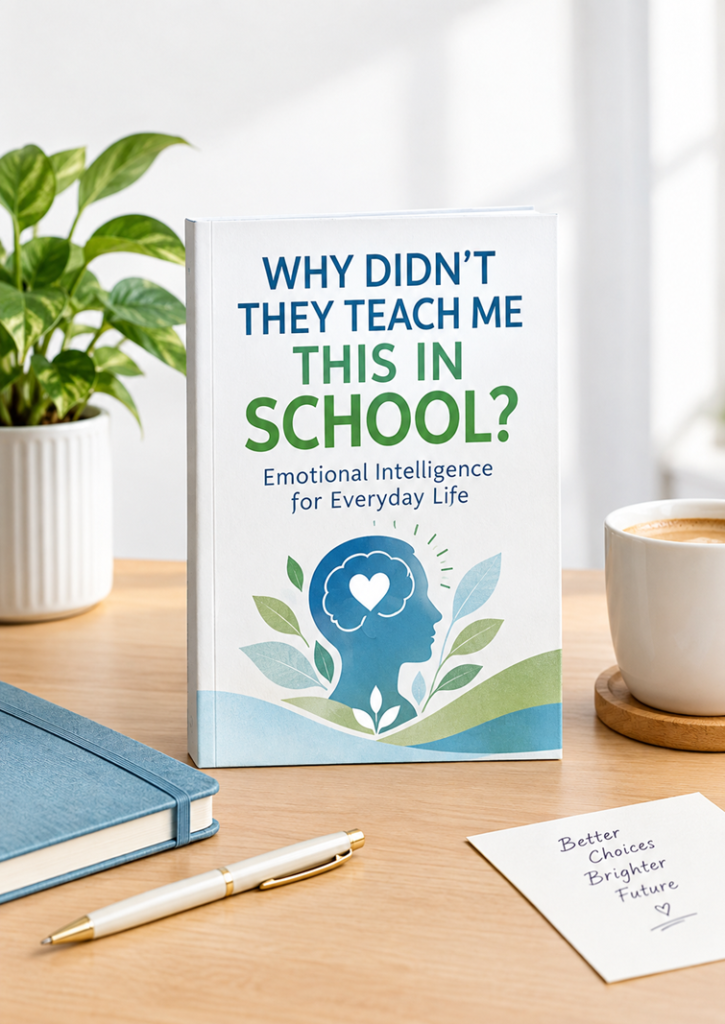
This is the idea at the center of Why Didn’t They Teach Me This in School? Emotional Intelligence for Everyday Life the simple but important recognition that emotional intelligence is a learnable skill set, not a fixed personality trait, and it’s one most of us have had to pick up the hard way, through trial, error, and experience.
Get the Emotional Ebook →
Emotional intelligence, often shortened to EQ, is the ability to recognize, understand, and manage your own emotions while also recognizing and responding well to the emotions of the people around you. It’s less about being “nice” and more about being accurate, accurately reading a situation, accurately naming what you feel, and choosing a response instead of just reacting.
Psychologists generally describe emotional intelligence as a combination of a few core abilities working together:
- Self-awareness: noticing what you’re feeling and why, in the moment it’s happening rather than hours later.
- Self-management (emotional regulation): choosing how you respond to a feeling instead of being controlled by it.
- Empathy: genuinely understanding what someone else might be experiencing, even when you see things differently.
- Social awareness: reading a room, a conversation, or a relationship accurately.
- Relationship and communication skills: expressing yourself clearly and handling disagreements without damaging the relationship.
None of this requires a psychology degree. Most of it shows up in ordinary moments, noticing you’re irritated before you snap at someone, or realizing a classmate’s harsh comment probably has more to do with their own stress than with you.
Why Schools Often Don’t Teach These Skills
It’s worth being fair to schools here: academic curriculums are already packed, and subjects like reading, math, and science are relatively easy to teach and test. Emotional skills are harder to standardize. There’s no worksheet that reliably teaches someone how to sit with disappointment or how to disagree with a friend without losing the friendship.
As a result, most people end up learning emotional intelligence the long way through lived experience rather than a classroom. Common teachers include:
- Mistakes and the discomfort of realizing you handled something poorly
- Difficult conversations you couldn’t avoid
- Friendships that tested your patience or communication
- Family relationships, for better and worse
- Workplace experiences, especially early ones
- Criticism that was hard to hear at the time
- Failures that forced some honest self-reflection
That’s really the starting point for Why Didn’t They Teach Me This in School? the idea that these lessons are valuable enough to be studied deliberately, instead of only absorbed by accident.

10 Emotional Intelligence Skills Everyone Should Learn
This is the most practical part of this guide. Below are ten emotional intelligence skills that show up constantly in everyday life at school, at work, and at home.
1. Recognizing your emotions
What it means: Being able to name what you’re feeling not just “fine” or “bad,” but frustrated, disappointed, anxious, or relieved.
Why it matters: You can’t manage a feeling you can’t accurately identify.
Everyday example: You feel unusually irritable during a study session and realize, on reflection, it’s actually anxiety about an upcoming exam.
How to develop it: Pause a few times a day and try to name your emotion in one specific word.
2. Identifying emotional triggers
What it means: Understanding which situations, comments, or patterns reliably set off a strong reaction in you.
Why it matters: Recognizing a trigger gives you a split second of choice before you react.
Everyday example: You notice you get defensive specifically when someone comments on your time management.
How to develop it: After a strong reaction, jot down what happened right before it.
3. Pausing before reacting
What it means: Creating a small gap between feeling something and acting on it.
Why it matters: Most regretted words and decisions happen in that unguarded first moment.
Everyday example: Taking a breath before replying to a frustrating text instead of firing back immediately.
How to develop it: Try counting to five, or simply saying “let me think about that,” before responding when emotions run high.
4. Listening actively
What it means: Fully focusing on what someone is saying instead of planning your reply while they talk.
Why it matters: People can tell the difference between being heard and being tolerated.
Everyday example: In a group project, letting a teammate finish their point before offering your own.
How to develop it: Try summarizing what someone said before you respond to it.
5. Expressing feelings clearly
What it means: Putting your emotions into words in a way others can understand, instead of hinting, withdrawing, or exploding.
Why it matters: Clear expression prevents small frustrations from turning into bigger conflicts.
Everyday example: Saying “I felt overlooked when the plan changed without me” instead of giving someone the silent treatment.
How to develop it: Practice starting sentences with “I feel…” rather than “You always…”
6. Understanding other perspectives
What it means: Considering how a situation might look or feel from someone else’s position.
Why it matters: It reduces unnecessary conflict and helps you respond with more patience.
Everyday example: Realizing a classmate’s short reply might reflect a stressful week rather than rudeness toward you.
How to develop it: Before assuming the worst, ask yourself what else could explain the other person’s behavior.
7. Handling criticism
What it means: Receiving feedback, even unwelcome feedback, without becoming defensive or shutting down.
Why it matters: Criticism is often the fastest route to genuine improvement, if you can actually hear it.
Everyday example: Reading harsh comments on a paper and looking for the useful point buried in the delivery.
How to develop it: When you receive criticism, wait a moment before responding and ask yourself, “is there something useful here?”
8. Managing disagreements
What it means: Working through a conflict without treating the other person as an opponent to defeat.
Why it matters: Most relationships survive disagreements; they’re damaged by how those disagreements are handled.
Everyday example: Disagreeing with a friend’s plan while still acknowledging their reasoning.
How to develop it: Focus on the specific issue at hand instead of bringing in past grievances.
9. Setting healthy boundaries
What it means: Clearly communicating your limits time, energy, or emotional capacity without over-explaining or apologizing excessively.
Why it matters: Without boundaries, resentment tends to build quietly until it comes out sideways.
Everyday example: Telling a group project partner you can’t take on additional tasks this week.
How to develop it: Practice saying a boundary in one plain sentence, without a long justification attached.
10. Taking responsibility for your actions
What it means: Owning your part in a situation instead of only focusing on what others did wrong.
Why it matters: It builds trust and models the same accountability you’d like from others.
Everyday example: Acknowledging that you contributed to a misunderstanding, even if you weren’t entirely at fault.
How to develop it: Practice a short, genuine acknowledgment: “I could have handled that differently.”
Emotional Intelligence for Students
Because Elite Academic Broker works closely with students, it’s worth looking specifically at how these skills show up in academic life. Emotional intelligence doesn’t guarantee higher grades, but it can make everyday academic situations noticeably easier to navigate.
- Handling academic pressure without it spilling into every part of your day
- Receiving feedback from lecturers without taking it as a personal judgment
- Working through group assignments with classmates who have different habits and communication styles
- Dealing with a difficult or unresponsive classmate without escalating tension
- Managing the frustration that comes with procrastination
- Communicating clearly with instructors, especially when asking for help or an extension
- Coping with a disappointing grade without spiraling into self-criticism
- Balancing school with personal responsibilities and relationships
- Building the kind of confidence that comes from handling setbacks well
- Preparing for the communication demands of professional life after graduation
These are situations every student eventually faces. Having some emotional groundwork in place tends to make them feel more manageable and less overwhelming.
Emotional Intelligence at Work and in Relationships
The same core skills that help in school carry directly into adult life.
At Work
- Receiving criticism from a manager without becoming defensive
- Managing disagreements with colleagues professionally
- Communicating clearly instead of relying on assumptions
- Working effectively within a team, even with different personalities
- Staying composed during stressful deadlines or high-pressure moments
In Relationships
- Listening fully instead of half-listening while forming a reply
- Expressing feelings honestly instead of withdrawing
- Making an effort to understand the other person’s perspective
- Setting boundaries around time and emotional energy
- Managing disagreements without turning them into bigger conflicts

Can Emotional Intelligence Be Learned?
Yes. Unlike some fixed personality traits, emotional intelligence is made up of skills and habits, and skills can be strengthened over time.
That improvement tends to come from a fairly consistent set of practices: paying attention to your own patterns, practicing new responses in real situations, reflecting honestly afterward, staying open to feedback, communicating more deliberately, journaling, pausing before reacting, and treating mistakes as information rather than failure.
It’s worth being realistic here this isn’t an overnight transformation. It’s closer to the kind of gradual improvement you’d expect from practicing any other skill, with plenty of room for slow, steady progress rather than instant change.
7 Simple Ways to Start Improving Emotional Intelligence Today
- 1: Name what you are feeling, as specifically as you can.
- 2: Pause before responding, especially when a reaction feels automatic.
- 3: Ask questions instead of assuming you already know someone’s intent.
- 4: Listen without interrupting, even when you disagree.
- 5: Keep a short emotional journal, even just a few lines a day.
- 6: Practice saying “I feel…” rather than “you always…” or “you never…”
- 7: Reflect on difficult conversations afterward, and consider what you’d do differently.
Why This Book May Be Worth Reading
If the ideas in this article resonated with you, Why Didn’t They Teach Me This in School? Emotional Intelligence for Everyday Life was written to take them further.
It’s intended as a practical resource rather than a purely theoretical one, walking through areas such as emotional awareness, self-management, communication, empathy, relationships, conflict, boundaries, and personal growth.
It may be a useful read for college and university students, young adults, people starting their careers, anyone who wants to communicate more effectively, readers interested in personal development, people who want to understand their own emotions more clearly, or simply anyone who feels they learned plenty of academic subjects but few practical emotional skills along the way.
| Ready to Learn the Life Skills School Didn’t Teach You?
If this article gave you a few useful ways to think about your own emotions and relationships, the ebook goes further, walking through each of these areas in more depth with practical exercises you can apply right away. It’s built for readers who want a clear, structured way to keep developing these skills rather than picking them up piecemeal through trial and error. |
Get the Ebook: Why Didn’t They Teach Me This in School? Emotional Intelligence for Everyday Life
Check our Store
Conclusion
School gives us a lot of genuinely valuable academic skills but emotional intelligence is a separate set of skills that most of us end up developing through life experience rather than a classroom.
The good news is that these skills can be learned deliberately: understanding yourself more clearly, managing your reactions, communicating with more intention, listening fully, handling conflict without damaging relationships, and reflecting honestly enough to keep growing.
If you’d like a practical resource to keep working through these ideas, Why Didn’t They Teach Me This in School? Emotional Intelligence for Everyday Life is available as a next step for readers who want to continue learning.
Frequently Asked Questions
What is emotional intelligence?
Emotional intelligence is the ability to recognize, understand, and manage your own emotions while also recognizing and responding well to the emotions of others. It includes self-awareness, self-management, empathy, social awareness, and relationship skills.
Why is emotional intelligence important in everyday life?
Everyday life is full of situations conflict, feedback, teamwork, relationships, that depend on how well you understand and manage emotions, both your own and other people’s. Stronger emotional intelligence tends to make these situations easier to navigate.
Can emotional intelligence be learned?
Yes. Emotional intelligence is made up of skills and habits rather than a fixed trait, so it can be developed gradually through awareness, practice, reflection, and feedback.
How can students improve emotional intelligence?
Students can build these skills by paying attention to their reactions during academic pressure, practicing calm communication with instructors and classmates, and reflecting on group work and feedback experiences rather than reacting to them in the moment.
What are the five main areas of emotional intelligence?
The five commonly discussed areas are self-awareness, self-management (emotional regulation), empathy, social awareness, and relationship or communication skills.
How does emotional intelligence improve communication?
It helps you express your own feelings clearly, listen more fully to others, and respond thoughtfully instead of reactively, which reduces misunderstandings and unnecessary conflict.
What life skills are often not taught in school?
Skills like managing emotions, communicating during conflict, handling criticism, setting boundaries, and understanding other perspectives are rarely part of a formal curriculum, even though they come up constantly in everyday life.









 Evan John