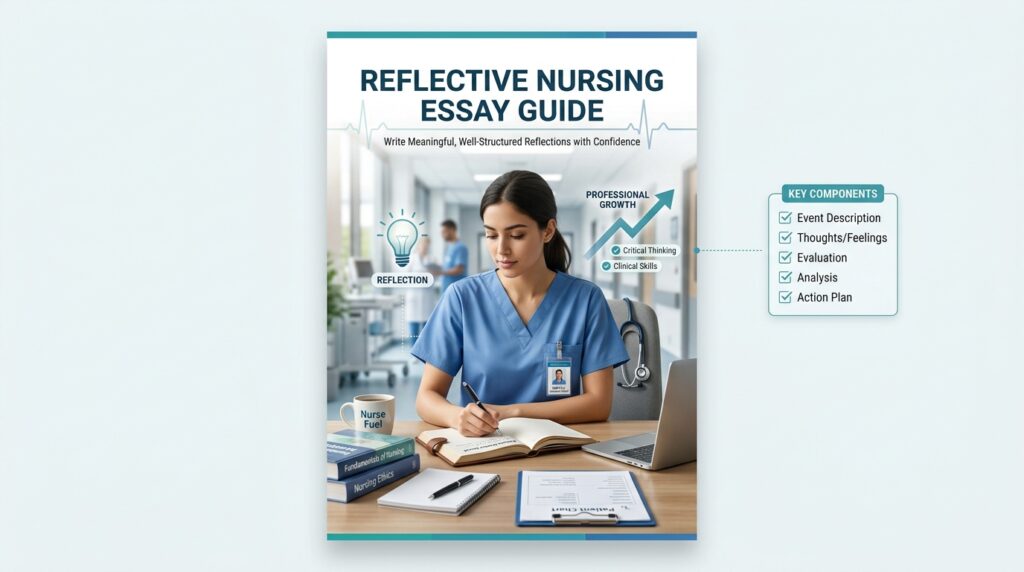
If you have ever stared at a blank page wondering where to begin your nursing reflection, you are not alone. Reflective writing is one of the most valuable yet most misunderstood skills in nursing education. This reflective nursing essay guide breaks the entire process down into clear, practical steps so you can write with confidence from your very first sentence to your final conclusion.
Reflective practice sits at the heart of professional nursing. When you reflect on a clinical experience, you do far more than recount what happened. You examine why it happened, how your decisions affected patient care, and what you will do differently next time. That process drives lifelong learning and makes you a safer, more compassionate nurse.
In this guide you will discover what a reflective nursing essay is, which reflective models work best for different situations, how to structure and write each section, a full sample essay, 40 topic ideas, 20 expert tips, and answers to the 15 most common student questions.
1. What Is a Reflective Nursing Essay?
A reflective nursing essay is a structured piece of academic writing in which you examine a real clinical experience from your nursing practice or placement. You describe what happened, explore your thoughts and feelings, analyse your actions using theory and evidence, and identify clear lessons for the future.
The word “reflective” is key. This is not simply a story about a shift you worked. It is a critical examination of your professional behaviour, clinical decision-making, and personal growth. Reflection in nursing is a deliberate, disciplined process and the essay is how you demonstrate that process on paper.
Why Is Reflective Writing Important in Nursing?
The Nursing and Midwifery Council (NMC) and the American Nurses Association (ANA) both emphasise reflective practice as a core professional standard. Reflective writing helps you:
- Connect theory to real clinical situations
- Identify knowledge gaps and address them proactively
- Develop emotional intelligence and self-awareness
- Improve patient safety through honest self-assessment
- Build a portfolio of professional development evidence
- Prepare for revalidation and continuing education requirements
| Key takeaway: Reflective nursing essays are not just academic exercises. They are training grounds for the reflective habits that great nurses practice throughout their careers. |
2. Why Nursing Schools Require Reflective Essays
Nursing programmes use reflective assignments to develop the whole nurse not just the technical skills, but the analytical mind and professional character. Here is why reflective essays are a standard assessment in BSN, ADN, MSN, and RN-to-BSN programmes worldwide.
1. Clinical Learning Deepening
Placement experience alone does not guarantee learning. Reflection transforms experience into genuine insight. When you analyse a clinical moment in writing, you encode the lesson far more deeply than passive observation allows.
2. Professional Growth
Nursing professionalism requires honest self-evaluation. Reflective essays teach you to assess your own nursing competencies without defensiveness a skill essential for annual reviews, revalidation, and career progression.
3. Critical Thinking Development
A strong reflective essay demands analytical thinking. You must move beyond describing events to evaluating decisions, weighing alternatives, and applying evidence-based practice. That cognitive muscle is exactly what safe clinical decision-making requires.
4. Communication Skills
Clear, accurate, empathetic written communication underpins nursing documentation, handover notes, incident reports, and patient advocacy. Reflective writing hones all of those skills simultaneously.
5. Lifelong Learning Culture
The World Health Organization (WHO) recognises reflective practice as a pillar of lifelong learning in healthcare. Nursing schools embed reflection early so that it becomes a career-long habit rather than a one-off assignment.
3. Common Reflective Models Used in Nursing
Reflective models give your essay a clear scaffold so you do not simply narrate events. Each model asks different questions, suits different types of experiences, and produces different depths of analysis. The four models below appear most frequently in nursing programmes worldwide.
Gibbs Reflective Cycle (1988)
Developed by Graham Gibbs, this six-stage cycle is the most widely used model in nursing reflection. Its circular structure emphasises that reflection is an ongoing process, not a one-time event.
- Description — What happened? Give an objective account of the situation, setting, and people involved.
- Feelings — What were you thinking and feeling during and after the experience?
- Evaluation — What was good and bad about the experience? Be honest and balanced.
- Analysis — Why did things turn out the way they did? Apply theory, research, and evidence.
- Conclusion — What else could you have done? What have you learned?
- Action Plan — What will you do differently next time? How will you develop your skills?
| Nursing Example (Gibbs): A student nurse notices that an elderly patient is becoming confused but hesitates to escalate. Using Gibbs, they describe the interaction, explore their feelings of uncertainty, evaluate what they did and did not do, analyse why communication skills and SBAR training matter, conclude that earlier escalation was needed, and commit to practising escalation scenarios in simulation. |
Driscoll’s Model of Reflection (1994, 2007)
John Driscoll’s model is elegant in its simplicity. Three trigger questions guide the entire reflection, making it ideal for shorter essays, portfolio entries, and post-placement summaries.
- What? — Describe the event. What happened? What did you do?
- So What? — What does it mean? How did it affect you, the patient, and the team?
- Now What? — What will you do as a result? How will practice change?
Example: A student witnesses a medication administration error. Using Driscoll, they describe the incident (What?), analyse the emotional impact and patient safety implications (So What?), and outline a personal learning plan focused on medication safety protocols (Now What?).
Kolb’s Reflective Cycle (1984)
David Kolb frames reflection within a broader learning cycle. It is especially useful for linking clinical experience to academic knowledge.
- Concrete Experience — A direct clinical event or activity
- Reflective Observation — Stepping back to observe and review what happened
- Abstract Conceptualisation — Connecting the experience to theory, research, or frameworks
- Active Experimentation — Planning how to apply new understanding in future practice
Kolb is particularly well-suited to simulation-based learning, skills labs, and clinical placements where the link between theory and practice is central to the assessment brief.
Johns’ Model of Structured Reflection (1994)
Christopher Johns developed a guided reflection framework built around a series of cue questions. It encourages deeper ethical and professional exploration than simpler models allow.
- Description — Describe the experience in detail, including context and key people
- Reflection — What was I trying to achieve? What were the consequences of my actions?
- Influencing Factors — Internal factors (knowledge, values, emotion) and external factors (environment, hierarchy, time pressure)
- Learning — Could I have dealt with the situation better? What knowledge was I missing?
- Future Action — How has this experience changed my nursing practice and professional identity?
Johns’ Model is particularly powerful for complex ethical scenarios, end-of-life care reflections, and leadership experiences where multiple influencing factors need careful unpacking.
Comparison Table: Which Model Should You Use?
| Model |
Best For |
Structure |
Depth |
| Gibbs (1988) |
Most clinical placement reflections; emotional experiences; general nursing essays |
6 stages — cyclical |
Medium–High |
| Driscoll (1994) |
Short reflections, portfolio entries, quick post-incident review |
3 questions — linear |
Low–Medium |
| Kolb (1984) |
Simulation, theory-to-practice links, skills development |
4 stages — cyclical |
Medium |
| Johns (1994) |
Ethical dilemmas, leadership, complex interpersonal situations |
5 cues — guided |
High |
4. How to Write a Reflective Nursing Essay Step-by-Step
Follow these nine steps and you will produce a well-structured, critically analytical nursing reflection essay from start to finish.
Step 1 — Choose a Meaningful Experience
Select an event from your clinical placement or nursing practice that genuinely challenged you, made you uncomfortable, surprised you, or taught you something significant. The best reflective essays come from moments of uncertainty, not smooth routine. A medication concern, a difficult patient interaction, a handover confusion, or an ethical dilemma all make excellent starting points.
| Tip: You do not need a dramatic event. Even a quiet moment a patient’s tearful disclosure, a communication breakdown in a ward round can yield rich, insightful reflection. |
Step 2 — Select Your Reflective Model
Use the comparison table above to choose the model that best fits your experience and assignment brief. If your lecturer has not specified a model, Gibbs Reflective Cycle is a safe, well-supported default.
Step 3 — Write Your Introduction
Your introduction should do three things: briefly introduce the reflective model you are using, identify the type of experience you are reflecting on (without patient-identifying details), and state what the essay will cover. Keep it to roughly 150–200 words. Do not dive into the full story in the introduction. Maintain patient confidentiality from your very first sentence.
Step 4 — Describe the Event Clearly
Provide a factual, objective account of the situation. Answer: Who was involved? What happened? Where and when? What was your role? Write in plain, clear language. This section should be factual rather than analytical save the “why” for later stages. Aim for around 200–300 words.
Step 5 — Explore Your Feelings Honestly
This stage surprises many students. Academic writing usually requires objectivity, yet here you are expected to write about emotions. Do so with courage and honesty. What were you thinking when it happened? Were you anxious, confused, proud, uncertain? How did you feel afterwards? Authentic self-disclosure strengthens the essay — provided you follow it immediately with analysis.
Step 6 — Analyse Your Actions Using Evidence
This is the intellectual core of the essay and the section most students under-develop. Ask yourself: What does the nursing literature say about this situation? What evidence-based guidelines or clinical frameworks apply? How do communication theory, nursing ethics, or patient safety research illuminate what happened? Reference peer-reviewed journals, clinical guidelines, NMC or ANA standards, and other credible sources.
Step 7 — Evaluate What Went Well and What Did Not
Balanced evaluation is more impressive than either self-congratulation or excessive self-criticism. Identify specific strengths in your response to the situation, and be equally specific about what could have been improved. Vague statements like “I could have communicated better” are weak always say how and why.
Step 8 — Draw Conclusions and Lessons Learned
What do you now understand that you did not before this experience? What knowledge gaps did it reveal? Concrete, specific conclusions anchored in your earlier analysis and referenced evidence score far higher than generic observations.
Step 9 — Write Your Action Plan and Conclusion
Conclude with a forward-looking action plan. What specific steps will you take to develop your practice? Which resources, training, or supervision will you seek? An action plan transforms a good reflection into a great one by demonstrating genuine professional commitment. Restate the primary learning outcome in your closing sentences, and briefly link back to the reflective model used.
5. Reflective Nursing Essay Structure
| Section |
Content Focus |
Approx. Word Count (2,000-word essay) |
| Introduction |
Model chosen, overview of experience (anonymised), essay roadmap |
150–200 words |
| Description |
Factual account — who, what, where, your role |
200–250 words |
| Feelings |
Thoughts and emotions during and after the event |
150–200 words |
| Analysis & Evaluation |
Evidence-based analysis, clinical frameworks, literature, strengths/limitations |
600–700 words |
| Conclusions |
Lessons learned, knowledge gaps addressed |
150–200 words |
| Action Plan / Conclusion |
Future practice changes, development goals, summary |
200–250 words |
| References |
APA 7, Harvard, or Vancouver as required |
Not counted in word limit |
| Important: For a 3,000-word essay, scale each section proportionally. The analysis section should always constitute the largest portion typically 40–45% of the total word count. |
6. Reflective Nursing Essay Example
The following is a condensed sample essay using Gibbs Reflective Cycle. It illustrates the tone, structure, and evidence expectations for a nursing reflection assignment at undergraduate level. Use it as a model never copy it directly.
Introduction
This essay reflects on an experience from my second-year adult nursing placement using Gibbs Reflective Cycle (1988). The experience relates to a communication situation involving an older patient referred to throughout as Patient A to maintain confidentiality in line with the Nursing and Midwifery Council Code (NMC, 2018). This essay will describe the event, explore my emotional response, analyse my actions using relevant evidence, evaluate what went well and what could be improved, and conclude with a personal development action plan.
Description
During an afternoon shift, I was asked to conduct a routine blood pressure check on Patient A, an 82-year-old man recently admitted following a fall. On approaching the bedside, I noticed the patient appeared distressed and was attempting to remove his monitoring leads. I attempted to reassure him verbally, but he became more agitated. I quickly called for my mentor, who calmly talked to the patient and successfully de-escalated the situation. I observed the interaction, feeling uncertain about what I should have done differently.
Feelings
In the moment, I felt a combination of anxiety and inadequacy. I was concerned for the patient’s safety but also unsure how to communicate effectively with someone who appeared acutely confused. Afterwards, I felt a persistent sense that I had failed the patient, despite knowing intellectually that seeking mentor support was the correct decision. These feelings led me to reflect more deeply on my knowledge of therapeutic communication and delirium management.
Evaluation
What went well: I correctly recognised that the patient’s behaviour required immediate escalation and acted swiftly. Prioritising patient safety over personal pride was the right choice. Observing my mentor’s communication techniques was also a valuable learning opportunity.
What could have been improved: I lacked the confidence to apply person-centred communication strategies before escalating. I was uncertain about the signs of acute delirium and therefore defaulted to anxiety rather than informed assessment.
Analysis
The patient’s presentation was consistent with acute delirium, a condition affecting up to 30% of hospitalised older adults (Inouye et al., 2014). The NICE Clinical Guideline CG103 (2019) recommends non-pharmacological de-escalation strategies including calm verbal reassurance, reorientation, and minimising sensory overload. My mentor demonstrated several of these strategies — making eye contact, using the patient’s name, speaking slowly, and acknowledging his distress. Buckley and Savage (2021) note that student nurses frequently underestimate the effectiveness of therapeutic presence in delirium management due to limited supervised exposure. McCabe (2004) further argues that person-centred communication must be practised deliberately to become instinctive, which suggests that simulation training could have prepared me more effectively for this situation.
Conclusions
This experience revealed a significant gap in my practical communication skills, specifically in managing acutely confused older patients. While I made the correct decision to escalate, I now understand that earlier application of delirium-specific communication strategies could have reduced Patient A’s distress. My emotional response — inadequacy and anxiety — was a normal but manageable reaction that reflection has helped me process constructively.
Action Plan
Following this reflection, I will complete an online module on delirium recognition and management through the NHS e-learning platform. I will also request specific mentorship sessions focused on therapeutic communication with confused patients before my next placement. Additionally, I will review the NICE delirium guidelines and Buckley and Savage (2021) in full, and include a summary in my professional development portfolio. I intend to revisit this reflection at the end of my next placement to evaluate whether my skills have improved. |
| Note: A full essay for submission would include a complete reference list in APA 7 or Harvard format. The citations above are illustrative. Always verify references against your institution’s preferred style guide. |
7. 20 Tips for Writing a High-Distinction Reflective Essay
These 20 expert tips come directly from nursing academics and senior markers. Apply them consistently and your essays will stand out for critical depth, academic rigour, and professional maturity.
- Use first person deliberately. Write “I assessed” not “the student assessed.” First person signals ownership of your experience and growth.
- Reflect, do not just describe. Description is the starting point critical analysis is the destination. If your paragraphs all start with “I did” and none start with “I now understand,” you are describing, not reflecting.
- Anchor every claim in evidence. Every evaluative statement should be supported by a peer-reviewed source, clinical guideline, or professional standard.
- Protect patient confidentiality rigorously. Use pseudonyms, omit dates and locations, and never include any detail that could identify a patient, colleague, or institution.
- Use APA 7 (or your required style) correctly. Inconsistent referencing is one of the most common reasons for mark deductions in reflective essays.
- Be genuinely honest about your shortcomings. Markers reward authentic self-awareness. Admitting an error and analysing why it happened is more impressive than presenting an unblemished performance.
- Apply your chosen model to every section. Do not abandon the model halfway through. Every section should map clearly onto the framework you introduced.
- Link theory to practice explicitly. Do not assume the marker will make the connection. Write it out: “This is consistent with Benner’s (1984) novice-to-expert framework, which suggests that…”
- Use academic language, but stay clear. Academic does not mean inaccessible. Write in clear, precise sentences. Avoid jargon for its own sake.
- Develop your action plan in specific detail. “I will improve my communication” is too vague. “I will complete the NMC-accredited therapeutic communication module by [date]” is specific and convincing.
- Proofread systematically. Read your essay aloud to catch awkward phrasing. Use a grammar checker. Then read it once more specifically for citation accuracy.
- Use transition words to guide the reader. Phrases like “furthermore,” “in contrast,” “as a result,” and “building on this analysis” signal academic maturity and logical flow.
- Balance positive and negative evaluation equally. Reflection is not a confession or a triumph — it is an honest, balanced appraisal.
- Keep your focus narrow. One well-analysed experience will always score higher than a rushed survey of three or four events.
- Adhere strictly to the word count. Most markers apply penalties for exceeding the word limit. Aim to land within 5% either side of the target.
- Use the NMC Code or ANA Standards as a framework for professional analysis. Referencing these standards elevates your analysis from personal opinion to professional accountability.
- Include recent research. Aim for sources published within the last 10 years unless citing a seminal foundational text (e.g., Gibbs, 1988).
- Maintain a reflective rather than defensive tone. Avoid language that sounds like excuse-making. “I did not escalate because I was busy” reads as defensive. “I now recognise that workload pressure contributed to delayed escalation, which highlights the importance of…” reads as reflective.
- Review past feedback on your writing. Your previous essay feedback is the most targeted guide to improvement available to you. Act on it explicitly.
- Start early. Reflective essays require time not because they are long, but because real reflection is a slow process. A rushed reflection essay is almost always identifiable to an experienced marker.
8. Common Mistakes Students Make
Awareness of common errors is one of the fastest ways to improve your marks. Avoid these ten pitfalls and your nursing reflection assignment will be significantly stronger.
| Mistake |
Why It Loses Marks |
How to Fix It |
| Only describing events |
Description alone does not meet the academic criteria for reflective writing |
After every descriptive paragraph, ask “so what does this mean?” and write the answer |
| No critical analysis |
Without analysis, the essay reads as a narrative not an academic piece |
Apply theory, research, and professional standards to every observation |
| No references or poor referencing |
Unsupported claims suggest a lack of academic rigour |
Aim for at least 8–12 credible sources; check every citation against APA 7 or your required style |
| Ignoring the reflective model |
The model provides the marking structure abandoning it leaves the essay shapeless |
Use subheadings named after each stage if necessary to stay on track |
| Weak or vague conclusions |
Generic endings suggest the writer did not learn anything specific |
Name the exact lesson, skill gap, or clinical knowledge that this experience revealed |
| Breaching patient confidentiality |
A serious professional and ethical violation that can result in a fail grade |
Use pseudonyms, omit identifying details, and review the NMC Code before submission |
| Lack of an action plan |
Without future-oriented planning, the reflection has no professional value |
Include specific, measurable development goals in your conclusion section |
| Excessive self-criticism |
Harsh self-judgment without analysis is not reflection it is rumination |
Balance critique with recognition of strengths; anchor both in evidence |
| Poor grammar and structure |
Unclear writing obscures analytical thinking and loses presentation marks |
Draft, rest, revise. Use the writing centre or academic support services. |
| Plagiarism |
Submitting another person’s reflection as your own is an academic integrity violation |
Write from your own genuine experience; cite all sources; run through a plagiarism checker before submission |
Also read on Nursing Student Life, Study Tips, Clinical Experience, Nursing School Schedule
9. 40 Reflective Nursing Essay Topics
Choosing the right topic is half the battle. The best topics are those you genuinely remember, felt something about, and learned from. Here are 40 ideas across every major area of nursing practice.
Clinical Placement & Patient Care
- A challenging patient interaction during a clinical placement
- Witnessing a medication administration error and its aftermath
- A patient who declined treatment ethical and communication reflections
- Managing a patient in acute pain when resources were limited
- Caring for a post-surgical patient experiencing unexpected complications
- A situation where patient advocacy made a measurable difference
- Caring for a patient with a language barrier and limited interpreter access
- A blood transfusion or IV complication you observed or responded to
Communication & Interpersonal Skills
- Delivering bad news alongside a senior nurse or physician
- A handover communication breakdown and its impact on patient safety
- Navigating a conflict with a colleague during a busy shift
- A therapeutic conversation with an anxious patient before a procedure
- Communicating with the family of a critically ill patient
Mental Health & Vulnerable Populations
- Supporting a patient experiencing a mental health crisis on a general ward
- Reflecting on unconscious bias when caring for a patient from a different background
- A safeguarding concern you identified and escalated appropriately
- Caring for a patient with dementia during personal care
- Responding to a patient expressing suicidal ideation
Leadership & Teamwork
- A moment when you demonstrated leadership as a student nurse
- A teamwork breakdown and what it taught you about interprofessional communication
- Observing a charge nurse make a difficult staffing decision
- Supporting a junior colleague through a stressful clinical situation
Ethical & Professional Challenges
- An ethical dilemma involving patient consent and capacity
- A situation where your personal values conflicted with a clinical decision
- Reflecting on cultural competence after caring for a patient from an unfamiliar background
- A nursing ethics case involving resource allocation or prioritisation
- Observing or experiencing unprofessional behaviour and how you responded
Specialist Areas
- End-of-life care and the emotional demands of palliative nursing
- A paediatric nursing experience that challenged your communication approach
- Emergency or high-dependency nursing under pressure
- A complex wound care or dressing procedure and what you learned about technique
- Administering insulin safely a reflection on medication competency
Personal & Professional Development
- Managing time effectively during a high-dependency shift
- Reflecting on your professional development over an entire clinical placement
- Your first independent clinical skill and the preparation behind it
- Using simulation training to prepare for real-world scenarios
- A moment of compassion fatigue and how you managed self-care
- A situation where a mentor gave you critical feedback that changed your practice
- Reflecting on the transition from student to registered nurse
- A near-miss incident and what it taught you about clinical decision-making
10. Frequently Asked Questions
What is a reflective nursing essay?
A reflective nursing essay is a structured academic piece in which you examine a specific clinical experience, analyse your actions and feelings, apply nursing theory and evidence, and identify what you will do differently in the future. It is a core assessment in most nursing programmes worldwide.
Can I write a nursing reflection in first person?
Yes — and you should. First-person writing is expected in reflective essays because the entire purpose is to examine your own thoughts, feelings, and actions. Using “I” is not informal here; it is academically appropriate and required by most reflective frameworks.
Which reflective model is best for a nursing essay?
Gibbs Reflective Cycle is the most widely used in nursing due to its clear six-stage structure. However, the best model depends on your assignment brief and experience type. Use Driscoll for shorter reflections, Johns for complex ethical situations, and Kolb when linking theory to practice is central.
How long should a nursing reflective essay be?
Most undergraduate nursing reflection assignments range from 1,000 to 3,000 words. Postgraduate and MSN reflections may reach 4,000–5,000 words. Always check your specific assignment brief for the exact requirement word counts vary significantly between institutions.
Can I include personal feelings in a nursing reflective essay?
Absolutely. Exploring your feelings is a formal stage in most reflective models (especially Gibbs). What matters is that you follow emotional disclosure with critical analysis — do not let the feelings section become a venting exercise. Use your emotions as a lens to examine your professional response.
How do I maintain patient confidentiality in a reflective essay?
Use pseudonyms such as “Patient A” or “Mr J.” Never include real names, dates, ward names, hospital names, or any detail that could identify the individual. State in your introduction that confidentiality has been maintained in accordance with the NMC Code (2018) or your relevant professional standard.
How many references should I include?
A general rule is 8–12 references for a 2,000-word essay, scaling proportionally for longer assignments. Include peer-reviewed journal articles, clinical guidelines, professional standards, and foundational texts. Avoid using non-academic websites as primary sources.
Can I reflect on a negative experience?
Negative experiences often make the strongest reflective essays. Reflecting honestly on an error, a near-miss, or a situation that went poorly demonstrates far more professional maturity than choosing an easy success story. Markers value the quality of your analysis, not the outcome of the event.
How do I conclude a reflective nursing essay?
Conclude with a forward-looking action plan that identifies specific steps for professional development. Summarise the key lessons learned, link them back to your reflective model, and restate why this experience matters for your future nursing practice. Avoid introducing new ideas in the conclusion.
What citation style should I use?
APA 7 is the most common format in North American and Australian nursing programmes. Harvard referencing is standard in many UK programmes. Vancouver is used in some clinical contexts. Always confirm the required style with your institution before writing.
Can I use subheadings in a reflective nursing essay?
This depends on your assignment brief and lecturer preference. Subheadings named after the stages of your reflective model can improve clarity, especially for longer essays. However, some markers prefer continuous prose. Check your brief or ask your lecturer.
What is the difference between a reflective essay and a case study?
A nursing case study focuses on a patient’s clinical presentation, diagnosis, and management plan using evidence-based practice. A reflective essay focuses on your personal learning and professional growth in response to a clinical experience. Both require critical analysis but from different angles.
Do I need to read nursing journals to write a good reflection?
Yes. A reflection without academic literature is a diary entry, not an essay. Journal articles, clinical guidelines, and professional standards provide the evidence base that elevates your analysis from personal opinion to academically credible argument.
How do I improve my critical analysis in a reflective essay?
After every descriptive or emotional statement, ask “What does the evidence say about this?” and “What would a more experienced nurse have done differently?” Use literature to answer those questions. The more precisely you connect your personal experience to established research, the stronger your analysis becomes.
Is it acceptable to seek writing support for a nursing reflective essay?
Seeking academic writing support including feedback, editing, structure guidance, and referencing help is a legitimate and widely encouraged part of nursing education. What matters is that the ideas, experience, and reflection are genuinely your own. Support with clarity, structure, and academic writing mechanics is appropriate.
11. Final Thoughts
Mastering the reflective nursing essay guide is about far more than passing an assessment. It is about developing the reflective mindset that will make you a safer, more empathetic, and more professionally accountable nurse throughout your career.
Every clinical placement offers dozens of reflection-worthy moments. The nurse who habitually asks “What did I learn from that, and what will I do differently?” is the nurse who continuously improves for their patients, their colleagues, and themselves. Start building that habit now, while your reflective writing assignments give you a structured space to practise.
Use the models, follow the steps, apply the evidence, and write with honesty. Your reflective essays will become not just academic submissions, but genuine records of your professional growth as a nursing student and future registered nurse.
Remember: reflection does not end at graduation. The NMC, ANA, and healthcare systems worldwide require reflective practice throughout your professional life. The skills you build writing nursing reflective essays today are the foundation of lifelong clinical learning.
| Need Help Writing a Reflective Nursing Essay?
Our specialist nursing academic writing team is here to help you produce high-quality, well-structured assignments that meet your programme’s standards.
We assist with:
– Reflective nursing essays (all models and academic levels)
– Nursing care plans and evidence-based practice assignments
– Research papers, literature reviews, and capstone projects
– APA 7, Harvard, and Vancouver formatting and referencing
– Editing, proofreading, and plagiarism review services
Academic integrity is at the heart of everything we do. Visit our website to get started. |









 Evan John