The Nursing Care Plan Template That Actually Makes Sense of ADPIE
It’s 11 p.m., your clinical is in nine hours, and you’re staring at a blank care plan grid trying to remember whether “related factors” go before or after “defining characteristics.” You’re not struggling with nursing. You’re struggling with a template that was never designed to teach you anything, just to be filled in. This one is different. It’s built around the actual clinical reasoning sequence, Assessment, Diagnosis, Planning, Implementation, Evaluation, so every box you fill in teaches you why it belongs there, not just what to write. Get the free nursing care plan workbook below.
What you’re getting
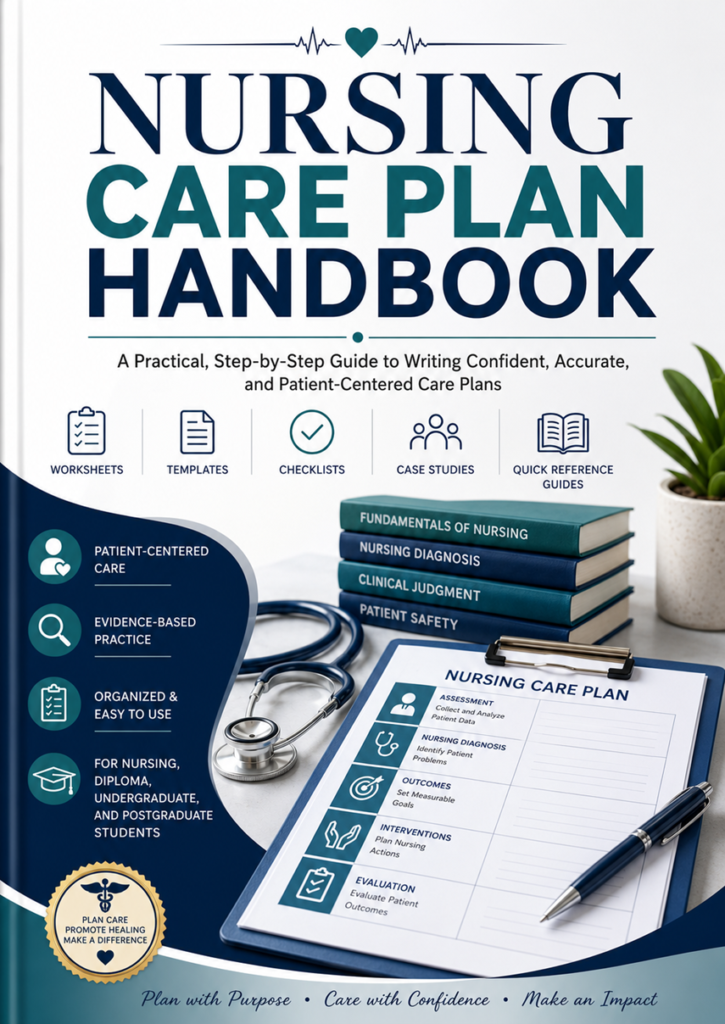
A 20-page, print-ready Nursing Care Plan Workbook (Word + PDF-friendly) built on the ADPIE framework, ANA Scope & Standards of Practice, and NANDA-I diagnostic language with three full guided worksheets, a NANDA-I quick reference, and space to keep working long after this term ends.
Free Nursing Care Plan Templates
Download your free Nursing Care Plan Template and learn a simple step-by-step approach to creating clearer, more organised care plans.
Download Nursing Care Plan Template →
Why Most Care Plan Templates Work Against You
Most templates are just a table. Two columns, a handful of cramped cells, and no explanation of what “good” looks like. So you end up guessing is this an outcome or an intervention? Does the rationale go here or there? and losing points on formatting instead of clinical reasoning.
This workbook fixes that by treating the care plan as a sequence rather than a form. Every section opens with a plain-language prompt telling you exactly what belongs there and why, so the logic of the nursing process stays visible the whole way through.
What’s Inside
| 01 |
How to Use This Workbook
A walkthrough of the workflow, plus prioritisation tips (Maslow’s, ABCs) before you start writing. |
| 02 |
The Nursing Process at a Glance (ADPIE)
A one-page breakdown of Assessment, Diagnosis, Planning, Implementation, and Evaluation. |
| 03 |
Patient Data Summary
A dedicated sheet for demographics, code status, allergies, meds, and key labs — so your worksheets stay focused on reasoning, not re-copying the chart. |
| 04–06 |
Three Full Care Plan Worksheets
Assessment data → PES-format diagnosis → goal & SMART outcomes → interventions & evidence-based rationale → evaluation & revision. |
| 07 |
NANDA-I Quick Reference
Common diagnoses organized by domain, so you’re not starting your search from zero. |
| 08 |
SMART Outcomes & Rationale Writing Guide
A worked example showing exactly how a strong intervention-rationale pair reads. |
| 09 |
Clinical Reflection & Evaluation Summary
Guided prompts to turn the completed plan into real post-clinical reflection. |
| 10–11 |
Appendix + Citation Guide
Two extra blank worksheets for future clinicals, plus an APA 7 reference log. |
Who This Is For
- Nursing students working on their first (or fifteenth) care plan assignment
- Anyone who finds NANDA-I formatting more confusing than the clinical reasoning itself
- Students who want one clean, reusable template instead of rebuilding a table every rotation
- Study groups or cohorts that want a shared, consistent format to compare notes against
Format
Delivered as an editable Word document — type directly into the field boxes, or print and complete by hand. 20 pages, US Letter, instant download.
Frequently Asked Questions
Is this compatible with any nursing program’s care plan requirements?
The workbook follows the standard ADPIE/NANDA-I structure used in most BSN and ADN programs. Always check your specific rubric but the core sequence (assessment → diagnosis → planning → implementation → evaluation) is universal.
Can I use it for more than one patient?
Yes, it includes three full worksheets plus two blank appendix worksheets, and you’re free to reuse the format for future clinicals.
Do I need Microsoft Word?
The file opens in Word, Google Docs, and most free document editors.
Medical/educational disclaimer: This workbook is a study and formatting tool. Always follow your program’s official rubric and your clinical instructor’s guidance for graded submissions.