Nursing school is an exciting journey filled with opportunities to learn, grow, and prepare for a rewarding career caring for others. However, if you’re currently navigating the demands of nursing education, you know firsthand that the academic workload can feel overwhelming at times. Between clinical rotations, exams, and the constant stream of nursing assignments, it’s easy to feel stretched thin.
Whether you’re tackling your first semester or pushing through your final year, mastering the art of nursing assignments is crucial to your success. These assignments aren’t just busy work, they’re designed to deepen your understanding of patient care, develop your critical thinking skills, and prepare you for real-world clinical situations. Yet many nursing students struggle with knowing where to start, how to manage their time effectively, or how to translate complex medical concepts into clear, well-organized writing.
The good news? With the right strategies and study tips for nursing students, you can transform assignment stress into academic confidence. This comprehensive guide shares six essential nursing assignment tips for students that will help you tackle your coursework more efficiently, improve your grades, and actually retain the knowledge you need for your future nursing career. Let’s dive into these proven techniques that successful nursing students use to excel in their academic writing while maintaining their sanity.
Read on Why homework is bad for students
What Are Nursing Assignments?
Nursing assignments are academic tasks that assess your understanding of healthcare concepts, patient care, ethics, and clinical practices. These assignments vary in format and complexity, including:
- Care plans
- Case studies
- Reflective journals
- Evidence-based research papers
- Group presentations
- Clinical reports
They are designed to bridge theory and practice, helping students apply classroom knowledge to real-world scenarios. If you’re ever stuck, seeking nursing homework help or nursing coursework help can provide valuable support.
Why Nursing Assignments Matter in Nursing Education
Nursing assignments are more than just grades—they’re foundational to your growth as a future nurse. Here’s why they matter:
- Develop critical thinking: Assignments challenge you to analyze clinical situations and make informed decisions.
- Strengthen communication skills: Clear, concise writing is essential for patient documentation and interdisciplinary collaboration.
- Prepare for clinical practice: Many assignments simulate real-life scenarios, helping you build clinical reasoning.
- Boost academic performance
Why Nursing Assignment Success Matters for Your Future Career
The importance of excelling at nursing assignments extends far beyond your GPA, though good grades certainly matter for scholarships, program progression, and future employment opportunities.
Building Your Foundation of Knowledge
Every nursing assignment you complete contributes to your professional knowledge base. The pathophysiology you research today becomes the foundation you’ll draw upon when caring for a patient with similar conditions tomorrow. When you deeply engage with assignments rather than rushing through them, you create stronger neural connections that make information easier to recall under pressure—like during a code blue situation.
Developing Professional Habits
The academic writing tips for nursing students you master now directly translate to professional nursing documentation. Charts, care plans, incident reports, and interdisciplinary communication all require the same clarity, accuracy, and attention to detail that nursing assignments demand. Nurses who can document effectively protect themselves legally, ensure continuity of care, and contribute to better patient outcomes.
Standing Out in a Competitive Field
Nursing remains a highly competitive field, especially for desirable positions in specialized units or prestigious healthcare facilities. Strong academic performance, demonstrated through excellent assignment work, sets you apart from other candidates. Many employers specifically ask about your academic achievements and nursing school experiences during interviews.
Of course. Here is a comprehensive, evergreen, and SEO-friendly blog article based on your request.
6 Essential Nursing Assignment Tips to Help You Succeed
Welcome to nursing school! You’ve embarked on a challenging yet incredibly rewarding journey to become a healthcare professional. Between lectures, labs, and clinical rotations, you’ll find a constant companion: the nursing assignment. These aren’t just busy work; they are critical tools designed to sharpen your clinical reasoning, deepen your understanding of complex health concepts, and prepare you for the realities of patient care.
However, it’s easy to feel overwhelmed. Juggling a demanding schedule while trying to produce high-quality academic work is a major challenge for many students. That’s where we come in. This guide is packed with must-know nursing assignment tips designed to help you navigate your coursework with confidence. Whether you’re struggling with a complex case study or a detailed care plan, these strategies will provide a clear roadmap from prompt to submission, helping you not just pass, but excel.
What Are Nursing Assignments, and Why Do They Matter?
Before diving into the “how,” it’s crucial to understand the “what” and “why.” In nursing education, assignments are much more than essays. They are practical, application-based tasks that simulate real-world nursing challenges. They come in many forms:
- Case Studies: In-depth analyses of a patient’s condition, treatment, and outcomes.
- Care Plans: Structured documents that outline a patient’s diagnosis, goals, interventions, and evaluations.
- Research Papers: Explorations of evidence-based practices, new treatments, or healthcare policies.
- Reflective Journals: Personal accounts of clinical experiences, focusing on learning and professional growth.
- Literature Reviews: A synthesis of existing research on a specific topic.
Getting concepts for these assignments is non-negotiable for your success. They are the primary way instructors assess your ability to apply theoretical knowledge to practical scenarios. Excelling at them builds the foundation for critical thinking you’ll need at the bedside and helps prepare you for the NCLEX. Think of each assignment as a workout for your nursing brain—the more you do, the stronger and more capable you become.
6 Game-Changing Nursing Assignment Tips for Students
Ready to transform your approach and reduce your stress levels? These six tips are the cornerstone of academic success in nursing school.
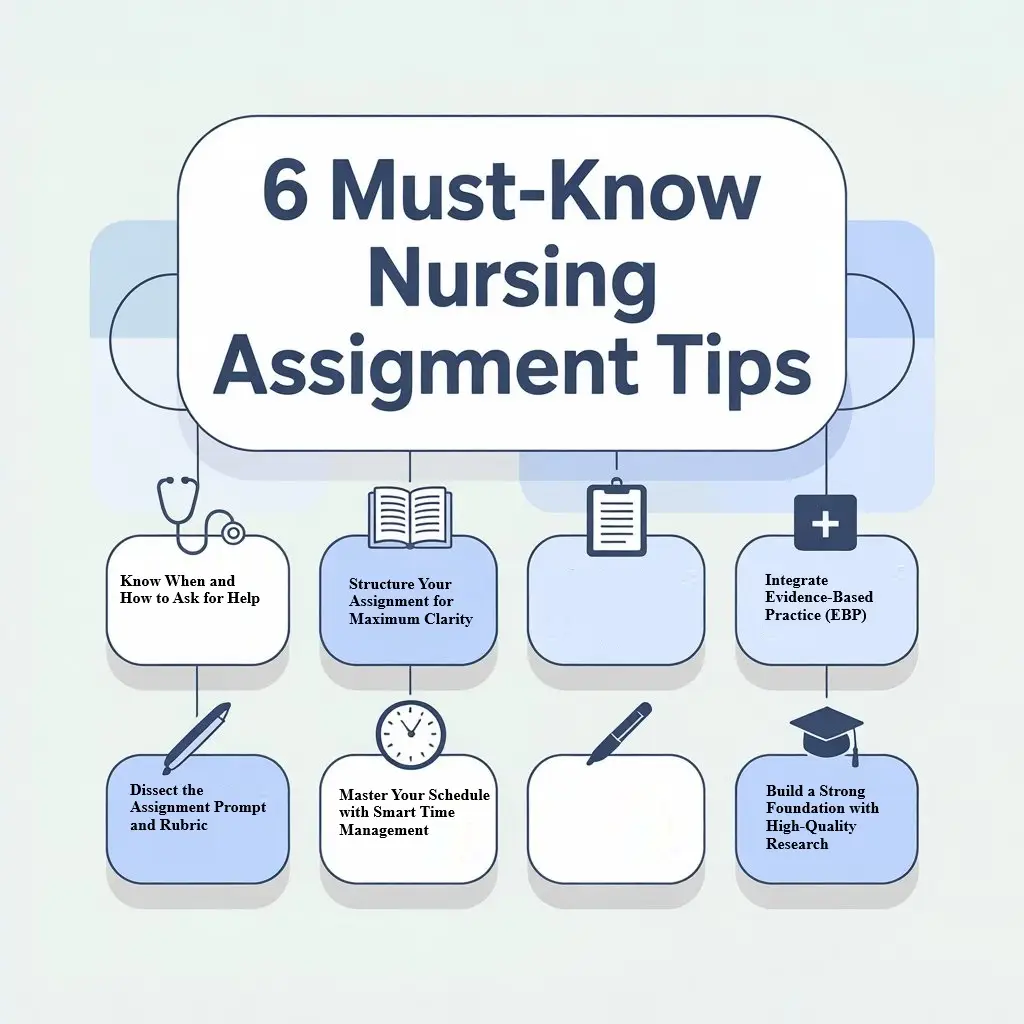
Tip 1: Dissect the Assignment Prompt and Rubric
The single biggest mistake students make is diving into research without fully understanding what is being asked of them. Before you write a single word, you must become a detective.
How to Do It:
- Read the Prompt Multiple Times: First, read it to get a general idea. Then, read it again, this time with a highlighter. Identify keywords and action verbs like “analyze,” “compare,” “evaluate,” or “describe.” These words tell you exactly what kind of thinking and writing is expected.
- Break It Down: If the prompt has multiple questions or parts, list them out separately. This creates a mini-outline and ensures you don’t accidentally miss a section.
- Master the Rubric: The grading rubric is your cheat sheet. It tells you exactly how your instructor will allocate points. Pay close attention to the criteria for “Excellence” or the highest grade bracket. What does an A+ paper include that a B paper doesn’t? Often, it’s the depth of analysis, the quality of sources, or the integration of nursing theory.
Treating the prompt and rubric as your map is one of the most effective study tips for nursing students. It ensures you’re on the right path from the very beginning, saving you from frustrating rewrites later.
Tip 2: Build a Strong Foundation with High-Quality Research
Nursing is an evidence-based profession, and your assignments must reflect that. Your opinions and experiences are valuable, but they must be supported by credible, peer-reviewed evidence. Knowing where and how to find this information is a superpower.
Where to Look:
- University Library Databases: This is your gold mine. Get familiar with databases like CINAHL (Cumulative Index to Nursing and Allied Health Literature), PubMed, and Cochrane Library. They are filled with peer-reviewed journals and articles.
- Professional Nursing Organizations: Websites for organizations like the American Nurses Association (ANA) or specialty-specific groups often publish position statements, clinical guidelines, and research.
- Textbooks and Required Readings: Don’t forget the basics! Your course materials are often the best starting point for foundational knowledge.
What to Avoid:
- Wikipedia: While it can be a decent starting point to get a general overview, it is not a citable academic source.
- General Health Blogs or Websites: Sites like WebMD or Healthline are for patients, not practitioners. They lack the academic rigor required for nursing assignments.
Effective research is a key component of any guide on how to write a nursing assignment. Always prioritize sources that are current (usually within the last 5 years, unless it’s a seminal work) and directly relevant to your topic.
Tip 3: Structure Your Assignment for Maximum Clarity
A well-organized paper is easier for your instructor to read, understand, and grade. A jumbled mess of ideas, no matter how brilliant, will always score lower. Most nursing papers follow a logical structure.
A Simple, Effective Outline:
- Introduction:
- Hook: Start with a compelling statistic, a brief patient scenario, or a strong statement to grab the reader’s attention.
- Background: Briefly introduce the topic and its relevance to nursing.
- Thesis Statement: This is the most important sentence of your introduction. It clearly states the main argument or purpose of your paper.
- Body Paragraphs:
- Topic Sentence: Each paragraph should start with a clear topic sentence that introduces the main idea of that paragraph.
- Evidence: Support your topic sentence with evidence from your research (paraphrased information, data, direct quotes).
- Analysis: This is where you shine. Explain why the evidence is important. How does it support your thesis? How does it apply to nursing practice?
- Concluding/Transition Sentence: Neatly wrap up the paragraph and smoothly lead into the next one.
- Conclusion:
- Restate Thesis: Rephrase your thesis statement in a new way.
- Summarize Key Points: Briefly recap the main arguments from your body paragraphs.
- Final Thought: End with a strong concluding statement about the future of the topic, its implications for nursing, or a call to action.
Adhering to these academic writing tips for nursing students and mastering APA formatting (or whatever style your school requires) for citations and references is non-negotiable. Using tools like the Purdue OWL website can be a lifesaver.
Tip 4: Integrate Evidence-Based Practice (EBP)
This tip is so crucial it deserves its own section. Evidence-Based Practice (EBP) is the backbone of modern nursing. It’s the process of using the best available evidence, combined with clinical expertise and patient values, to make clinical decisions. Your assignments are the perfect training ground for this skill.
How to Showcase EBP in Your Writing:
- Don’t Just State Facts, Connect Them: Instead of just saying, “Handwashing reduces infection,” you can write, “According to a 2022 study in the American Journal of Nursing, implementing a strict hand hygiene protocol was shown to decrease hospital-acquired infections by 30%, demonstrating its critical role in patient safety.”
- Use the PICO(T) Framework: For research-heavy assignments, framing your question using the PICO(T) model (Patient/Population, Intervention, Comparison, Outcome, Time) can help focus your research and writing.
- Reference Clinical Guidelines: Citing established clinical practice guidelines from reputable organizations shows that you understand how to apply high-level evidence to your practice.
Consistently applying EBP is one of the most important nursing writing tips you can learn. It elevates your work from a simple summary to a professional analysis.
Also read on Mental Health Nursing: Best Assignment Topics for 2025
Tip 5: Master Your Schedule with Smart Time Management
Procrastination is the enemy of quality work. The “I’ll do it tomorrow” mindset leads to rushed, stressful, and subpar submissions. Given the heavy workload in nursing school, effective time management isn’t just a good idea—it’s essential for survival.
Practical Time Management Tips for Nursing Students:
- Use a Planner: Whether digital (like Google Calendar) or physical, a planner is your command center. Schedule everything: classes, clinicals, study blocks, assignment deadlines, and even personal time.
- Break It Down: A 10-page research paper feels daunting. But “Week 1: Find 5 sources,” “Week 2: Write outline,” “Week 3: Draft introduction and body,” feels manageable. Breaking large tasks into smaller, bite-sized steps makes them less intimidating.
- The Pomodoro Technique: Work in focused 25-minute intervals, followed by a 5-minute break. After four “Pomodoros,” take a longer 15-30 minute break. This technique can boost focus and prevent burnout.
- Set Realistic Goals: Don’t plan to write an entire care plan after a 12-hour clinical shift. Be realistic about your energy levels and schedule your most demanding tasks for when you’re most alert.
If you find yourself consistently overwhelmed, don’t be afraid to seek nursing coursework help from academic advisors who can assist with scheduling strategies.
Tip 6: Know When and How to Ask for Help
Trying to be a hero and do everything on your own is a recipe for burnout. Nursing is a collaborative profession, and your education is no different. Smart students know how to leverage their resources.
Your Support System:
- Professors and TAs: They are your number one resource. Attend office hours. Ask questions after class. If you’re unclear on an assignment’s expectations, ask them! They would much rather clarify things early on than receive a paper that completely misses the mark.
- University Writing Center: These centers are staffed with experts trained to help students improve their writing. They can assist with everything from brainstorming and outlining to grammar and citation formatting.
- Peer Study Groups: Working with classmates can be incredibly beneficial. You can discuss complex topics, share resources, and proofread each other’s work.
- Reputable Academic Support: Sometimes, you might need more structured guidance. Seeking nursing assignment help or nursing homework help from credible academic support services can provide model answers and tutoring to help you understand difficult concepts. Just be sure to use these services ethically as a learning aid, not a shortcut.
Check for Common Nursing Assignment Errors
Pay special attention to these frequent mistakes:
- Inconsistent verb tense: Medical information is usually written in present tense, while case scenarios might be past tense. Stay consistent within sections.
- Incorrect medical terminology: Double-check spelling of medications, diseases, and anatomical terms. A small typo can completely change meaning.
- Missing or incorrect citations: Every fact, statistic, or idea from your research needs proper attribution. Missing citations can result in plagiarism accusations, even if unintentional.
- Formatting inconsistencies: Ensure your headings, spacing, margins, and font match assignment requirements exactly.
Verify All Requirements Are Met
Create a final checklist based on the assignment instructions and rubric:
- ✓ Word count meets requirements (not significantly under or over)
- ✓ All required sections included
- ✓ Minimum number of sources used and properly cited
- ✓ Correct formatting style (APA, MLA, etc.)
- ✓ File named correctly and submitted to the right location
- ✓ Plagiarism checked using institutional resources
This systematic final review ensures you don’t lose points for easily avoidable oversights.
Common Challenges and How to Overcome Them
Even with these nursing assignment tips for students, you’ll likely encounter obstacles. Here’s how to address the most common challenges:
“I don’t know where to start.”
This feeling of overwhelm is normal, especially with complex assignments. Combat this by breaking the assignment into the smallest possible first step. Don’t think “I need to write a 10-page care plan.” Instead, think “I need to spend 20 minutes choosing a relevant patient scenario.” One small step leads to momentum.
“I’m running out of time.”
If deadlines are approaching faster than you’d like, prioritize ruthlessly. Focus on meeting the core assignment requirements first. You can add polish later if time allows, but a complete draft that meets basic requirements is better than a beautifully written introduction with nothing else.
“I don’t understand the clinical concept.”
Don’t try to write about something you don’t understand—it will show in your work. Instead, pause and seek clarification. Review your textbook, watch educational videos, ask classmates, or visit your instructor’s office hours. The time invested in truly understanding the concept will result in a stronger assignment and better knowledge retention.
“My writing sounds too simple/too complicated.”
Finding the right level of complexity comes with practice. If your writing feels too simple, enhance it by incorporating more evidence-based reasoning and professional terminology while explaining clinical significance. If it feels too complicated, try explaining your main point to a friend, then write it as simply as you spoke it.
When to Seek Nursing Assignment Help
Let’s be honest: nursing school is a marathon, not a sprint. There’s no shame in needing support. Seeking nursing assignment help or nursing homework help is a sign of strength and self-awareness, not weakness.
-
Your Professors & Tutors: They are your first and best resource. They want you to succeed.
-
University Writing Center: A fantastic, often underutilized, free service for nursing coursework help with structure and writing.
-
Reputable Online Services: If you seek external nursing homework help, use them ethically. They should be used as a model to learn from, not a document to submit as your own. Look for services that offer tutoring and guidance, not just completed papers.
Conclusion: Building Competence, One Assignment at a Time
The journey through nursing school is a marathon, not a sprint. The tips for nursing school assignments outlined above are more than just strategies to get better grades, they are habits that will build your competence, confidence, and critical thinking skills.
By learning to deconstruct prompts, conduct thorough research, write clearly, integrate evidence, manage your time, and seek help when needed, you are actively shaping yourself into the kind of nurse patients deserve: knowledgeable, diligent, and resourceful. Embrace each assignment as an opportunity to grow, and you’ll not only succeed in your studies but also lay the groundwork for a long and impactful career. You’ve got this!
FAQ
1. What is the best way to start a nursing assignment? The best way to start is by carefully reading the assignment prompt and the grading rubric at least twice. Highlight keywords and break the prompt into smaller, manageable questions. This creates a clear outline and ensures you know exactly what is expected before you begin researching or writing.
2. How do I make my nursing writing sound more academic? To sound more academic, focus on being clear, concise, and evidence-based. Avoid using slang or overly casual language. Always support your claims with citations from credible sources like peer-reviewed journals. Using specific nursing terminology correctly also elevates your writing. These are essential academic writing tips for nursing students.
3. I’m struggling to balance assignments with my clinicals. Any advice? This is a common challenge! The key is proactive time management tips for nursing students. Use a planner to schedule dedicated study and writing blocks around your clinical shifts. Break down assignments into very small tasks that you can complete in short bursts, like finding one article or writing one paragraph. Don’t be afraid to use a day off to rest rather than trying to cram, burnout is your biggest enemy.
4. What’s the most common mistake students make on nursing assignments? The most common mistake is not fully answering the prompt or ignoring the grading rubric. Students often write a good paper on the general topic but fail to address the specific questions or criteria outlined by the instructor, leading to a lower-than-expected grade.
5. Where can I find reliable nursing assignment help? Start with your university’s free resources, such as your professor’s office hours and the academic writing center. For more personalized nursing homework help, you can form study groups with classmates. If you need more structured support, look into reputable online tutoring services that specialize in nursing education and can provide expert guidance.









 Evan John