Writing a critical analysis goes beyond simply summarizing a text; it involves breaking down a work to evaluate its strengths, weaknesses, and underlying messages. Whether you’re analyzing a book, film, article, or artwork, the goal is to interpret and critique the material thoughtfully and objectively. Critical analysis is vital in both academic and professional settings, Read More
Chat with our experts to get the best quote. Make the payment via online banking, debit/credit cards or through paypal. Recieve an order confirmation number.
Sit back and relax. Your well written, properly referenced research paper will be mailed to your inbox, before deadline. Download the paper. Revise and Submit.
Writing a critical analysis goes beyond simply summarizing a text; it involves breaking down a work to evaluate its strengths, weaknesses, and underlying messages. Whether you’re analyzing a book, film, article, or artwork, the goal is to interpret and critique the material thoughtfully and objectively. Critical analysis is vital in both academic and professional settings, helping you develop sharper reasoning, deeper insight, and a more persuasive writing style.
What is Critical Analysis?
Critical analysis is the process of thoughtfully evaluating and interpreting a work, such as a text, film, or speech, to judge its meaning, effectiveness, or value. It goes beyond a simple summary by examining how the work is constructed, what arguments or messages it presents, and whether those elements are logical, persuasive, or flawed. A strong critical analysis highlights strengths and weaknesses, supports its points with evidence, and reflects a balanced, objective perspective.
Why is Critical Analysis important?
Why is critical thinking important? It enables individuals to approach problems and situations rationally and analytically. This thinking involves actively analyzing, interpreting, and evaluating information rather than accepting it at face value. By using critical thinking skills, individuals can better identify biases and assumptions, evaluate evidence, and make informed decisions. Critical analysis is also essential for problem-solving and decision-making in personal and professional contexts.
Critical thinking skills are more important than ever in today’s rapidly changing world. With the vast amount of information available, it can be easy to become overwhelmed or to accept information that is not accurate or reliable. Critical thinking allows individuals to sift through the data, identify relevant and correct information, and make informed decisions. It is a valuable skill that can help individuals navigate the challenges of daily life and succeed in their personal and professional endeavors.
How to Write a Critical Analysis Writing
Before you start writing an academic critical analysis, do a critical reading. Writing a critical analysis is a challenging but crucial skill that requires a logical, analytical, and objective approach.
Here is a more detailed guide on how to write a critical analysis with examples to help you understand the process better:
Understand the Context:
The first step in writing an academic critical analysis is understanding the context of the information you are analyzing. For instance, if you are studying a literary text, consider the author’s background, the period it was written in, the literary genre, and the intended audience. If you are analyzing an argument, consider the purpose of the argument, the intended audience, and the context in which it was presented.
Example: If you are analyzing F. Scott Fitzgerald’s novel The Great Gatsby, consider the author’s background as a writer in the 1920s, the cultural and social milieu of the Jazz Age, and the novel’s themes of wealth, power, and disillusionment.
Read and Evaluate the Information:
The next step is to read the information critically, taking note of the main arguments, evidence, and assumptions. Consider the credibility and relevance of the sources used and evaluate any biases or limitations.
Example: If you are analyzing an article on the benefits of exercise, read the article carefully, evaluate the quality and relevance of the research cited, and consider any potential biases or limitations, such as sample size or funding sources.
Develop Your Argument:
Based on your evaluation, develop your argument or position. Identify the information’s strengths and weaknesses and present your analysis logically and coherently.
Example: In analyzing “The Great Gatsby,” you might argue that the novel critiques the American Dream as a false promise of wealth and happiness. You could provide evidence from the text, such as Gatsby’s pursuit of Daisy and his belief that money can buy happiness, to support your argument.
Provide Evidence:
Support your argument with evidence, using examples from the information to demonstrate your points. To incorporate evidence effectively, use direct quotes, paraphrasing, or summarizing.
Example: To analyze the article on the benefits of exercise, you might provide evidence from the research cited, such as studies showing a correlation between regular exercise and improved mental health.
Consider Alternative Viewpoints:
Acknowledge alternative viewpoints and address them in your analysis. Evaluate their strengths and weaknesses and demonstrate how your argument is superior.
Example: In analyzing “The Great Gatsby,” you might consider alternative interpretations of the novel, such as the view that it celebrates the excess and glamour of the Roaring Twenties. You could evaluate the strengths and weaknesses of this interpretation and demonstrate why your argument is more compelling.
Draw Conclusions:
Finally, draw conclusions based on your analysis and provide recommendations or suggestions for future research or action.
Example: In analyzing the article on the benefits of exercise, you might conclude that regular exercise has multiple benefits for physical and mental health. You could recommend further research into the specific types and amounts of exercise most effective for different populations.
Writing a critical analysis requires a thorough understanding of the context, careful evaluation of the information, development of a well-reasoned argument, provision of evidence, consideration of alternative viewpoints, and conclusion drawing. You can develop this essential skill with practice and patience and become a more effective communicator and critical thinker.
How to Improve Your Critical Analysis Writing Skills
Improving your critical analysis writing skills takes practice and effort. Here are some tips to help you improve:
Read widely: Reading various texts and concepts can help you develop your analytical and critical thinking skills.
Practice analyzing: Analyze texts or concepts regularly to improve your analytical skills.
Develop a structure: Creating an outline or structure can help you organize your thoughts and improve the clarity of your analysis.
Seek feedback: Get feedback from your professors or peers to improve your critical analysis writing skills.
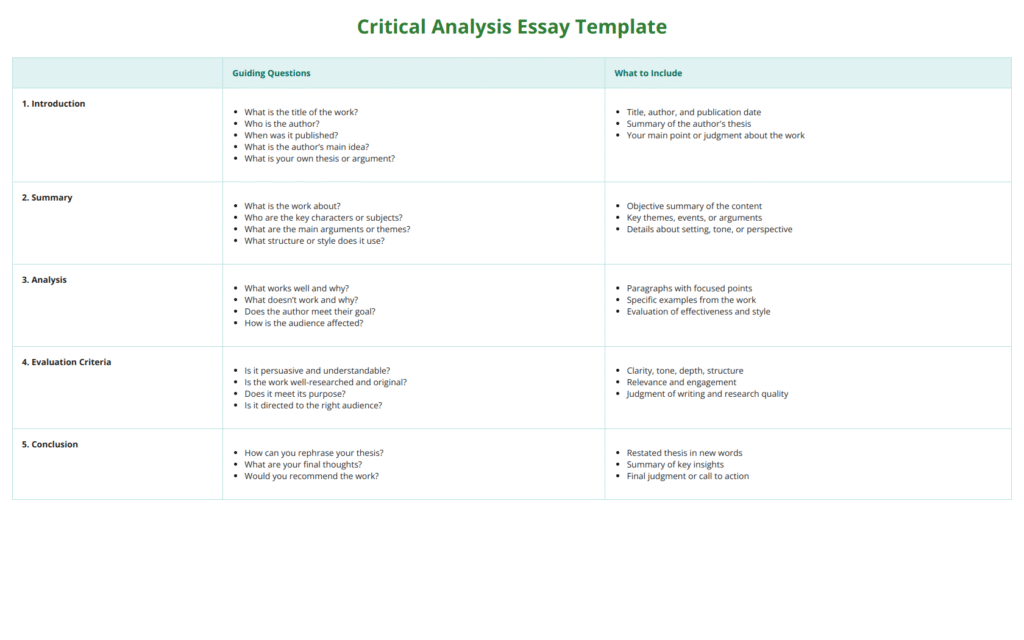
Critical Analysis Essay Template
A critical analysis essay involves a detailed evaluation of a work’s overall effectiveness, what it does well, and where it falls short. You can apply this approach to a book, article, film, or other media. To write effectively, begin by reading the work carefully, researching unfamiliar concepts, and reviewing related materials to strengthen your understanding.
Introduction
Your introduction should:
Mention the title of the work, the author’s name, and the date of publication.
Summarize the main idea or argument of the work and identify the author’s thesis.
Present your own thesis statement, expressing your central evaluation of the work.
Examples:
The novella “The Metamorphosis” by Franz Kafka is a powerful story because the author skillfully explores alienation and identity through surreal transformation.
The article “Narratives of Intercultural Transformation” by Ingrid Adams is both informative and insightful due to its clear analysis of cultural adaptation.
Summary
Your summary should:
Provide a brief overview of the work’s main points.
Include essential details—who, what, where, when, why, and how.
Optionally, discuss the structure, style, or point of view used by the author.
Examples:
This book focuses on…
The author argues that…
The main character is…
The research was conducted in…
The theme centers around…
Analysis
Your analysis forms the core of the essay. It should:
Critically explain what you liked or disliked about the work.
Support your opinions with specific evidence or examples from the text.
Evaluate whether the author achieved their purpose or goal.
Consider whether the work is:
Focused, persuasive, and clear
Informative and well-written
Original and engaging
Directed at the right audience
Thoroughly researched with sound conclusions
Each aspect of your analysis should be developed in separate, well-structured paragraphs.
Conclusion
Your conclusion should:
Restate your thesis in fresh, confident language.
Summarize your key insights or findings.
End with a call to action or a final evaluative comment.
Examples:
You must read this book because…
This article is not a reliable source because…
Final Note
Critical analysis should be engaging! It’s your opportunity to express your perspective on a piece of work, but your ideas must always be supported by evidence, reasoning, and examples from the text.
The following are some of the best critical essay topics
The impact of social media on society: A critical analysis.
An analysis of the portrayal of women in media and its impact on society.
The effects of globalization on local cultures: A critical analysis.
The role of education in promoting social mobility: A critical analysis.
An analysis of the impact of climate change on the global economy.
The influence of advertising on consumer behavior: A critical analysis.
The impact of technology on the job market: A critical analysis.
An analysis of the relationship between poverty and crime.
The role of the media in shaping public opinion: A critical analysis.
An analysis of the impact of immigration on the host country’s economy.
The relationship between mental health and social media use: A critical analysis.
An analysis of the impact of income inequality on social justice.
The impact of colonialism on contemporary society: A critical analysis.
An analysis of the impact of AI on employment and the economy.
The role of the government in promoting economic development: A critical analysis.
The impact of the gig economy on workers’ rights: A critical analysis.
An analysis of the relationship between social media use and political polarization.
The impact of technology on human relationships: A critical analysis.
The role of education in reducing income inequality: A critical analysis.
An analysis of the impact of globalization on the environment.
The relationship between access to healthcare and social justice: A critical analysis.
An analysis of the impact of the #MeToo movement on society.
The impact of automation on the future of work: A critical analysis.
An analysis of the relationship between education and economic growth.
The role of media literacy in promoting critical thinking: A critical analysis.
Critical Analysis Writing Sample
Are you struggling with critical analysis writing and not sure where to start? Look no further! Our critical analysis writing sample is the perfect guide to help you improve your analytical skills and produce a well-written, well-organized critical analysis essay. With our carefully crafted writing sample, you will learn how to analyze and evaluate texts effectively, develop compelling arguments, and provide evidence to support your claims. Take advantage of this valuable resource and take your critical analysis writing to the next level. Unlock your potential and excel in your academic pursuits with our comprehensive critical analysis writing sample.
Critical analysis writing is a versatile skill that can be applied in various fields and scenarios. To help you better understand essential analysis writing, here are some examples:
Analysis of a movie or book
In this analysis, you critically evaluate a movie or book’s characters, plot, and themes. You can analyze how the characters are portrayed, how they develop throughout the story, and their motivations. You can also evaluate the movie or book’s plot structure, pacing, and themes. A critical analysis of a film or book can help you develop your interpretations and insights about the work.
Analysis of a scientific study
In a critical analysis of a scientific study, you critically examine the study’s methodology, data, and conclusions. You can evaluate the study’s design, sample size, and data analysis techniques. You can also assess the strength of the evidence presented in the research and evaluate the validity and reliability of the conclusions drawn. A critical analysis of a scientific study can help you determine the quality of the research and identify any limitations or biases that may affect the findings.
Analysis of a political speech
A critical analysis of a political speech involves critically evaluating the arguments and evidence presented in the speech. You can analyze the rhetoric and persuasive techniques used by the speaker and the logic and coherence of their arguments. You can also evaluate the evidence presented and assess its relevance, accuracy, and reliability. A critical analysis of a political speech can help you develop your understanding of the issues and evaluate the credibility of the speaker’s claims.
These are just a few examples of the types of critical analysis writing you may encounter. By learning to analyze different types of texts and concepts critically, you can develop your analytical skills and improve your ability to think critically and objectively about the world around you.
What to Avoid When Writing a Critical Analysis
When writing a critical analysis, it’s important to maintain academic integrity and clarity. Here are common pitfalls to avoid:
Summarizing Instead of Analyzing A critical analysis goes beyond summarizing the content. Avoid simply retelling what happened. Instead, focus on interpreting, evaluating, and discussing the work’s meaning, strengths, and weaknesses.
Lack of a Clear Thesis Without a clear argument or thesis, your analysis will lack direction. Avoid vague or overly broad claims. Your thesis should present a specific point of view that guides the rest of your analysis.
Overuse of Personal Opinions While personal insights are welcome, avoid excessive use of phrases like “I think” or “I feel.” Your analysis should be grounded in evidence, not just subjective impressions.
Failing to Use Evidence Critical analysis must be supported by textual or contextual evidence. Avoid making claims without supporting them with quotations, examples, or scholarly sources.
Being Too Harsh or Too Lenient Avoid extreme bias. A balanced critique considers both the subject’s strengths and weaknesses. Objectivity enhances credibility.
Neglecting Structure and Coherence Jumping between ideas or presenting them in an unorganized manner weakens your argument. Use clear paragraphs with transitions and logical flow.
Ignoring the Author’s Intent or Context Avoid critiquing a work without considering the historical, cultural, or biographical context in which it was created. This may lead to misinterpretation.
Using Informal or Unacademic Language Colloquial expressions, slang, or overly casual tone can reduce the professionalism of your analysis. Maintain an academic writing style throughout.









 Evan John