It’s 2 a.m., the unit is finally quiet, and you still have four sets of notes to chart before shift change. You know what happened with each patient. You just don’t know how to say it the way your instructor or your unit’s compliance team expects.
If that feels familiar, you’re not alone. Documentation is one of the most frequently performed skills in nursing, and yet most students and new nurses are never given a clear, reusable format. You’re left rebuilding your notes from scratch every single shift, second-guessing your wording, and wondering if you documented “enough.”
Good documentation isn’t about writing more. It’s about writing the right information, in the right structure, every time. That consistency is what protects your patients, your license, and your time.
That’s exactly why we built the Nursing Notes Templates Bundle: 7 Professional Clinical Documentation Templates for Nursing Students & Nurses. It’s a ready-to-use set of charting formats designed to take the guesswork out of documentation, whether you’re on your first clinical rotation or your fiftieth shift as a working nurse.
In this post, we’ll cover why documentation matters so much, what’s inside the templates bundle, the most common charting mistakes to avoid, and a real example of a properly structured nursing note.
📝 Why Clinical Documentation Matters
Documentation often feels like paperwork standing between you and patient care. In reality, it is patient care. Here’s why it deserves the same attention as any hands-on skill.
It Protects Your Patients
Clear, timely notes give every provider who reads them an accurate picture of what happened and when. Gaps or vague entries can lead to missed changes in condition, duplicated treatments, or delayed interventions.
It Protects You Professionally and Legally
In nursing, the standard is simple: if it wasn’t documented, it didn’t happen. Thorough, objective notes are your best defense if care is ever questioned, and they demonstrate the clinical judgment you exercised in the moment.
It Supports Continuity of Care
The next nurse, physician, or specialist relies entirely on your documentation to understand the patient’s trajectory. A well-structured note lets them pick up exactly where you left off, without having to ask the patient again or recheck the chart line by line.
It Reflects Your Clinical Judgment
Instructors and preceptors read your notes to evaluate how you think, not just what you did. A clear, well-organized note signals strong clinical reasoning, even before anyone sees you at the bedside.
💡 QUICK TIP
Chart as close to real time as your unit allows. The longer you wait, the more details blur together, and the harder it becomes to write an accurate, specific note.
📦 What’s Inside the Nursing Notes Templates Bundle
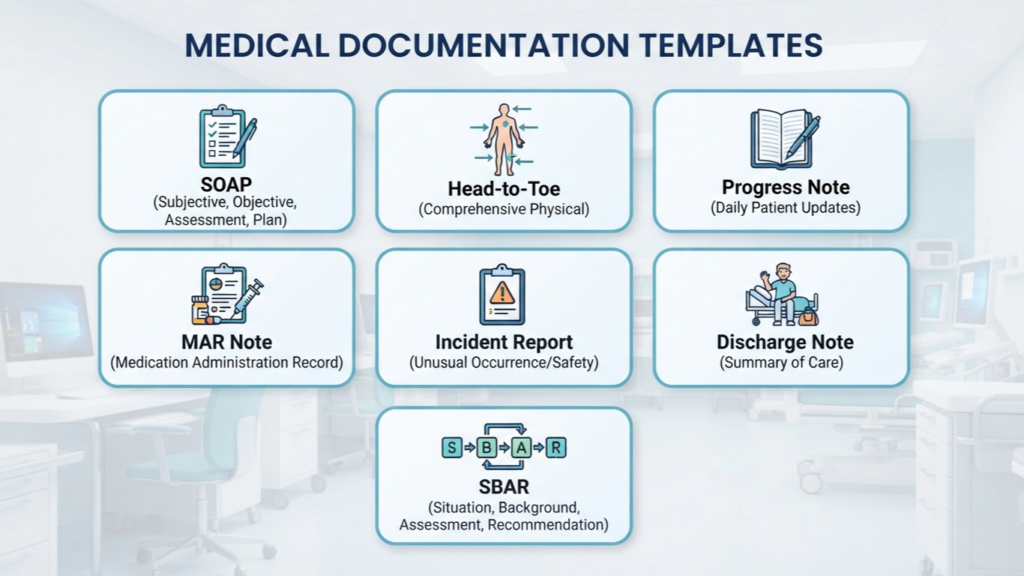
The bundle includes seven templates, each built around a specific charting situation you’ll face constantly in school and in practice.
- SOAP Note Template — A structured Subjective, Objective, Assessment, and Plan format for clear, standardized progress notes.
- Head-to-Toe Assessment Template — A full-body systems checklist to guide and document a thorough physical assessment.
- Nursing Progress Note Template — A flexible format for documenting ongoing changes in patient status throughout a shift.
- Medication Administration Note Template — A consistent structure for documenting medications given, patient response, and any follow-up needed.
- Incident / Event Report Template — A factual, objective format for documenting falls, errors, or unexpected events without unnecessary risk language.
- Discharge & Patient Education Note Template — A clear way to document what was taught, how the patient responded, and what follow-up care was arranged.
- SBAR Shift Handoff Template — A Situation, Background, Assessment, Recommendation format for fast, accurate handoffs between shifts or providers.
💡 QUICK TIP
You don’t need to memorize seven different formats. Once you understand the logic behind one, the rest follow the same underlying pattern: gather data, organize it, and communicate it clearly.
⚠️ Common Documentation Mistakes to Avoid
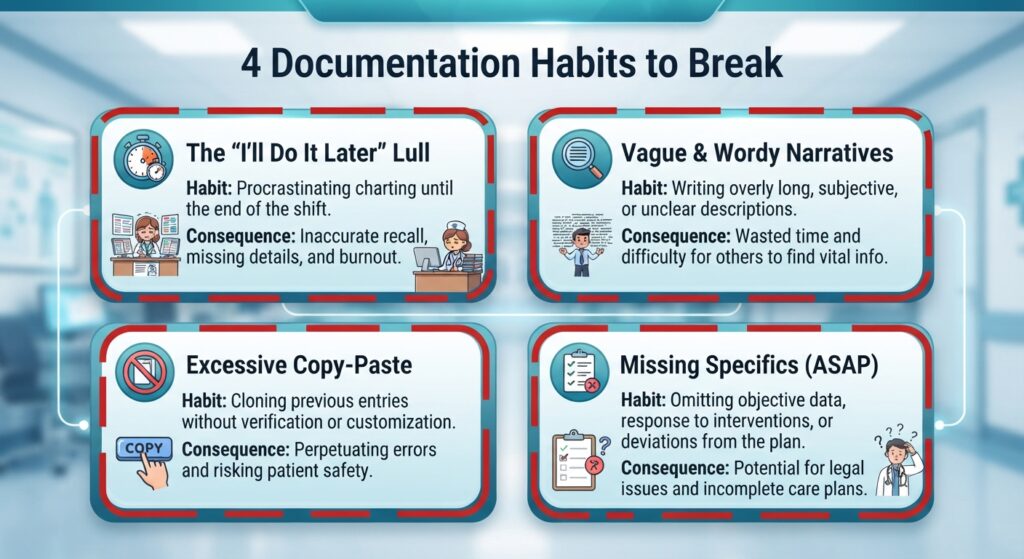
Most charting problems come down to a handful of repeated habits. Recognizing them is the first step to writing cleaner, stronger notes.
Vague or subjective language. Phrases like “patient seems fine” or “resting comfortably” don’t constitute clinical evidence. Objective, measurable observations are always stronger.
Late or retrospective entries. Charting hours after care was given increases the risk of missing details and can raise questions about accuracy.
Copy-paste charting. Reusing a previous note without updating it for the current shift is one of the fastest ways to miss a real change in patient condition.
Missing objective data. Vital signs, intake and output, and specific assessment findings should always support the narrative rather than replace it.
✅ What Makes Documentation Professional and Legally Sound
Strong documentation shares the same core qualities, no matter which template you’re using.
Objective, Factual Language
Describe what you observed and did, not what you assumed. “Patient rated pain 6/10” is defensible. “Patient appeared to be exaggerating pain” is not.
Timeliness
Document as close to the event as possible. Real-time or near-real-time notes are more accurate and more credible.
Consistency
Using the same structure every time, whether that’s SOAP, SBAR, or a head-to-toe format, makes your notes easier to read, audit, and hand off.
Approved Terminology
Stick to your facility’s approved abbreviations and standardized terms. Shortcuts that aren’t recognized can create confusion or compliance issues.
🧾 Example: A Properly Structured SOAP Note
Here’s a simplified example of how a clean, professional SOAP note comes together in practice.
| Subjective |
Patient reports “sharp pain in my lower back, about a 6 out of 10,” worse when sitting up. |
| Objective |
Vital signs stable: BP 124/78, HR 82, RR 16, Temp 98.4°F. Guarding noted on movement. No visible swelling or bruising at lumbar region. |
| Assessment |
Acute lower back pain, likely musculoskeletal in origin, consistent with reported onset and physical findings. |
| Plan |
1. Administer prescribed analgesic and reassess pain in 60 minutes.
2. Encourage position changes to reduce discomfort.
3. Notify the provider if pain persists above 6/10 after intervention.
4. Continue routine vital sign monitoring per unit protocol. |
💡 QUICK TIP
Notice that every subjective statement is paired with an objective backup. That pairing is what makes a note clinically credible instead of just descriptive.
📘 How the Nursing Notes Templates Bundle Helps
Reading a well-structured example is one thing. Having a ready-made template for every documentation scenario you’ll actually face is another.
That’s exactly what the Nursing Notes Templates Bundle gives you: seven professional, pre-formatted templates you can adapt to any patient, any unit, and any clinical scenario.
- Ready-to-use formats for the seven most common types of nursing documentation.
- Consistent structure that makes your notes easier to read, audit, and defend.
- Faster charting, because you’re filling in a proven format instead of building one from scratch under pressure.
- Fewer missed details, since each template prompts you for the objective data that matters most.
- Greater confidence walking into clinical, orientation, or a new unit, knowing your documentation meets a professional standard.

🎯 Who Should Get This Templates Bundle?
Nursing Students
- Want a clear format for clinical documentation assignments
- Are preparing for their first hands-on charting experience
- Need to build confident, professional habits early
New Graduate Nurses
- Want to chart faster and more accurately during orientation
- Need a reliable structure across different units and specialties
- Are building the documentation habits that will define their practice
Clinical Instructors and Preceptors
- Want a consistent format to teach and evaluate documentation
- Need examples that reflect real clinical standards
- Are you looking for a resource to share across a cohort or unit
Also read on Best Side Hustles for College & University Students: A Practical Guide
❓ Frequently Asked Questions
Is this bundle suitable for nursing students with no clinical experience yet?
Yes. Each template is written in plain, guided language, so you can learn the structure even before your first clinical shift.
Does the bundle include real documentation examples?
Yes. Every template includes a completed sample note, so you can see exactly how it should look when filled in.
Are these templates appropriate for different clinical settings?
Yes. The seven templates are built around universal documentation needs, so they adapt easily across med-surg, ICU, pediatrics, and other specialty units.
Can this help specifically during clinical placements?
Absolutely. Many students use these templates to prepare for clinical documentation requirements before they ever set foot on the unit.
Is this useful once I’m working as a licensed nurse?
Yes. New nurses frequently keep using these templates well past orientation, especially when rotating between units or facilities with different charting systems.
🌟 Final Thoughts: Chart with Confidence, Every Shift
Documentation doesn’t have to be the part of nursing you dread most. With the right templates, it becomes a fast, structured habit instead of a nightly source of stress.
If you’re ready to stop rebuilding your notes from scratch every shift, the Nursing Notes Templates Bundle was built to make that possible.
Whether you’re preparing for your very first clinical documentation assignment or looking to standardize your charting as a working nurse, these seven templates are designed to meet you exactly where you are.









 Evan John