It’s 11 p.m. Clinical starts in eight hours, and you’re staring at a blank care plan template with no idea where to begin. The assessment data feels scattered. The list of possible nursing diagnoses feels endless. And no matter how many times your instructor explains it, “related to” and “as evidenced by” still read like a foreign language.
If that scenario feels familiar, you’re in good company. Nearly every nursing student remembers the specific stress of writing their first care plan. The frustration isn’t a sign that you’re behind. It’s a sign that no one has broken the process down for you yet.
Here’s the reassuring part: nursing care plans are a learnable skill, not a talent some students have and others don’t. Once you understand the logic that drives them, each plan gets faster, clearer, and far less intimidating than the last.
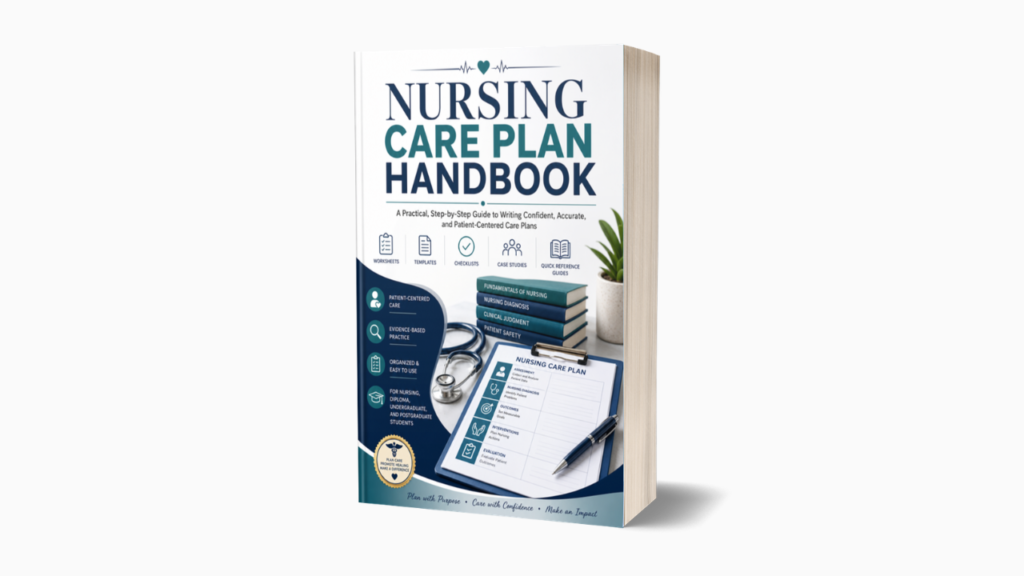
That’s exactly the gap the Nursing Care Plan Handbook: A Step-by-Step Guide to Confident, Evidence-Based Care Plans was built to close. It replaces guesswork with a repeatable, evidence-based framework you can apply to any diagnosis, in school or at the bedside.
We’ll walk through why care plans matter, how the nursing process actually works, the mistakes that trip up most students, and what a genuinely strong, evidence-based care plan looks like from start to finish.
Read on: What Is a Nursing Care Plan? A Beginner’s Guide
🩺 Why Nursing Care Plans Matter
It’s tempting to treat a care plan as “just another assignment” standing between you and your next clinical shift. In reality, it’s one of the few tools that brings together every aspect of nursing judgment on a single page.
They Protect Patient Safety
A well-built care plan helps you catch problems before they escalate. Working through a patient’s needs systematically makes you far less likely to miss an early warning sign, such as a developing infection or an overlooked fall risk.
They Sharpen Clinical Reasoning
Care plans force you to connect cause and effect. Why is this patient short of breath? What does that mean for the next four hours of care? This is the exact thinking that separates a nurse who follows orders from one who anticipates what a patient needs next.
They Strengthen Team Communication
A clear care plan gives the entire care team a shared reference point. Physicians, nurses, and allied health staff can scan it and immediately understand the patient’s status, priorities, and plan of care.
They Drive Academic Success
Care plans carry significant weight in most nursing programs, and for good reason. Learning to write them well doesn’t just protect your GPA. It builds the exact clinical reasoning skills tested on the NCLEX and expected of you on day one of your first nursing job.
💡 QUICK TIP
Treat a care plan as a conversation with your patient’s body. Every symptom is telling you something. Your job is to listen for it, then respond in writing.
🔄 The Nursing Process Made Simple
Every nursing care plan is built on the same five-step framework, commonly remembered by the acronym ADPIE. Once this framework becomes second nature, everything else about care planning gets easier.
- Assessment — Gather data about your patient, including vital signs, physical findings, lab values, and the patient’s own words. This step is your foundation, so accuracy matters more than speed.
- Nursing Diagnosis — Identify the patient’s actual or potential health problems based on your assessment data. A nursing diagnosis is not the same as a medical diagnosis; it focuses on how the patient is responding to their condition.
- Planning — Set specific, realistic goals and determine which interventions will help the patient reach them.
- Implementation — Carry out the interventions, whether that means administering medication, providing education, or offering physical support.
- Evaluation — Determine whether the goals were met. If not, revisit and adjust the plan accordingly.

💡 QUICK TIP
ADPIE isn’t a one-time checklist. You’ll cycle through these five steps continuously as your patient’s condition changes across a single shift.
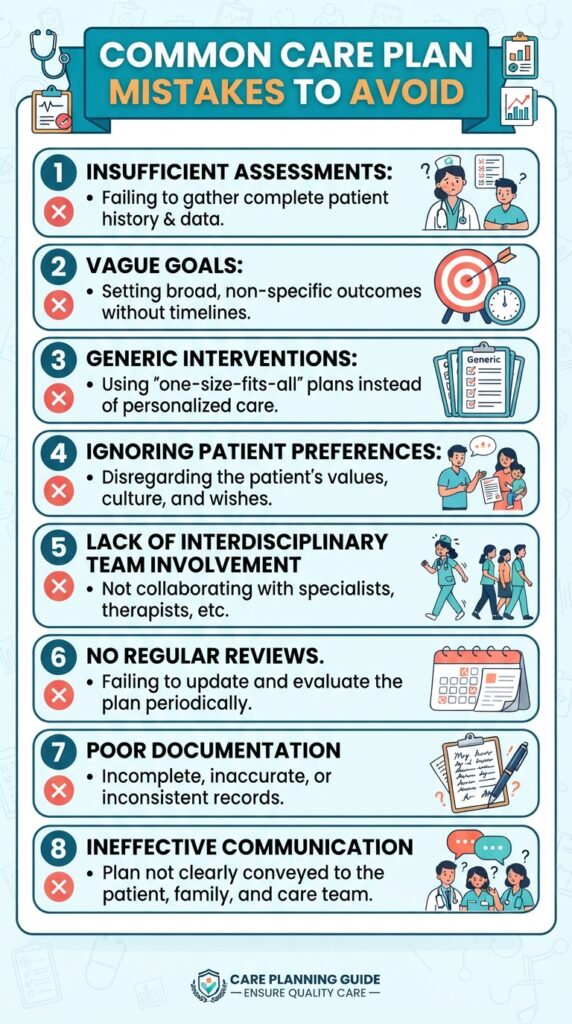
⚠️ The Biggest Mistakes Students Make
Most care plan struggles trace back to a short list of recurring errors. If any of these sound familiar, don’t be discouraged. Nearly every practicing nurse made the same mistakes on the way to getting it right.
Choosing the wrong nursing diagnosis. Selecting a diagnosis that doesn’t match the assessment data is one of the most common errors students make. The data should always drive the diagnosis, never the other way around.
Writing vague, unmeasurable goals. “Patient will feel better” can’t be evaluated by anyone on the care team. Goals need to be specific enough that progress is objectively clear.
Skipping evidence-based interventions. Interventions should be grounded in current clinical guidelines and research, not habit or guesswork copied from a previous assignment.
Weak or incomplete documentation. If care isn’t documented clearly, it’s difficult to demonstrate it happened at all, and harder for the next nurse to pick up where you left off.
✅ What Makes an Evidence-Based Care Plan?
A strong nursing care plan isn’t just complete. It’s evidence-based, meaning every component is grounded in current clinical research and recognized best practice.
SMART Goals
Effective goals are Specific, Measurable, Achievable, Relevant, and Time-bound. Instead of “patient will improve breathing,” a SMART goal reads: “Patient will maintain oxygen saturation above 94% on room air within 24 hours.”
Patient-Centered Interventions
The strongest interventions are tailored to the individual rather than copied generically from a textbook. A newly diagnosed diabetic patient needs a different teaching approach than one who has managed the condition for twenty years.
Measurable Outcomes
You should always be able to answer, “How will I know this goal was met?” If a goal can’t be measured, it isn’t ready to be included in the plan.
Documentation Best Practices
Clear, objective, and timely documentation isn’t only a school requirement. It’s a professional and legal standard that protects both you and your patient.
📋 Example Mini Nursing Care Plan
Sometimes the fastest way to understand a concept is to see it applied. Here is a simplified, realistic example.
| Patient Scenario |
A 68-year-old male is admitted following a total hip replacement. He rates his pain 7 out of 10 and is reluctant to move or participate in early mobility. |
| Assessment |
Patient reports sharp, localized pain at the surgical site. Guarding behavior is observed. Vital signs are mildly elevated (HR 92, BP 138/86). Mobility is limited by pain. |
| Nursing Diagnosis |
Acute Pain related to surgical incision, as evidenced by a verbal pain rating of 7/10 and guarding behavior. |
| Goal (SMART) |
Patient will report pain at 3/10 or lower within 4 hours of intervention. |
| Interventions |
1. Administer prescribed analgesics as ordered and monitor effectiveness.
2. Reposition the patient every two hours to reduce pressure and improve comfort.
3. Teach guided relaxation and deep-breathing techniques.
4. Reassess pain level 30–60 minutes after medication administration. |
| Evaluation |
Patient reports pain reduced to 3/10 following intervention and participates in physical therapy with minimal discomfort. Goal met. |
💡 QUICK TIP
Notice how every section connects. The diagnosis comes directly from the assessment, the goal is measurable, and the evaluation answers that goal directly. That is the pattern to look for every time you write a plan.
📘 How the Nursing Care Plan Handbook Helps
If working through that example made the process feel a little clearer, imagine having that same clarity for every diagnosis you encounter, not just one.
That is the purpose behind the Nursing Care Plan Handbook. It was written specifically to help nursing students and new nurses move from confusion to confidence, without piecing together information from a dozen scattered sources.
- Step-by-step guidance that walks you through every stage of the nursing process, so you always know what comes next.
- Practical, reusable templates so you’re never starting from a blank page.
- Real-world examples across common diagnoses, showing exactly how theory translates into practice.
- Faster care plan writing, because you’re working from a proven structure instead of guessing.
- Greater confidence heading into clinical rotations, assignments, and eventually your own independent practice.
This resource isn’t about memorizing more information. It’s about finally understanding the framework so the information makes sense on its own.
Nursing Students
- Need a clear, structured breakdown of the nursing process
- Want to stop dreading care plan assignments
- Are preparing for clinical placements and want to feel ready
New Graduate Nurses
- Want to write care plans more efficiently in real clinical settings
- Need a confidence boost during orientation and preceptorship
- Are you looking to sharpen clinical reasoning skills
Clinical Instructors and Nurse Educators
- Want a reliable resource to recommend to students
- Need consistent examples to use in teaching
- Are you looking for a tool that reinforces evidence-based practice
❓ Frequently Asked Questions
Is this suitable for beginner nursing students?
Yes. The handbook was designed with beginners in mind and breaks down each step of the nursing process in plain, easy-to-follow language.
Does it include care plan examples?
Yes. The Nursing Care Plan Handbook includes real-world care plan examples across a range of common nursing diagnoses.
Is it based on evidence-based nursing practice?
Yes. Every template and example is grounded in current, evidence-based nursing standards, so you’re learning practices that hold up in real clinical settings.
Can it help with clinical placements?
Absolutely. Many students use the handbook specifically to prepare for clinical rotations, where care plans often need to be written quickly and accurately.
Is it useful after graduation?
Yes. New graduate nurses frequently find it just as valuable during orientation and early practice, when care plan writing needs to become faster and more independent.
🌟 Final Thoughts: You Can Write Confident Care Plans
Care plans don’t have to feel like a mystery you’re constantly racing to solve at the last minute. With the right framework, they become tools that sharpen your clinical thinking and strengthen the care you provide.
If you’re ready to stop dreading care plan assignments and start writing them with clarity and confidence, the Nursing Care Plan Handbook was built for exactly that.
Whether you’re preparing for your next clinical rotation, working through a challenging assignment, or starting your first nursing role, this guide is designed to meet you where you are and help you grow from there.









 Evan John