It’s a familiar scene: a care plan due Thursday, a discussion post due Friday, a case study due next Monday, and clinicals in between. On top of that, there’s reading to finish and an exam to study for. Trying to keep all of it straight in your head usually means something gets missed. Remembering deadlines isn’t a real system. Once you have more than two or three assignments running at once, you need somewhere to see everything at a glance, and a way to decide what to work on next. This guide walks through a practical, step-by-step approach to organizing nursing assignments that you can start using today, no special apps or complicated methods required.
Why Nursing Assignments Can Be Difficult to Organize
Nursing programs stack a wide range of assignment types onto an already full schedule. Between multiple courses, different assignment formats, overlapping due dates, clinical responsibilities, required reading, exams, and group projects, it’s easy for something to slip through.
Large assignments make this harder. A care plan or research paper isn’t one task; it’s several stages spread over days or weeks. The goal isn’t to work harder or stay up later. It’s to build a system that makes every deadline and priority visible, so you can plan around it instead of being surprised by it.
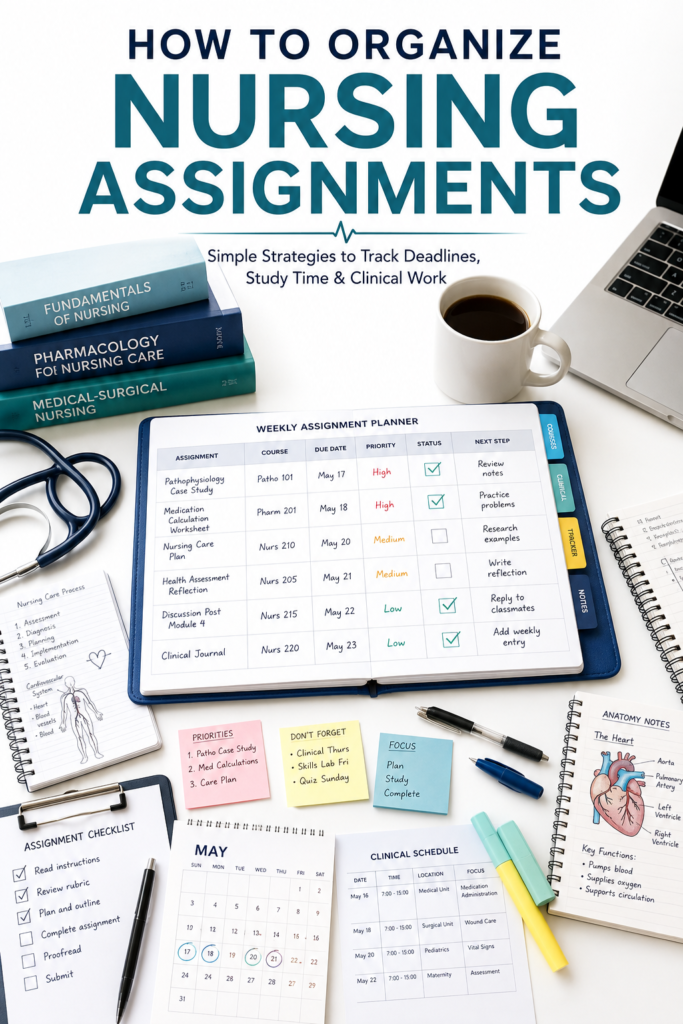
The First Step: Make a Master List of Your Nursing Assignments
Before you can organize anything, you need one place that holds every assignment from every course. Checking five different course pages to remember what’s due is exactly the habit that causes missed deadlines.
For each assignment, record the assignment name, the course it belongs to, the due date, an estimated workload, a priority level, its current status, and the next concrete step. Keeping this in a single list, rather than scattered across separate syllabi, makes weekly planning far simpler.
| Assignment |
Course |
Due Date |
Priority |
Status |
Next Step |
| Cardiac Care Plan |
Med-Surg Nursing |
Oct 14 |
High |
Researching |
Confirm nursing diagnoses |
| Discussion Post: Ethics |
Nursing Ethics |
Oct 9 |
Medium |
Not Started |
Read the assigned case |
| Evidence-Based Practice Paper |
Nursing Research |
Oct 21 |
High |
Outline Complete |
Draft literature review |
| Pharmacology Quiz Prep |
Pharmacology |
Oct 11 |
Medium |
Studying |
Review Ch. 9 flashcards |
Separate Nursing Assignments by Type
Not every assignment should be planned the same way. Grouping assignments by type makes it easier to estimate how much time and preparation each one actually needs.
Nursing Essays
Usually need time for outlining and at least one revision pass, since grading often focuses on clarity and argument structure.
Nursing Care Plans
Require gathering patient or case data first, then building out diagnoses and interventions in stages rather than all at once.
Case Studies
Depend on carefully reading the scenario before you can answer questions accurately, so build in reading time separate from writing time.
Evidence-Based Practice Assignments
Need extra time up front to find and read appropriate sources before any writing can start.
Discussion Posts
Are usually shorter, but still benefit from being scheduled early in the week rather than the night a reply is due.
Research Assignments
Should be planned around library or database access, since finding the right sources often takes longer than expected.
Clinical Documentation
Is easiest to complete the same day as your shift, while details are still fresh, rather than saving it for later in the week.
Group Projects
Need their own timeline that accounts for coordinating with classmates, which usually takes longer than solo work.
Create an Assignment Calendar
Once your master list is built, transfer all due dates to a monthly calendar. Seeing everything laid out by week, rather than by course, makes it much easier to spot problems in advance.
Look specifically for weeks with multiple deadlines, exam periods, heavy clinical weeks, and any large projects that will need extra lead time. A monthly view lets you prepare for a hard week two or three weeks out, instead of realizing it’s arrived.
Break Large Nursing Assignments Into Smaller Tasks
One of the biggest organizational mistakes is treating an assignment’s due date as a single task. A care plan or research paper is really a sequence of smaller stages, and starting early only helps if you know what to actually start on.
- Read the assignment instructions in full
- Identify the specific requirements and grading criteria
- Choose or refine your topic
- Conduct initial research
- Find and evaluate appropriate sources
- Create an outline
- Write a first draft
- Review the content for clarity and completeness
- Check references and formatting
- Proofread
- Submit
The exact stages will vary by assignment type, but the principle stays the same: break it down before you schedule it, and start early enough to leave real time for revision.
Use the “Next Action” Method
“Work on my nursing assignment” is too vague to act on, which is exactly why it’s easy to put off. “Find three peer-reviewed sources for the introduction” is specific enough to actually sit down and do.
Turning a vague task into a specific next action removes the guesswork of figuring out where to start each time you open the assignment.
- “Work on care plan” → “List nursing diagnoses for the case”
- “Write essay” → “Draft the introduction paragraph”
- “Study for exam” → “Review flashcards for Chapter 9”
- “Do research paper” → “Find two sources on the assigned topic”
- “Finish discussion post” → “Reply to two classmates’ posts”
- “Work on group project” → “Send teammates the outline for feedback”
Prioritize Nursing Assignments by Deadline and Workload
Not every assignment deserves the same amount of attention right now. A simple three-level system can help you decide what to work on first.
High Priority
Due soon, or requires significant preparation, even if the deadline is a bit further out.
Medium Priority
Due later but still needs planning, so it doesn’t become urgent.
Low Priority
Small tasks that can be finished quickly without much lead time.
Priority should weigh both the deadline and the workload together. A short discussion post due tomorrow may still rank below a large paper due next week that needs research time started now.
Build a Weekly Nursing Assignment Schedule
With priorities set, build a weekly schedule that includes classes, clinicals, study sessions, assignment work, reading, exam prep, personal responsibilities, and rest. Leaving the rest out of the schedule usually just means it gets skipped.
| Day |
Classes/Clinical |
Assignment Work |
Study Focus |
| Monday |
Med-Surg lecture |
Care plan: gather patient data |
Pharmacology review |
| Tuesday |
Clinical, 7 am–3 pm |
— |
Post-clinical documentation |
| Wednesday |
Open |
Draft literature review |
Weak topic review |
| Thursday |
Pharmacology lecture |
Care plan: finalize interventions |
Quiz prep |
| Friday |
Open |
Discussion post + replies |
— |
| Saturday |
Open |
Proofread the care plan |
— |
| Sunday |
Open |
Weekly planning |
Review the week ahead |
Adapt this to your own course load and clinical rotation. The structure matters more than the specific example.
Use Time Blocks Instead of Trying to “Find Time”
“Finding time” usually means waiting for a free moment that never quite arrives. Time blocking assigns a specific task to a specific window, so the decision is already made before the day starts.
- Monday: 4:00–5:00 PM — Research care plan
- Tuesday: 6:00–7:00 PM — Draft nursing essay
- Wednesday: 5:00–5:45 PM — Review pharmacology notes
Scheduling a specific task for a specific period tends to reduce procrastination, since there’s no decision left to make in the moment. It won’t guarantee a particular grade, but it does make it far more likely that the work will actually get started.
Keep an Assignment Progress Tracker
A due date only tells you when something is finished, not how close you are to finishing it. A simple status tracker fills that gap.
- Not Started
- Instructions Reviewed
- Researching
- Outline Complete
- Drafting
- Revising
- Proofreading
- Ready to Submit
- Submitted
Updating the status weekly makes it easy to see at a glance which assignments actually need attention, rather than relying on memory.
Give Yourself a Personal Deadline
Setting an internal deadline a day or two before the real one builds in a buffer for anything that comes up. If the official deadline is Friday, treat Wednesday evening as your own finish line.
That extra time can be used to review your work, correct mistakes, check references, resolve a technical problem with submission, or handle an unexpected schedule change. This is a buffer for yourself, not a reason to treat the real deadline as flexible.
How to Organize Nursing Assignments When You Have Multiple Deadlines
Some weeks bring several deadlines at once. A short process can keep that kind of week manageable instead of chaotic.
- List every deadline for the week
- Estimate the workload for each one
- Identify which assignments require research time
- Break large assignments into smaller tasks
- Mark, which tasks are most urgent
- Schedule specific work sessions for each task
- Review your progress daily
- Adjust the schedule as needed
For example, a student with a care plan due Wednesday, a discussion post due Thursday, and a quiz Friday might spend Monday gathering care plan data, Tuesday drafting the care plan and writing the discussion post, Wednesday finalizing and submitting the care plan, and Thursday reviewing for the quiz after the discussion post is done. Breaking the week down this way keeps any single day from becoming overwhelming.
Common Nursing Assignment Organization Mistakes
Keeping deadlines only in memory
Write every deadline down in one master list as soon as you receive it.
Starting large assignments too late
Break the assignment into stages and schedule the first stage for this week, not next week.
Treating every assignment as equally urgent
Use the priority system above to decide what actually needs attention first.
Forgetting to schedule research time
Add a dedicated research step before drafting, especially for evidence-based assignments.
Ignoring revision time
Set a personal deadline that leaves at least a day for review before submitting.
Overloading one day with too many tasks
Spread tasks across the week using time blocks instead of stacking everything at once.
Not checking the assignment instructions carefully
Reread instructions before starting, not just before submitting.
Failing to track completed work
Update your progress tracker weekly so nothing gets lost between stages.
Forgetting clinical-related paperwork
Complete clinical documentation the same day as your shift, while details are fresh.
Creating an unrealistic schedule
Build in rest and buffer time rather than filling every hour.
Nursing Assignment Planner vs. Regular Calendar
A general calendar can hold due dates, but it usually stops there. A dedicated nursing assignment planner adds the layers a busy nursing workload actually needs.
| Feature |
Regular Calendar |
Nursing Assignment Planner |
| Due dates |
Yes |
Yes |
| Assignment breakdown |
Limited |
Yes |
| Progress tracking |
Limited |
Yes |
| Priority tracking |
Limited |
Yes |
| Clinical planning |
Limited |
Yes |
| Study planning |
Limited |
Yes |
| Nursing-specific organization |
No |
Yes |
Not every nursing student needs a specialized planner. Some manage well with a calendar and a simple list. The best system is the one you’ll actually keep using, whichever format that turns out to be.
How a Nursing Student Planner + Study Workbook Can Help
A planner and a study workbook cover two different needs. The planner organizes what to do and when: deadlines, priorities, and scheduled work sessions. A study workbook helps you actively work through study goals, topic review, and preparation once you sit down to study.
Used together, the planner tells you it’s time to work on pharmacology at 5 PM on Wednesday, and the workbook gives you a structured way to actually use that time. Combining the two turns habits into a single, organized system for the semester.
Ready to get your nursing school workload organized? The Nursing Student Planner + Study Workbook is designed to help nursing students organize assignments, plan study time, track progress, and stay on top of deadlines.
Get Nursing Student Planner + Study Workbook
A Simple Nursing Assignment Organization System You Can Start Today
If you only take one thing from this guide, use this five-step system:
- Write down every assignment
- Add every deadline
- Break large assignments into tasks
- Schedule specific work sessions
- Review and update your planner every week
Frequently Asked Questions About Organizing Nursing Assignments
How do I organize my nursing school assignments?
Start with a single master list of all assignments and their due dates, then break larger ones into smaller tasks and schedule specific work sessions for each.
What is the best way to track nursing assignment deadlines?
A single tracker that lists every course’s deadlines together, rather than checking each syllabus separately, is the most reliable approach.
How do I manage multiple nursing assignments at once?
List every deadline for the week, estimate the workload for each, and schedule tasks throughout the week rather than tackling everything on the same day.
How early should I start a nursing assignment?
Early enough to break it into stages and still leave time for revision before your personal deadline, which should be a day or two before the official one.
How can I break a nursing assignment into smaller tasks?
Separate it into stages such as reading instructions, researching, outlining, drafting, revising, and proofreading, then schedule each stage separately.
Should I use a planner for nursing school?
A planner helps if you’re currently relying on memory or scattered notes. Some students manage well with a calendar and list instead; the right tool is whichever one you’ll consistently use.
How do I organize nursing assignments and clinicals?
Add clinical shifts to the same schedule as your assignments so you can see where they overlap, and plan documentation for each shift on the same day.
Is a printable nursing assignment planner useful?
It can be, especially for students who prefer writing by hand and want a full visual overview of the week.
How do I prioritize nursing assignments?
Weigh both the deadline and the workload together, since a large assignment due later can still need attention sooner than a small one due soon.
What should a nursing assignment tracker include?
At minimum, the assignment name, course, due date, priority, current status, and the next concrete step.
Conclusion
Nursing students don’t need a complicated productivity system. They need a clear way to see what’s due, decide what to do next, and schedule enough time to do it properly. A master list, a calendar, broken-down tasks, and a weekly review cover most of what’s required.
A nursing student planner can bring all of these pieces, assignments, deadlines, study sessions, and other academic responsibilities into one central place. If you’re ready to put a system like this in place, take a look at the Nursing Student Planner + Study Workbook and see if it fits how you like to work.
Get Nursing Student Planner + Study Workbook









 Evan John