Nursing school can feel like juggling several schedules at once. There are lecture classes, clinical rotations, skills labs, assigned readings, care plans, and exams, often all scheduled for the same week. A regular calendar app can tell you when class starts, but it can’t help you plan study time around a twelve-hour clinical shift or track which nursing skills you still need to practice before checkoff.
That’s where a nursing student planner comes in. Instead of spreading your semester across sticky notes, phone reminders, and half-finished to-do lists, a nursing-specific planner brings your classes, clinicals, assignments, and study time into one system you can actually follow. It isn’t about adding more to your plate. It’s about seeing everything in one place, so nothing catches you off guard.
This guide covers what a nursing student planner actually is, what a good one should include, and how to build a study system that fits the realities of nursing school.
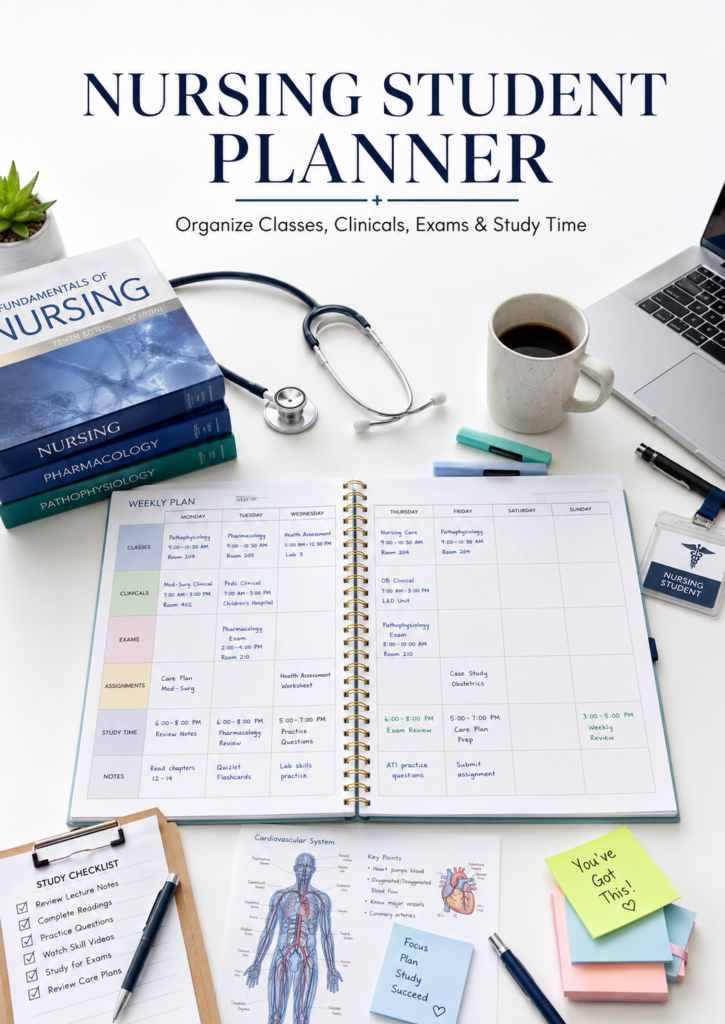
What Is a Nursing Student Planner?
A nursing student planner is a planning system built specifically for nursing students to organize classes, clinical schedules, exams, assignments, and study time in one place. Unlike a general student planner, it’s designed around the way nursing programs actually run.
Most nursing programs don’t follow the same schedule every week. Clinical days rotate, hospital sites change between rotations, and skills checkoffs happen alongside regular coursework. A nursing student planner accounts for this by including dedicated sections for classes, clinicals, exams, assignments, study sessions, skills practice, reading, care plan work, and important deadlines, rather than treating every week as identical.
Why Nursing Students Need a Dedicated Planner
Nursing programs pack more moving parts into a semester than most other majors. A dedicated planner exists to manage that load in a way a generic calendar wasn’t built to handle.
Managing Multiple Deadlines
Care plans, quizzes, papers, and lab reports from different courses often land in the same week. A planner that lists every deadline in one place makes it easy to spot overlaps early, instead of discovering three things due on the same day.
Planning Study Time Around Clinicals
Clinical days already take up eight to twelve hours, and the schedule can shift from one rotation to the next. A nursing planner helps you block realistic study windows around your actual clinical schedule, rather than assuming every day looks the same.
Keeping Track of Exams and Assignments
Each course usually runs on its own exam schedule. Without one system pulling those dates together, it’s easy to lose track of which test is coming up next, especially during a busy month.
Building Consistent Study Habits
Planning study sessions in advance, rather than deciding each day as you go, makes it easier to build a repeatable weekly rhythm. Over time, that rhythm becomes easier to stick to than a schedule you’re rebuilding from scratch every morning.
Reducing Last-Minute Studying
Seeing an exam three weeks out, instead of three days out, gives you room to spread the material over several shorter sessions. That’s harder to do when deadlines only show up on a syllabus you rarely open.
What Should Be Included in a Nursing Student Planner?
A good nursing student planner does more than list dates. Each section below serves a specific purpose in how you plan and study.
Semester Overview
A one-page view of the whole term: start and end dates, breaks, and major exam blocks or rotation changes. Use it at the start of the semester to map out the big picture before filling in the weekly details.
Monthly Calendar
A month-at-a-glance page for spotting when several deadlines cluster together, so you know which weeks to start preparing for early.
Weekly Nursing Study Planner
Breaks the week into class time, clinical time, and open study blocks. Fill it in every Sunday to plan the week ahead based on what’s actually on your plate.
Daily Study Planner
A single-day page for prioritizing the few things that must get done, useful on heavy clinical or exam days when a full weekly view is more detail than you need.
Assignment Tracker
One running log of every assignment across all your courses, with due dates and a status column, such as not started, in progress, or submitted. This keeps assignments from getting lost between different course syllabi.
Exam and Quiz Tracker
A dedicated page listing every exam and quiz date along with the topics each one covers, so you can plan study sessions backward from test day.
Clinical Schedule
A separate calendar just for clinical shifts, including site, unit, and shift times. Clinical schedules often arrive separately from your academic calendar, so keeping them in their own section avoids confusion.
Clinical Preparation Checklist
A checklist for what to review or bring before each shift, such as patient prep, skills to practice, or required forms. Many students fill this out the night before clinical.
Nursing Skills Practice Tracker
A log of the skills you need to practice and get checked off before a competency exam, so you can see at a glance which ones still need more repetition.
Reading Tracker
A simple log of assigned chapters and whether you’ve completed them, which matters given how much reading nursing courses typically assign.
Study Hours Tracker
A record of how many hours you actually study per subject. Comparing this against how difficult each course is can reveal whether your time is going where it’s needed most.
Nursing Care Plan Tracker
A page for tracking care plan assignments, due dates, and diagnosis focus. Care plans often run on a separate timeline from regular homework, so it helps to track them on their own.
Weekly Reflection Page
A short page for reviewing what worked and what didn’t at the end of each week. This is what makes the following week’s plan an adjustment instead of a guess.
Goal-Setting Pages
Space for short-term weekly goals and longer-term semester goals, which helps keep the bigger picture in view during especially heavy weeks.
Get Nursing Student Planner + Study Workbook
How to Use a Nursing Student Planner
Having the right pages only helps if you use them consistently. Here’s a practical way to put one to work.
- Enter all major semester dates first, including term start and end dates, breaks, and exam weeks, straight from your syllabi.
- Add your class and clinical schedule, including rotating clinical days if your program uses them.
- Record every assignment deadline from each course syllabus in your assignment tracker as soon as you receive it.
- List every exam and quiz date so you can see all of them in one place, not scattered across separate course pages.
- Break large assignments, like care plans and papers, into smaller tasks with their own target dates.
- Block out study sessions around your fixed commitments, and treat those blocks like appointments you can’t skip.
- Review the planner every week, ideally on a Sunday, and update anything that’s changed.
- Adjust the following week’s plan using your reflection page, carrying over anything you didn’t finish.
How to Create a Nursing School Study Schedule
A realistic study schedule starts with your fixed commitments, classes, and clinicals, and builds study time around them rather than the other way around. From there, assign a study focus to each open block based on what’s coming up, and list the specific task you’ll work on.
The table below is only an example. Your actual schedule should reflect your real class times, clinical rotation, and course load.
| Day |
Classes/Clinical |
Study Focus |
Tasks |
| Monday |
Pharmacology lecture, 9–11 am |
Cardiac medications |
Read the assigned chapter, review flashcards |
| Tuesday |
Clinical, 7am–3pm |
Pre-clinical prep |
Chart review, prep checklist |
| Wednesday |
Med-Surg lecture |
Renal system |
Practice questions |
| Thursday |
Clinical, 7am–3pm |
Post-clinical review |
Documentation, skills log update |
| Friday |
Open |
Weakest topic this week |
Quiz prep, targeted review |
| Saturday |
Open |
Care plan work |
Draft assigned section |
| Sunday |
Open |
Weekly planning |
Update planner, review week ahead |
Nursing Study Planner vs. Regular Student Planner
A general student planner is built around a fixed weekly schedule: the same classes at the same times each week, with space for assignments and exams. A nursing-specific planner includes sections that a general planner doesn’t cover, such as clinical scheduling, skills tracking, and care plan deadlines.
| Feature |
General Planner |
Nursing Student Planner |
| General academic planning |
Yes |
Yes |
| Clinical scheduling |
No |
Yes |
| Nursing skills tracking |
No |
Yes |
| Exam planning |
Basic |
Detailed, by topic |
| Assignment tracking |
Yes |
Yes, across course types |
| Study time tracking |
Rarely |
Yes |
| Nursing-specific organization |
No |
Yes |
A general planner may be enough during early prerequisite semesters, before clinicals start, and the course load is lighter. Once clinical rotations begin, a nursing-specific planner tends to be more useful simply because it has a place for clinical shifts, prep checklists, and skills tracking that a generic layout doesn’t.
Printable Nursing Student Planner vs. Digital Planner
Neither format is better for every student. It depends on how you like to work.
Printable Planner
- Writing by hand can make plans easier to remember
- Gives a full visual overview of the week or month at a glance
- Doesn’t require a device or app
- Works well alongside handwritten class or clinical notes
- Easy to annotate, highlight, or mark up as plans change
Digital Planner
- Entries are searchable, so finding a past deadline is quick
- Easy to edit when a clinical schedule or deadline changes
- Can sync with calendar apps you already use
- Accessible from a phone, tablet, or laptop
Some students use both: a printable weekly planner for hands-on planning, alongside a digital calendar for reminders and schedule changes. Choose based on how you already prefer to work, not based on which one sounds more productive.
How a Nursing Study Workbook Can Complement Your Planner
A planner and a study workbook solve two different problems. The planner handles when and what: your schedule, deadlines, and study blocks. A study workbook handles the actual work of learning the material once you sit down to study.
Used together, the planner tells you when to study pharmacology on Tuesday afternoon, and the workbook gives you a structured way to actually work through that material once you get there. A nursing study workbook can include study-planning pages, topic review pages, space for notes, practice questions, exam-preparation sections, reflection prompts, progress tracking, and study checklists.
What Nursing Professors Wish Every Student Knew
Tips for Staying Organized in Nursing School
- Plan the week before it starts, not on Monday morning
- Prioritize deadlines by due date, not by which course feels most urgent that day
- Break large assignments into smaller tasks with their own dates
- Schedule study sessions like fixed appointments, not “whenever there’s time”
- Prepare for clinicals a day or two early instead of the night before
- Keep a running list of topics you consistently score lower on
- Avoid stacking too many study blocks into one day; leave room to actually finish them
- Review your planner and progress at the same time each week
- Build in buffer time for the weeks you know will be heavier
- Keep your syllabi, planner, and study materials in one place instead of scattered across apps
Organize Your Nursing School Routine With a Planner Built for It
Everything covered above, the semester overview, clinical schedule, assignment tracker, skills log, and study workbook pages, is easier to keep up with when it’s already built into one system instead of assembled from scratch.
The Nursing Student Planner + Study Workbook is designed around the sections nursing students actually need: classes, clinicals, exams, assignments, study sessions, goals, and progress tracking, in one printable format you can adapt to your own program.
Ready to organize your nursing school routine? See what’s included in the Nursing Student Planner + Study Workbook and start planning your next semester.
Who Can Benefit From a Nursing Student Planner?
- New nursing students are adjusting to a heavier, less predictable schedule
- Experienced nursing students juggling multiple advanced courses at once
- Students entering clinical rotations for the first time
- Students preparing for major exams or competency checkoffs
- Students who struggle with time management or last-minute studying
- Students balancing nursing school with work, family, or other responsibilities
Frequently Asked Questions
What is a nursing student planner?
A nursing student planner is a tool designed to help nursing students organize classes, clinicals, exams, assignments, and study time in one place.
What should a nursing student planner include?
At minimum, it should include a semester overview, class and clinical schedules, an assignment tracker, an exam tracker, and space for study planning.
Is a nursing student planner worth using?
For most nursing students, yes, since it brings together schedules and deadlines that would otherwise be spread across several courses and apps.
How do I organize my nursing school schedule?
Start by entering all fixed commitments, classes, and clinicals, then add assignments and exams, and finally schedule study time around what’s left.
How do I plan study time around clinicals?
Block study sessions on non-clinical days first, then use any remaining time on clinical days for lighter review rather than new material.
Is a printable nursing planner better than a digital planner?
Neither is universally better. Printable planners give a clear visual overview, while digital planners are easier to search and update.
How do I keep track of nursing assignments?
A single assignment tracker that lists every course’s deadlines in one place, rather than checking each syllabus separately, makes this easier.
How can a nursing study workbook help?
A study workbook gives you a structured way to work through material during the study sessions your planner has already scheduled.
How often should I update my nursing planner?
Most students update it weekly, plus any time a clinical schedule or deadline changes.
Conclusion
Nursing school involves more moving pieces than most students are used to managing: classes, clinicals, exams, assignments, and study time, all on different schedules. A nursing student planner brings those pieces into one system, so you can see what’s coming and plan for it instead of reacting to it week to week.
A planner alone handles the scheduling side. Paired with a study workbook, you also get a structured way to work through the material once study time arrives. If you’re ready to bring more structure to your semester, take a look at the Nursing Student Planner + Study Workbook and see whether it fits the way you like to study.
Get Nursing Student Planner + Study Workbook









 Evan John