Imagine a 58-year-old patient walks into your unit with a blood pressure reading of 168/102 mmHg, complaining of a dull headache and blurred vision. Do you know exactly what nursing diagnoses to write, what goals to set, and what interventions to implement right now? If you’re looking for a reliable sample nursing care plan for hypertension, you’re in the right place. This guide gives you everything: NANDA diagnoses, measurable goals, evidence-based interventions, and clear rationale.
What Is Hypertension? A Quick Clinical Overview
Hypertension, or high blood pressure, is defined as a sustained systolic BP ≥ 130 mmHg or diastolic BP ≥ 80 mmHg according to the 2023 ACC/AHA guidelines. It is one of the most common chronic conditions worldwide, affecting more than 1.28 billion adults.
For nurses, hypertension is not just a number on a monitor, it’s a major modifiable risk factor for heart disease, stroke, kidney failure, and retinopathy. Developing an accurate and thorough nursing care plan is a critical first step in managing this condition safely.
Also read How to Write Nursing Care Plans Step-by-Step
Nursing Assessment for Hypertension
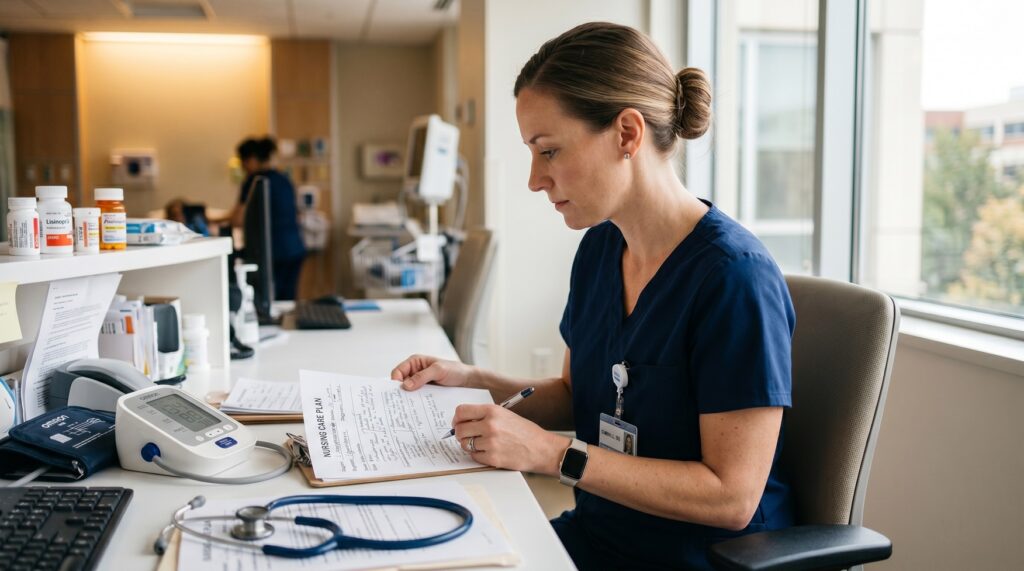
Before you write a single diagnosis, a thorough nursing assessment is essential. This is the foundation of any solid nursing care plan for hypertension.
Subjective Data (What the Patient Reports)
- Complaints of headache, especially in the occipital region
- Reports of dizziness, nausea, or blurred vision
- History of hypertension, diabetes, or cardiovascular disease
- Current medications, including OTC NSAIDs or contraceptives
- Dietary habits: high sodium intake, alcohol use
- Stress levels and sleep patterns
Objective Data (What You Observe and Measure)
- Blood pressure readings (both arms if possible)
- Heart rate, respiratory rate, oxygen saturation
- Signs of end-organ damage: papilledema, S3/S4 heart sounds, peripheral edema
- BMI and waist circumference
- Lab results: BMP, CBC, lipid panel, urinalysis (protein/creatinine ratio)
Free Download on Nursing_Care_Plan_Hypertension
NANDA Nursing Diagnoses for Hypertension
Below are the most clinically relevant NANDA-I approved nursing diagnoses used in a sample nursing care plan for hypertension. Choose the ones that fit your specific patient’s data.
| # |
Nursing Diagnosis |
Related To |
Evidence (AEB) |
| 1 |
Risk for Decreased Cardiac Output |
Increased afterload, vasoconstriction |
BP 168/102, tachycardia HR 98 |
| 2 |
Acute Pain (Headache) |
Increased intracranial pressure from elevated BP |
Patient rates pain 6/10, occipital location |
| 3 |
Deficient Knowledge |
Unfamiliarity with disease process and treatment |
Patient asks “Why do I need medication every day?” |
| 4 |
Risk for Ineffective Health Management |
Complex medication regimen, lifestyle changes |
History of medication non-adherence |
| 5 |
Anxiety |
Threat to health status, perceived loss of control |
Restlessness, expressed worry about stroke risk |
Sample Nursing Care Plan for Hypertension: Full NCP
Here is a fully written sample nursing care plan for hypertension using the first and most critical diagnosis: Risk for Decreased Cardiac Output.
Nursing Diagnosis 1: Risk for Decreased Cardiac Output
Related to: Increased systemic vascular resistance, elevated afterload secondary to hypertension.
Goal / Expected Outcomes:
- Patient will demonstrate BP within target range (≤ 130/80 mmHg) within 24–48 hours.
- Patient will maintain heart rate 60–100 bpm without arrhythmias during hospitalization.
- Patient will report absence of chest pain, palpitations, or dyspnea within 8 hours.
Nursing Interventions and Rationale:
- Monitor BP every 1–4 hours (or per protocol). Rationale: Frequent monitoring detects hypertensive urgency or crisis early, enabling timely intervention.
- Administer antihypertensive medications as ordered (e.g., amlodipine, lisinopril, metoprolol). Rationale: Pharmacologic therapy is first-line management; ACE inhibitors also provide end-organ protection.
- Maintain a calm, low-stimulation environment; limit visitors if BP is severely elevated. Rationale: Psychological stress activates the sympathetic nervous system, raising BP further.
- Educate the patient to avoid the Valsalva maneuver (straining, heavy lifting). Rationale: Straining causes a sudden spike in intracranial and systemic pressure, worsening cardiac workload.
- Assess for signs of hypertensive emergency: severe headache, chest pain, vision changes, confusion, oliguria. Rationale: A BP > 180/120 mmHg with end-organ damage constitutes a hypertensive emergency requiring IV therapy.
- Position patient with head elevated 30–45 degrees. Rationale: Semi-Fowler’s position reduces cardiac preload and cerebral perfusion pressure mildly.
Also read NANDA Nursing Diagnoses List 2026
Nursing Diagnosis 2: Deficient Knowledge Regarding Hypertension Management
Goal: Patient will verbalize understanding of hypertension, medication adherence, and lifestyle modifications before discharge.
Key Nursing Interventions:
- Teach the DASH diet (Dietary Approaches to Stop Hypertension): reduce sodium to < 2,300 mg/day, increase fruits and vegetables.
- Explain how each medication works and the danger of stopping them without medical advice.
- Demonstrate proper home BP monitoring technique; have patient return-demonstrate.
- Discuss the importance of regular physical activity: 150 minutes of moderate exercise per week.
- Counsel on smoking cessation and alcohol limitation (< 2 drinks/day for men, < 1 for women).
Evaluation / Expected Outcomes
After implementing the nursing care plan for hypertension, document your evaluation:
- Was the BP goal achieved? Document actual readings.
- Did the patient correctly verbalize medication names and schedule?
- Did the patient demonstrate correct BP cuff placement and reading?
- Were any complications (hypertensive crisis, renal impairment) prevented?
If goals were not met, revise the plan. Nursing care plans are living documents reassess continuously.
Special Considerations in Your Nursing Care Plan
Hypertension in Pregnancy (Preeclampsia)
When writing a nursing care plan for hypertension in pregnant patients, add diagnoses such as Risk for Impaired Fetal Gas Exchange and Risk for Seizure Activity. Monitor for proteinuria, visual disturbances, and epigastric pain classic signs of preeclampsia.
Hypertension in Older Adults
In elderly patients, isolated systolic hypertension is most common. Be cautious with aggressive BP lowering orthostatic hypotension and falls are major risks. Add Risk for Falls to the care plan.
Secondary Hypertension
Always consider secondary causes renal artery stenosis, Cushing’s syndrome, pheochromocytoma, sleep apnea especially in younger patients or those resistant to multiple antihypertensives.
FREQUENTLY ASKED QUESTIONS
| Q1: What is the most important nursing diagnosis for hypertension?
The priority nursing diagnosis for hypertension is typically Risk for Decreased Cardiac Output related to increased systemic vascular resistance. This takes priority because uncontrolled hypertension directly strains the heart and can lead to myocardial infarction or heart failure if not managed immediately. |
| Q2: What are the nursing goals for a patient with hypertension?
Key nursing goals include: maintaining BP at or below 130/80 mmHg, preventing end-organ damage, ensuring medication adherence, and empowering the patient with knowledge about lifestyle modifications such as the DASH diet, exercise, and smoking cessation. |
| Q3: What NANDA diagnosis is used for hypertension?
Common NANDA-I diagnoses for hypertension include: Risk for Decreased Cardiac Output, Acute Pain, Deficient Knowledge, Risk for Ineffective Health Management, and Anxiety. The appropriate diagnosis depends on the individual patient’s assessment data. |
| Q4: What nursing interventions help lower blood pressure?
Nursing interventions to lower blood pressure include: administering prescribed antihypertensives, encouraging a low-sodium diet, facilitating a calm environment, promoting regular physical activity, teaching stress-reduction techniques, and monitoring BP trends closely. |
| Q5: Can a nursing care plan for hypertension be used for both inpatient and outpatient settings?
Yes. While inpatient care plans focus on acute stabilization and preventing hypertensive crisis, outpatient care plans emphasize long-term management, patient education, medication adherence, and lifestyle modification. The NANDA diagnoses may differ in priority but overlap significantly. |
Conclusion
A well-written sample nursing care plan for hypertension is more than a homework exercise it’s a clinical blueprint that protects patients from preventable complications like stroke, renal failure, and heart disease. By using accurate NANDA diagnoses, setting measurable goals, and implementing evidence-based interventions with clear rationale, you equip yourself to deliver safer, smarter care.
Whether you’re a nursing student preparing for clinicals or an experienced RN updating your documentation skills, this framework gives you a proven starting point. Customize it to each patient because great nursing is never one-size-fits-all.









 Evan John