You’ve finished nursing school. Now comes the NCLEX. If the thought of that exam sends your heart rate above 100 bpm, take a breath. You are not alone, and you are not unprepared. What mfost nursing students lack is not knowledge, it’s a structured NCLEX study plan.
This guide gives you everything: a clear NCLEX schedule for beginners, a plug-and-play daily template, free printable study tables, high-yield mnemonics, the best resources for 2026, and answers to every question you’ve typed into Google at midnight. Read it once, bookmark it, and come back to it every week of your prep. nursing documentation is a legal and professional duty
By the end of this post you will know exactly how to pass the NCLEX fast, without burning out, without wasting money on the wrong resources, and without second-guessing yourself on exam day.
What Is the NCLEX? (Quick Answer)
The NCLEX National Council Licensure Examination, is the standardized test every nursing graduate must pass to earn a license as a Registered Nurse (RN) or Licensed Practical/Vocational Nurse (LPN/VN). Since 2023, the exam runs in the Next Generation NCLEX (NGN) format, which focuses on clinical judgment and decision-making rather than straight memorization.
| NCLEX Fast Facts — What Every Beginner Should Know |
| Format: Computerized Adaptive Testing (CAT) the exam adjusts to your performance in real time |
| Length: 85 to 150 questions under the NGN format (was 75–265 previously) |
| Time: Up to 5 hours including two optional breaks |
| Topics: 8 Client Needs categories including Safe Care, Pharmacology, and Physiological Integrity |
| Results: Available within 48 hours via the NCLEX Quick Results service |
| Pass Rate: Approximately 82–85% for first-time US-educated candidates (NCSBN, 2024) |
Here is the most important thing to understand: the NCLEX does not test whether you memorized every drug in your pharmacology textbook. It tests whether you can think like a safe, entry-level nurse. That distinction changes everything about how you should study.
Why a Structured NCLEX Study Plan Matters
Most students who fail the NCLEX the first time are not academically weak. They failed because they studied without a plan — reading random chapters, doing questions with no strategy, and spending three weeks on content they already know.
A structured NCLEX study plan does three things that random studying cannot:
- Eliminates decision fatigue. You wake up and know exactly what to study. No wasted time.
- Ensures full coverage. Every high-yield NCLEX topic gets touched before exam day.
- Builds exam stamina. Consistent daily practice trains your brain for the real test environment.
| PRO TIP: Studies show that students who complete 2,000+ NCLEX-style practice questions before their exam have significantly higher pass rates. Volume and quality of practice, not just content review , is the deciding factor. |
Also read on How to Write SOAP Notes in Word
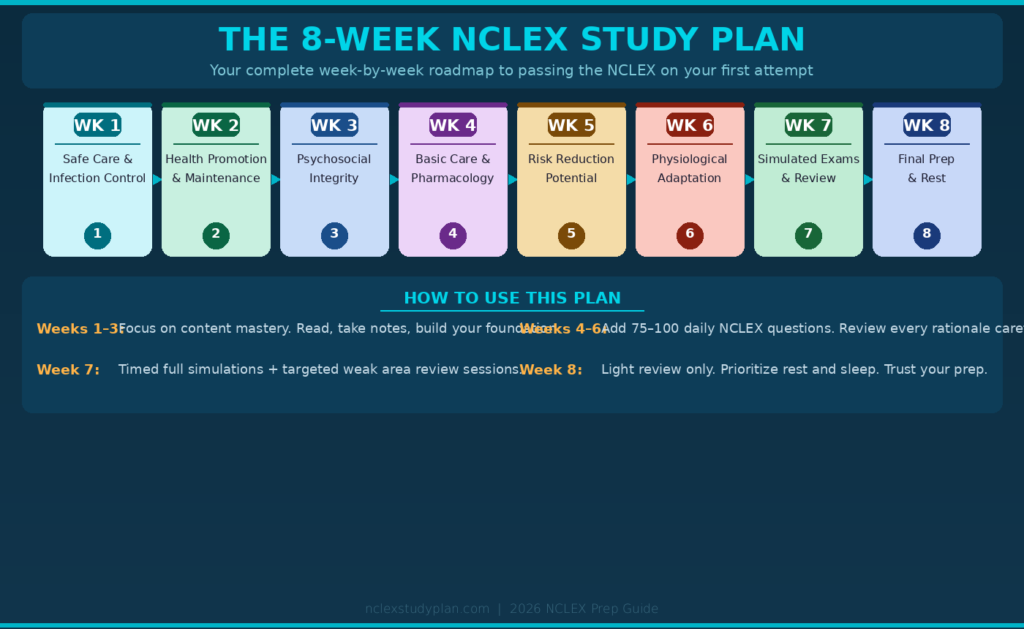
The 8-Week NCLEX Study Plan for Beginners (Free Template)
This NCLEX schedule for beginners is built for students studying 4 to 6 hours per day. If you have more time, compress it to 6 weeks. If your exam is 10 weeks out, add an extra review week after Week 6.
| Week |
Focus Area & Daily Goals |
| Week 1 |
Baseline Diagnostic Exam + Safe & Effective Care Environment (Management of Care, Safety & Infection Control) |
| Week 2 |
Health Promotion & Maintenance, Growth & Development, Immunizations, Prenatal Care, Health Screening |
| Week 3 |
Psychosocial Integrity. Therapeutic Communication, Mental Health Disorders, Crisis & Abuse, Substance Use |
| Week 4 |
Physiological Integrity Part 1 Basic Care & Comfort + Pharmacology Fundamentals (start daily drug drills) |
| Week 5 |
Physiological Integrity Part 2. Reduction of Risk (Lab Values, Diagnostic Tests, Complications, Pre/Post-Op Care) |
| Week 6 |
Physiological Integrity Part 3. Physiological Adaptation (Acute & Chronic Illness, Fluid & Electrolytes, Emergencies) |
| Week 7 |
Full-Length Simulated Exams (timed) + Targeted Weak Area Review + Strategy Drills for NGN item types |
| Week 8 |
Light Content Review + Mnemonic Refresher + Mental Prep. NO heavy cramming. Sleep and rest are non-negotiable. |
| PRO TIP: Print this table and display it at your study space. Crossing off each week creates a powerful psychological momentum boost, and momentum is what keeps you consistent through 8 weeks of prep. |
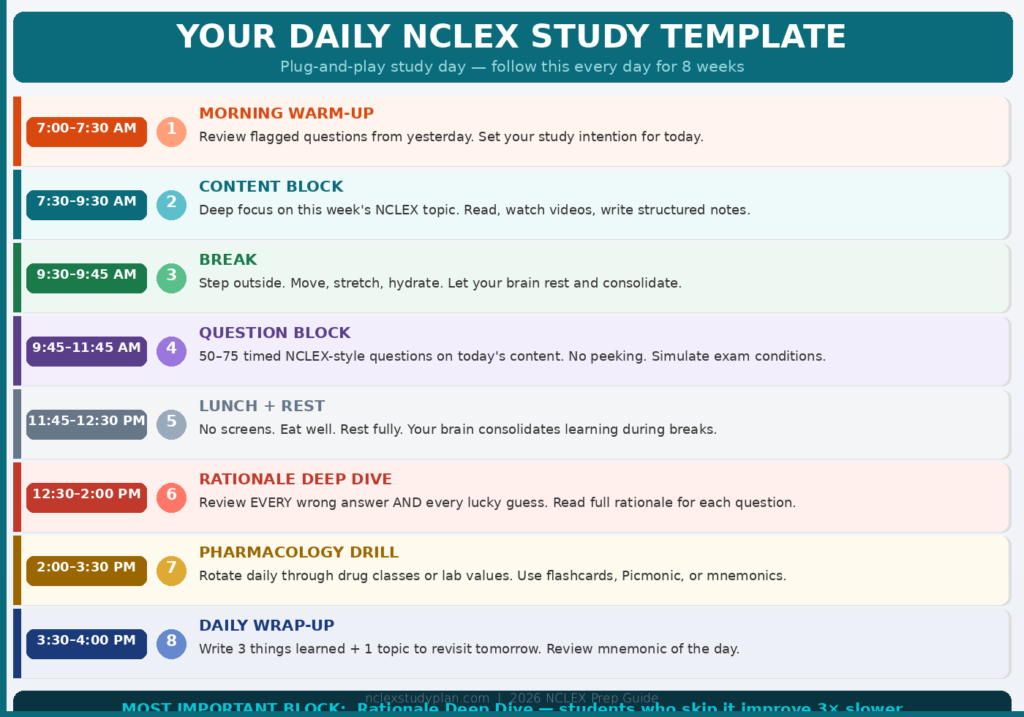
Your Daily NCLEX Study Template, Plug & Play
Use this daily schedule as your baseline. It is designed around research on spaced repetition and active recall, the two most effective study methods for high-stakes exams.
| Time Block |
Activity |
| 7:00 – 7:30 AM |
Morning Warm-Up , Review yesterday’s flagged questions and weak-area flashcards |
| 7:30 – 9:30 AM |
Content Block, Focused study on your week’s topic using your chosen review resource |
| 9:30 – 9:45 AM |
Break, Get outside. Move your body. Hydrate. |
| 9:45 – 11:45 AM |
Question Block, Complete 50–75 timed NCLEX-style questions on today’s topic |
| 11:45 AM – 12:30 PM |
Lunch + Rest, No screens. Let your brain consolidate. |
| 12:30 – 2:00 PM |
Rationale Deep Dive, Review every single question you got wrong AND ones you guessed correctly |
| 2:00 – 3:30 PM |
Pharmacology / Lab Values Drill, Rotate through drug classes or critical lab ranges daily |
| 3:30 – 4:00 PM |
Wrap-Up, Write down 3 things you learned + 1 topic to revisit tomorrow |
The most important block in that schedule is the rationale review. Students who skip it and just check their score improve slowly. Students who read every rationale, especially for questions they got right by chance, accelerate dramatically.
High-Yield NCLEX Mnemonics You Must Know in 2026
Mnemonics compress complex clinical information into something your brain can retrieve instantly under exam pressure. Here are five that cover the highest-yield NCLEX categories.
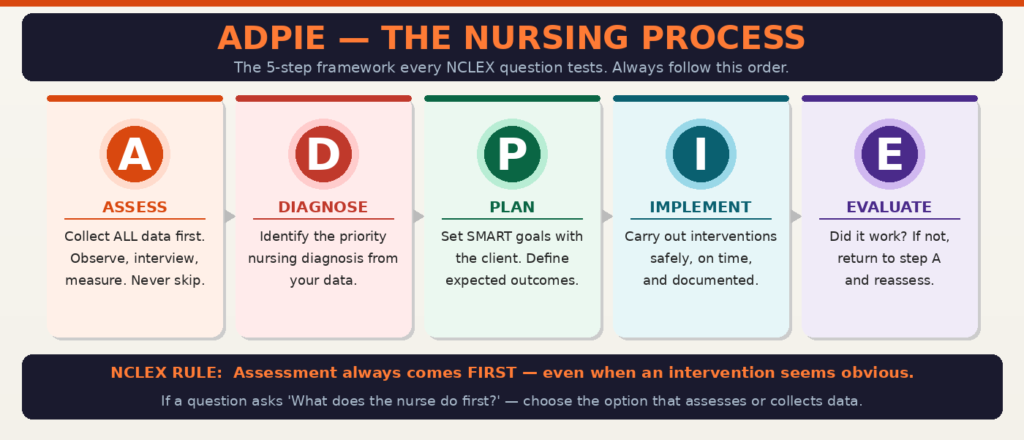
| ADPIE — The Nursing Process, Always Follow This Order |
|
| A — Assess |
Collect data first. Always assess before any intervention. |
| D — Diagnose |
Identify the priority nursing diagnosis based on your assessment. |
| P — Plan |
Set SMART, measurable goals with the client when possible. |
| I — Implement |
Carry out the nursing interventions, safe, timely, and documented. |
| E — Evaluate |
Did the intervention achieve the goal? If not, restart the process. |
| ABCs — Prioritization — What to Address First |
|
| A — Airway |
Always the top priority. If the airway is compromised, act immediately. |
| B — Breathing |
Assess rate, effort, O2 saturation. Intervene before circulation. |
| C — Circulation |
Pulse, blood pressure, perfusion. Address after airway and breathing. |
| MASLOW NEXT |
Once ABCs are stable: Safety needs, then psychological needs, then self-actualization. |
| NCLEX RULE |
Physical needs always beat psychological needs on the NCLEX unless stated otherwise. |
| SATA — Select All That Apply — The Smart Approach |
|
| S — Slow down |
Read every option independently. Each one is true or false on its own. |
| A — Absolute terms |
Words like ‘always’ and ‘never’ are usually wrong, be skeptical. |
| T — Think safety first |
Options that promote safety and reduce risk are almost always correct. |
| A — Apply clinical judgment |
Ask: would a safe nurse do this? If yes, select it. |
| RICE — Pharmacology — What to Teach Every Patient |
|
| R — Renal function |
Monitor BUN and creatinine for nephrotoxic drugs. Adjust doses for renal impairment. |
| I — Interactions |
Check drug-drug and drug-food interactions before administering. |
| C — Compliance |
Educate on finishing full courses (especially antibiotics). Never stop abruptly without MD. |
| E — Education |
Before discharge: teach side effects, timing, storage, and when to call the provider. |
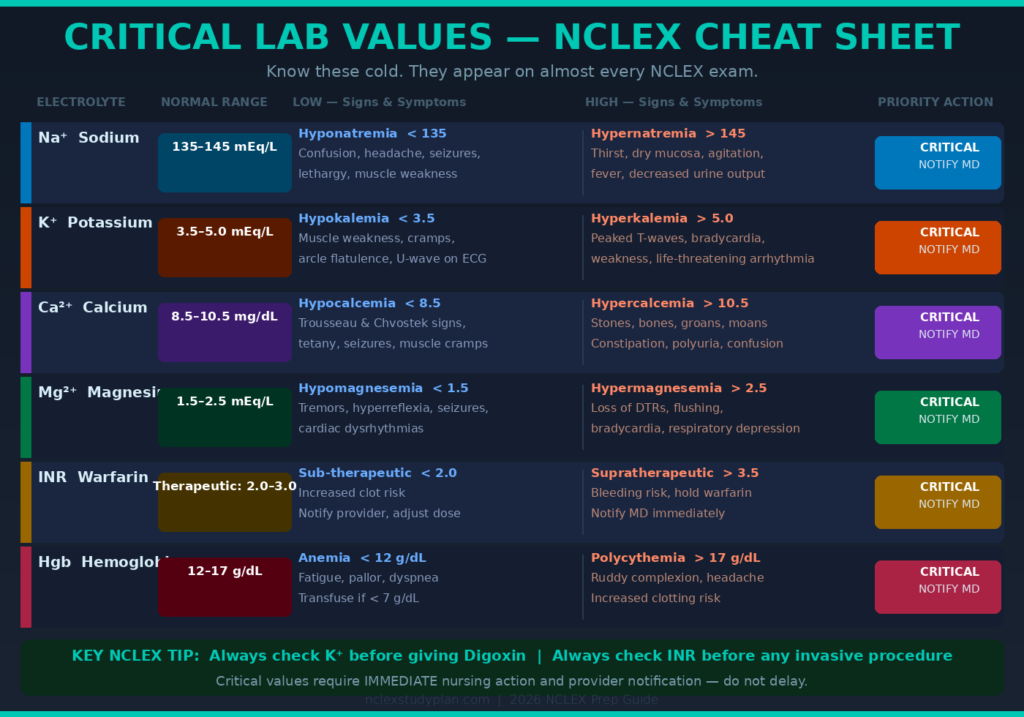
| CRITICAL LABS — Lab Values Every NCLEX Student Must Memorize |
|
| Na+ |
135–145 mEq/L | Low = hyponatremia (confusion) | High = hypernatremia (thirst, fever) |
| K+ |
3.5–5.0 mEq/L | Critical: < 3.0 or > 6.0 | Affects cardiac rhythm, always check before digoxin |
| Ca++ |
8.5–10.5 mg/dL | Low = Trousseau’s/Chvostek’s sign | High = hypercalcemia (stones, bones, moans) |
| INR |
Therapeutic 2.0–3.0 for warfarin | Hold warfarin if > 3.5 and notify provider |
| H&H |
Hgb: 12–17 g/dL | Hct: 37–52% | Low = possible transfusion threshold < 7 g/dL |
Best NCLEX Study Resources for 2026
Not all prep materials are equal. Here is what actually works, ranked by how much impact they have on your score.
| Top NCLEX Resources : 2026 Edition |
| 1. UWorld NCLEX-RN/PN :The gold standard for practice questions. Detailed rationales mirror actual exam logic. |
| 2. NCSBN Learning Extension : Official NGN practice items. Use this to get comfortable with the new item formats. |
| 3. Kaplan NCLEX Prep : Best for learning the Decision Tree prioritization strategy. |
| 4. Mark Klimek Audio Lectures (Free) : High-yield audio content. Exceptional for pharmacology and psych nursing. |
| 5. Picmonic : Visual mnemonics that make pharmacology stick. Great for visual learners. |
| 6. Simple Nursing (YouTube/App) : Free, plain-English explanations of complex concepts. |
| 7. NCLEX Mastery App : Best for mobile study sessions. Use during commutes or study breaks. |
| 8. La Charity Prioritization Book : Essential if you struggle with delegation and prioritization questions. |
Earn ANCC-accredited nursing CEUs online — free courses available
| PRO TIP: You do not need all eight. Start with UWorld as your question bank, one content review source (Kaplan or Mark Klimek), and the NCSBN practice exam for NGN format familiarization. Three resources used deeply beat eight used shallowly every time. |
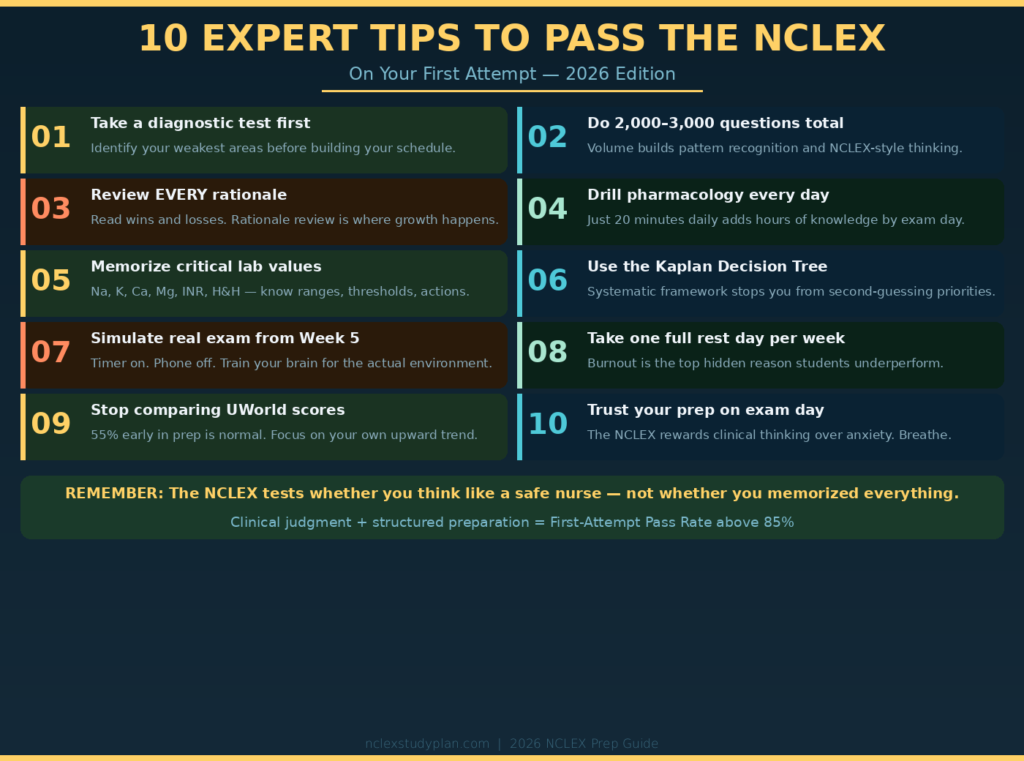
10 Expert Tips to Pass the NCLEX on Your First Try
- Take a diagnostic test first. Identify your weakest content areas before building your schedule so you can weight your time appropriately.
- Aim for 2,000–3,000 practice questions total. Volume builds pattern recognition. You will start to see how the NCLEX thinks.
- Review every rationale — wins and losses. Reading why a right answer is right is just as valuable as understanding why a wrong answer is wrong.
- Drill pharmacology every single day. Even 20 focused minutes daily adds up to hours of drug knowledge by exam day. It is the highest-yield topic.
- Memorize your critical lab values cold. Na, K, Ca, Mg, BUN, Creatinine, PT/INR, H&H — know normal ranges, critical thresholds, and nursing actions.
- Use the Kaplan Decision Tree for prioritization. When two answers both seem correct, the decision tree helps you choose systematically rather than by gut feeling.
Download the free IHI SBAR communication template
- Simulate real exam conditions weekly from Week 5. Set a timer, no phone, no breaks between questions. Train your brain for the actual test environment.
- Take one full rest day each week. Burnout is one of the top reasons students underperform. Rest is productive — it is when your brain consolidates learning.
- Stop comparing your UWorld scores to others. A 55% in UWorld early in prep is normal. Focus on your upward trajectory, not other people’s snapshots.
- Trust your preparation on exam day. The NCLEX rewards clinical thinking over test anxiety. Breathe. Read every question twice. Choose the safest answer.
Frequently Asked Questions About the NCLEX (FAQPage Schema)
Add these questions to RankMath’s FAQ Block in WordPress to trigger the FAQPage schema and earn rich results in Google Search.
Q: How long should I study for the NCLEX?
Most nursing students need 6 to 10 weeks of dedicated full-time prep. If you graduated recently and content is still fresh, 6 weeks may be enough. If it has been 6 or more months since graduation, plan for 8 to 12 weeks. Daily consistency matters far more than total calendar days.
Q: How many NCLEX practice questions should I do per day?
Target 75 to 100 questions per day once you reach Week 3 of your study plan. In Weeks 1 and 2, prioritize content review and build up to full question blocks. By Week 7, attempt 150-question simulated exams to build stamina and timing.
Q: What is the hardest topic on the NCLEX?
Most students find pharmacology and prioritization questions the most challenging. Pharmacology spans every system and accounts for a large portion of the exam. Prioritization questions require clinical judgment rather than recall, which makes them feel unpredictable until you learn the frameworks.
Q: Is UWorld enough to pass the NCLEX?
UWorld is the best single question bank available, but it works best when combined with a content review resource like Kaplan or Mark Klimek and the official NCSBN practice exam for Next Generation NCLEX item format exposure. No single tool covers everything.
Q: Can I pass the NCLEX at 85 questions?
Yes — and many students do. The computerized adaptive format closes at 85 questions if the system is highly confident you are above or below the passing standard. Finishing at 85 questions is not a signal that you passed or failed. Wait for your official result.
Q: What should I do the night before the NCLEX?
Stop studying by early evening. Do a light review of key mnemonics if it calms you, but avoid heavy content review. Prepare your ID and testing documents, eat a nutritious dinner, and aim for 7 to 8 hours of sleep. Your preparation is already done. The night before is about protecting it.
Q: What is the NCLEX pass rate in 2024?
According to NCSBN data, the first-attempt pass rate for US-educated RN candidates is approximately 82 to 85 percent. For US-educated PN candidates, the rate is around 83 percent. International candidates and repeat test takers have lower pass rates, which is why a strong first-attempt study plan is so valuable.
Key Takeaways, Your NCLEX Study Plan at a Glance
| Summary: Everything You Need to Pass the NCLEX in 2026 |
| The NCLEX tests clinical judgment under the NGN format, study to think, not just to recall |
| Use the 8-week schedule: content-first in Weeks 1–3, question-heavy from Week 3 onward |
| Follow the daily template: content block + question block + rationale review = the winning formula |
| Master 5 core mnemonics: ADPIE, ABCs, SATA, RICE, and Critical Lab Values |
| Use UWorld as your primary question bank + one content source + NCSBN for NGN items |
| Target 2,000–3,000 questions total and review every rationale, wins and losses |
| Pharmacology and prioritization are your highest-yield topics, never skip them |
| Rest one full day per week and protect the night before your exam, sleep is not optional |
Final Thoughts
You have already done the hard part. You survived nursing school, endured clinical rotations, and made it to the threshold of your license. The NCLEX is one more step and with the right NCLEX study plan, it is a very manageable one.
Follow the 8-week schedule. Use the daily template. Drill the mnemonics. Review every rationale. And on exam day, trust what you have built over the past weeks. You did not come this far to stop here.
Good luck, future nurse. The profession needs you.









 Evan John