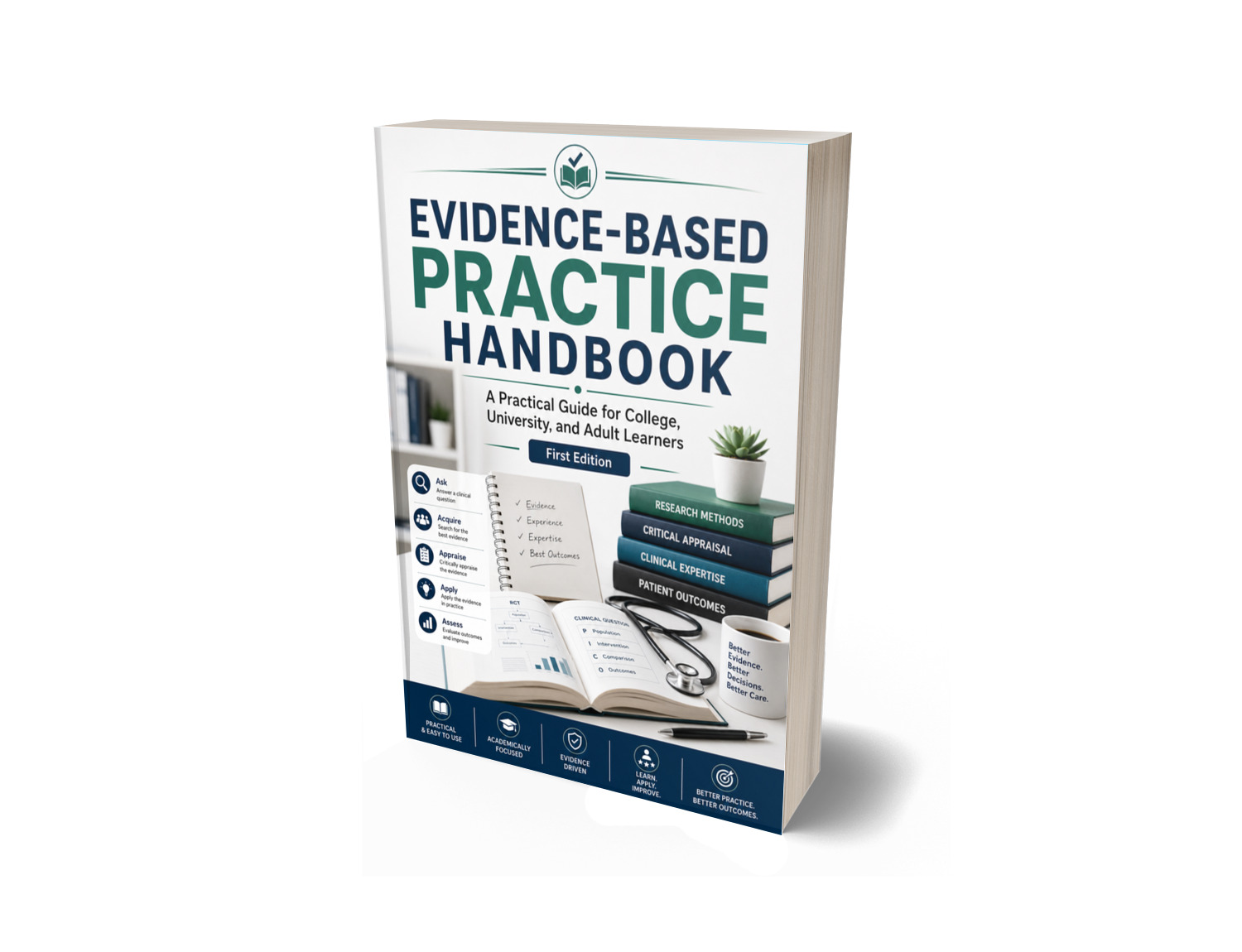
Evidence-Based Practice (EBP) is one of the most important skills every healthcare student and professional must develop.
Whether you’re studying nursing, medicine, physiotherapy, pharmacy, public health, occupational therapy, or another healthcare discipline, your ability to find, evaluate, and apply research evidence directly affects the quality of patient care you provide.
Unfortunately, many students find Evidence-Based Practice confusing.
Terms like systematic reviews, meta-analysis, critical appraisal, PICO(T), levels of evidence, and research methodology often seem overwhelming, especially when introduced alongside demanding coursework and clinical placements.
The Evidence-Based Practice Handbook was created to change that.
Rather than presenting complicated research concepts filled with technical jargon, this handbook explains Evidence-Based Practice in clear, practical language that students can understand and immediately apply in both academic assignments and clinical settings.
Whether you’re writing an EBP assignment, preparing a nursing care plan, completing a research project, or making clinical decisions during placement, this guide gives you a practical roadmap from asking the right question to applying the best available evidence with confidence.
Why Evidence-Based Practice Matters More Than Ever
Healthcare is constantly evolving.
New treatments, technologies, medications, and clinical guidelines emerge every year. What was considered best practice a decade ago may no longer be the safest or most effective approach today.
Evidence-Based Practice helps healthcare professionals make informed decisions by combining:
- The best available research evidence
- Clinical expertise
- Patient values and preferences
Instead of relying solely on tradition or personal opinion, EBP encourages decisions supported by high-quality research while recognising that every patient is unique.
For students, mastering Evidence-Based Practice is no longer optional. Universities, healthcare institutions, and professional regulators expect graduates to demonstrate the ability to locate, evaluate, interpret, and apply research evidence responsibly.
This handbook provides the knowledge and practical tools needed to develop that confidence.
What Makes This Evidence-Based Practice Handbook Different?
Unlike many research textbooks that focus heavily on theory, this handbook is designed around practical learning.
Every chapter follows a structured format that makes complex concepts easier to understand and apply.
Each chapter includes:
- Clear learning objectives
- Simple explanations
- Step-by-step guidance
- Practical examples
- Real-life healthcare scenarios
- Expert tips
- Common mistakes to avoid
- Reflection questions
- Mini exercises
- Chapter summaries
- Key takeaways
Instead of passively reading about Evidence-Based Practice, you’ll actively build the skills required for academic success and evidence-informed clinical practice.
What You’ll Learn Inside the Handbook
Part One: Building Strong Evidence-Based Practice Skills
The first section introduces the core principles of Evidence-Based Practice before gradually developing more advanced research and appraisal skills.
Chapter 1 – What Evidence-Based Practice Really Is
Begin with a clear understanding of what Evidence-Based Practice actually means.
Learn:
- The simple definition of EBP
- Why Evidence-Based Practice matters
- How EBP improves patient care
- Why every healthcare student should understand it
- How evidence supports safe clinical decision-making
Real-life examples demonstrate how evidence influences everyday healthcare decisions.
Chapter 2 – The History of Evidence-Based Practice
Understanding where Evidence-Based Practice came from helps students appreciate why it has become the international standard for healthcare.
Explore:
- Early foundations of scientific healthcare
- The development of modern EBP
- The evidence revolution of the 1990s
- Why modern healthcare extends beyond research alone
This chapter explains how Evidence-Based Practice continues to evolve alongside medicine and healthcare.
Chapter 3 – The Five-Step Evidence-Based Practice Process
This chapter introduces the practical framework used worldwide.
You’ll master the five essential steps:
- Ask focused clinical questions.
- Acquire the best available evidence.
- Critically appraise research quality.
- Apply evidence appropriately.
- Assess outcomes and improve future practice.
These five steps become the foundation for every evidence-based decision throughout your career.
Chapter 4 – Writing Better Clinical Questions Using PICO(T)
Many students struggle before they even begin searching because their research question is too broad.
This chapter teaches you how to transform vague ideas into focused clinical questions using the internationally recognised PICO(T) framework.
You’ll learn how to:
- Build strong research questions
- Improve literature searches
- Match question types with study designs
- Save time during research
Practical examples make the PICO(T) process easy to understand.
Chapter 5 – Searching Research Literature Like a Professional
Finding quality research is a skill.
Instead of relying on random internet searches, you’ll learn how professionals search academic literature.
Topics include:
- Choosing the right databases
- Developing effective search strategies
- Using keywords and Boolean operators
- Applying search filters
- Finding relevant evidence quickly
This chapter helps students search smarter rather than harder.
Chapter 6 – Understanding Levels of Evidence
Not every research study provides the same level of confidence.
Learn how the hierarchy of evidence works and why study design matters.
Understand:
- Evidence pyramids
- Randomised controlled trials
- Cohort studies
- Case-control studies
- Qualitative research
- Expert opinion
- Clinical guidelines
You’ll develop the ability to judge the strength of evidence before using it in assignments or practice.
Chapters 7 & 8 – Critically Appraising Research
Reading research is very different from evaluating research.
Separate chapters explain how to critically appraise both:
- Quantitative studies
- Qualitative studies
You’ll learn practical appraisal frameworks that help determine whether research findings are trustworthy, meaningful, and applicable.
Chapter 9 – Systematic Reviews and Meta-Analyses Explained Simply
These research designs often confuse students.
This chapter explains:
- What systematic reviews are
- How meta-analyses combine evidence
- Their strengths
- Their limitations
- When to trust review findings
Complex statistical concepts are explained in clear, student-friendly language.
Chapter 10 – Applying Evidence to Clinical Practice
Research findings are only valuable when applied appropriately.
Learn how to:
- Balance evidence with clinical expertise
- Respect patient preferences
- Adapt recommendations to individual situations
- Make thoughtful healthcare decisions
Real clinical scenarios demonstrate how evidence informs—not replaces—professional judgement.
Chapter 11 – Overcoming Barriers to Evidence-Based Practice
Even when good evidence exists, applying it isn’t always easy.
Explore common challenges including:
- Lack of time
- Limited confidence
- Resource constraints
- Organisational culture
- Resistance to change
You’ll also learn practical strategies for overcoming each barrier.
Chapter 12 – Evaluating Outcomes
Evidence-Based Practice doesn’t end after implementation.
Learn how to:
- Measure outcomes
- Monitor improvements
- Evaluate success
- Sustain positive clinical change
Understanding evaluation helps ensure that evidence continues to improve patient care over time.
Chapter 13 – Academic Writing with Evidence
Strong evidence deserves strong academic writing.
This chapter teaches students how to:
- Integrate research effectively
- Paraphrase confidently
- Use citations correctly
- Structure evidence-based assignments
- Maintain academic integrity
These skills are valuable for essays, literature reviews, dissertations, research proposals, and Evidence-Based Practice assignments.
Chapter 14 – Building Your Lifelong Evidence Toolkit
Evidence-Based Practice is a career-long skill.
The final chapter helps students develop sustainable habits for continuous learning by introducing:
- Reliable evidence sources
- Research monitoring
- Personal evidence systems
- Ongoing professional development
These strategies help healthcare professionals remain current long after graduation.
Part Two: Your Practical Evidence-Based Practice Toolkit
Learning is easier when you have practical tools.
This handbook includes a complete toolkit designed to help students immediately apply what they’ve learned.
Practical Worksheets
Reinforce your learning with downloadable worksheets including:
- PICO(T) Question Builder
- Literature Search Strategy Log
- Quantitative Research Appraisal Worksheet
- Qualitative Research Appraisal Worksheet
- Evidence Application Planner
Each worksheet encourages active learning rather than passive reading.
Professional Templates
Save time with ready-to-use templates such as:
- Evidence-Based Paper Outline
- Weekly Evidence Reading Log
- One-Page EBP Project Proposal
These templates simplify assignment planning and project organisation.
Printable Checklists
Never miss an important step again.
Use comprehensive checklists before:
- Beginning literature searches
- Evaluating research sources
- Applying evidence
- Submitting assignments
These printable resources improve consistency and confidence.
Quick Reference Guides
Need a fast refresher?
The handbook includes concise reference pages covering:
- The Five Steps of EBP
- PICO(T) Framework
- Hierarchy of Evidence
Perfect for revision before assignments, exams, or clinical placements.
Real Clinical Case Studies
Theory becomes easier when applied to practice.
Work through realistic scenarios including:
- Outdated clinical protocols
- Misinterpreted research findings
- Appropriate evidence application
These case studies demonstrate how healthcare professionals use evidence to solve everyday clinical problems.
Frequently Asked Questions
Students often ask questions such as:
- Do I need statistics to understand Evidence-Based Practice?
- Can expert opinion count as evidence?
- How recent should research be?
- What’s the difference between a literature review and a systematic review?
- Can qualitative research provide strong evidence?
The handbook answers these common questions using practical, easy-to-understand explanations.
Bonus Learning Resources
The handbook also includes:
- Common mistakes recap
- Recommended books
- Trusted healthcare websites
- Study apps
- AI tools for responsible academic support
- Productivity tools
- Top 50 Expert Tips
- 30-Day EBP Jumpstart Action Plan
- Weekly goals
- Daily habits
- Progress checklist
- Success tracker
These additional resources help transform knowledge into lasting professional habits.
Who Is This Handbook For?
The Evidence-Based Practice Handbook is ideal for:
- Nursing students
- Medical students
- Midwifery students
- Pharmacy students
- Physiotherapy students
- Occupational therapy students
- Public health students
- Allied health professionals
- Graduate healthcare students
- Healthcare educators
- Anyone learning Evidence-Based Practice for the first time
Whether you’re completing your first EBP assignment or preparing for professional practice, this handbook supports every stage of your learning journey.
Why You’ll Love This Handbook
✔ Explains complex research concepts in simple language
✔ Covers the complete Evidence-Based Practice process
✔ Includes practical examples and real-life clinical scenarios
✔ Helps students critically evaluate research with confidence
✔ Features worksheets, templates, checklists, and case studies
✔ Supports assignments, dissertations, and clinical placements
✔ Develops lifelong research and critical thinking skills
✔ Ideal for independent study or classroom learning
Start Building Your Evidence-Based Practice Skills Today
Healthcare professionals make better decisions when those decisions are informed by high-quality evidence.
The Evidence-Based Practice Handbook provides the practical guidance, structured learning, and professional tools needed to understand research, evaluate evidence critically, and apply it confidently in both academic and clinical settings.
Whether you’re preparing for exams, writing assignments, completing clinical placements, or planning your future healthcare career, this handbook will help you become a more confident, capable, and evidence-informed practitioner.
Learn to ask better questions. Find stronger evidence. Make smarter clinical decisions. Build a career grounded in evidence-based practice.









 Evan John