Theory of Knowledge | IB Diploma Programme
A Complete Guide for IB Students
The May 2026 TOK essay titles challenges students to think deeply about the nature, production, and limits of knowledge across multiple areas of knowledge (AOKs). Each title requires genuine critical engagement, well-reasoned arguments, and concrete examples drawn from at least two AOKs. Below is a concise analysis of all six titles to help you choose the best fit and plan your argument confidently.
May 2026 TOK Essay Titles
|
Essay Title |
| 1 |
In the production of knowledge, does it matter that observation is an essential but flawed tool? Discuss with reference to the natural sciences and one other area of knowledge. |
| 2 |
To what extent do you agree that doubt is central to the pursuit of knowledge? Answer with reference to two areas of knowledge. |
| 3 |
Is the power of knowledge determined by the way in which the knowledge is conveyed? Discuss with reference to mathematics and one other area of knowledge. |
| 4 |
In the acquisition of knowledge, can we only understand something to the extent that we understand its context? Discuss with reference to two areas of knowledge. |
| 5 |
To what extent do you agree with the claim that “all things are numbers” (Pythagoras)? Answer with reference to the arts and the human sciences. |
| 6 |
To what extent is interpretation a reliable tool in the production of knowledge? Answer with reference to history and one other area of knowledge. |
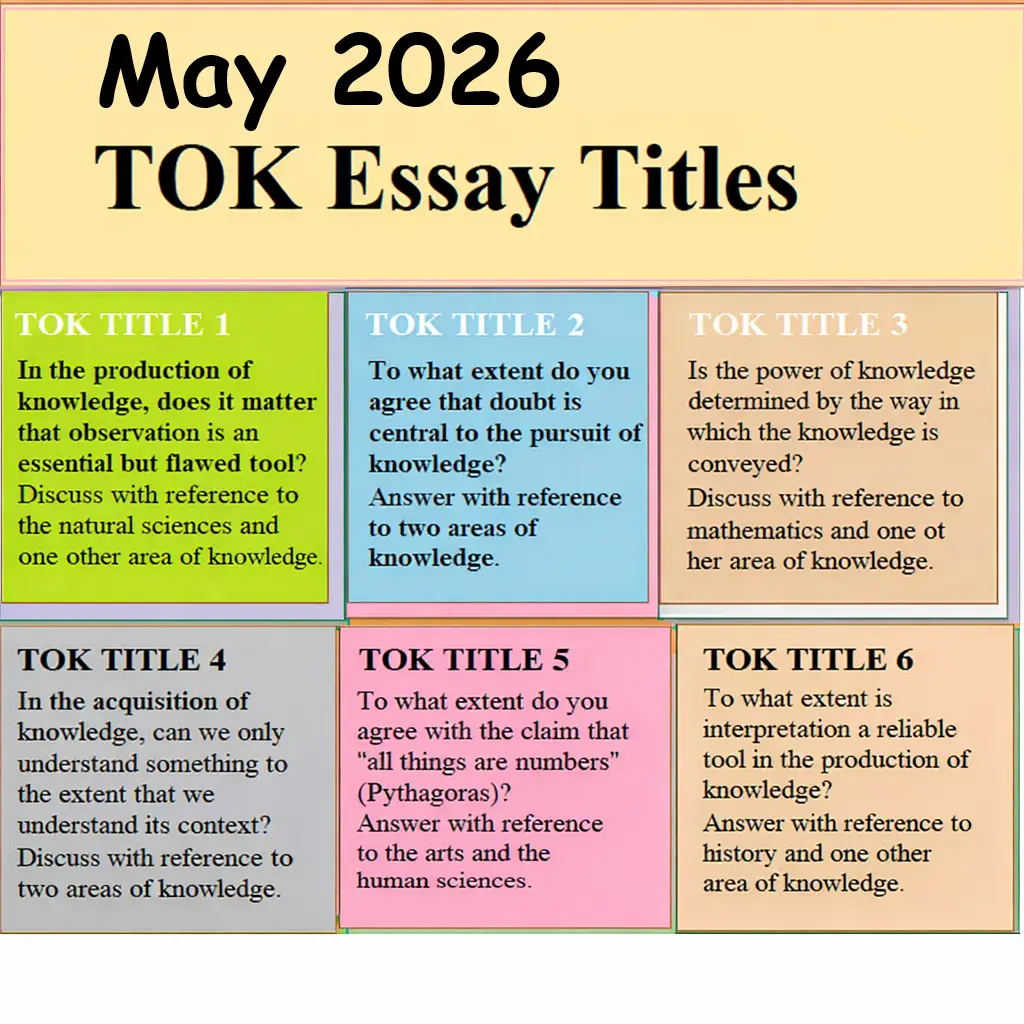
TOK Essay Titles for May 2026: Descriptions
Title 1: Observation as an Essential but Flawed Tool
| In the production of knowledge, does it matter that observation is an essential but flawed tool? Discuss with reference to the natural sciences and one other area of knowledge. |
This title asks students to grapple with a fundamental paradox: observation underpins much of how we generate knowledge, yet it is inherently imperfect. In the natural sciences, empirical observation is the bedrock of the scientific method experiments, measurements, and data collection all rely on our capacity to observe the world. Yet observations are shaped by instrumentation error, cognitive bias, and the limits of human perception.
Students might explore how paradigm shifts (such as the move from geocentrism to heliocentrism) were resisted because earlier observers interpreted data through a flawed lens. In the history of science, Galileo’s use of the telescope was revolutionary, yet even that tool introduced distortions.
A productive second AOK is history, where historians ‘observe’ the past only indirectly through artefacts, documents, and testimonies, each mediated by the perspective of their creators. The flawed nature of these historical sources does not render historical knowledge impossible, but it does shape its character. Alternatively, students could explore the human sciences, where observational methods such as surveys, ethnography, and behavioural studies are equally subject to observer bias.
The key TOK question is whether the flawed nature of observation undermines knowledge or, paradoxically, drives us toward better methodologies as we work to correct those flaws.
Title 2: Doubt as Central to the Pursuit of Knowledge
| To what extent do you agree that doubt is central to the pursuit of knowledge? Answer with reference to two areas of knowledge. |
René Descartes famously used radical doubt as the starting point for rebuilding knowledge from the ground up. This title invites students to evaluate whether doubt is not merely useful but essential to how knowledge progresses.
In the natural sciences, doubt is institutionalised through peer review, replication, and falsifiability. Karl Popper argued that a scientific claim only has meaning if it can, in principle, be doubted and disproven. Without doubt, science risks stagnation and dogma. The history of science is littered with examples from the long-held belief in a static universe to the dismissal of tectonic plate theory where insufficient doubt allowed false certainties to persist.
In mathematics, doubt plays a different but equally important role. Mathematical truths are established through proof, yet doubt about whether a proof is watertight has produced breakthroughs. Gödel’s incompleteness theorems famously showed that within any sufficiently complex formal system, there are true statements that cannot be proven a discovery born directly from doubting the completeness of mathematics itself.
Students might also consider ethics or history, where received wisdom is frequently challenged by new evidence or shifting moral frameworks. The essay should also address the limits of doubt: excessive scepticism can lead to paralysis, and some foundational assumptions must be accepted to make progress at all.
Title 3: The Power of Knowledge and How It Is Conveyed
| Is the power of knowledge determined by the way in which the knowledge is conveyed? Discuss with reference to mathematics and one other area of knowledge. |
This is a rich title that explores the relationship between content and form does the medium shape the message so profoundly that it changes the power of knowledge itself? In mathematics, knowledge is conveyed through formal notation, proofs, diagrams, and increasingly through computational models. A mathematical truth, such as the Pythagorean theorem, can be conveyed through a formal proof, a geometric diagram, or a practical building application and each conveyance gives that knowledge a different kind of power and accessibility.
Students might examine how mathematical notation itself was a revolutionary conveyance tool: the development of algebraic symbols in the 16th and 17th centuries transformed mathematicians’ ability to generalise and share knowledge across language barriers. By contrast, before formal notation, mathematical ideas were conveyed through verbose prose, which limited both their power and reach.
A strong second AOK is the arts, where the mode of conveyance sculpture, painting, music, literature is inseparable from the knowledge conveyed. A photograph of a war communicates something that a statistical report of casualties cannot, and vice versa. Or students might choose the natural sciences, exploring how data visualisation, scientific writing conventions, and public science communication affect which discoveries become influential.
The essay should consider whether some knowledge loses essential power when translated from its ‘native’ mode of conveyance, and whether knowledge that cannot be effectively conveyed is truly powerful at all.
Title 4: Understanding and Context in Knowledge Acquisition
| In the acquisition of knowledge, can we only understand something to the extent that we understand its context? Discuss with reference to two areas of knowledge. |
This title raises a deep epistemological question about the relationship between understanding and contextual embeddedness. To what extent is knowledge inherently situated? Can any claim, finding, or piece of information be fully understood in isolation?
In history, context is everything. Interpreting a primary source a political speech, a treaty, a personal diary without knowledge of the historical, cultural, and political context in which it was produced risks fundamental misunderstanding. The same words can carry entirely different meanings across different historical moments. Historians are trained precisely to reconstruct context as a prerequisite for understanding.
In the natural sciences, the role of context is more contested. Scientific laws are often presented as universal Newton’s laws, the laws of thermodynamics suggesting that their truth transcends context. Yet the history of science shows that even these laws must be understood in the context of the paradigm and the instruments of their time. Einstein’s relativity did not simply replace Newtonian mechanics; it contextualised it, showing where and why Newtonian physics works as an approximation.
Students might also draw on ethics (where moral judgements are often context-dependent) or the arts (where understanding a work’s cultural and historical context shapes interpretation). The essay should explore whether there are limits to context-dependence, whether any knowledge transcends its context entirely.
Title 5: “All Things Are Numbers” : Pythagoras
| To what extent do you agree with the claim that “all things are numbers” (Pythagoras)? Answer with reference to the arts and the human sciences. |
This is arguably the most philosophically provocative title of the six. The Pythagorean claim that numerical relationships are the fundamental structure of reality has echoed through centuries of thought from the mathematical order of musical harmony to the algorithms that now curate our social media feeds. Students are asked to test this bold claim against two specific AOKs: the arts and the human sciences.
In the arts, there is genuine tension. On one hand, mathematical structures pervade music (rhythm, tuning systems, the golden ratio in visual composition) and architecture. Contemporary digital art is, at its base layer, purely numerical. On the other hand, artistic knowledge seems to resist full quantification. The emotional resonance of a Beethoven symphony, the ineffable quality of a great painting these seem to exceed any numerical description. Does the Pythagorean claim illuminate or impoverish our understanding of art?
In the human sciences, the trend toward quantification has been dramatic. Economics, psychology, sociology, and political science have all embraced statistical methods, mathematical modelling, and data analytics. Behavioural economics attempts to quantify decision-making; demography models population dynamics with equations. Yet critics argue that reducing human behaviour to numbers strips out precisely what is most important agency, meaning, culture, and lived experience.
Students should avoid a simple yes/no answer. The best essays will trace where numerical description genuinely captures reality and where it systematically distorts or excludes it.
Title 6: Interpretation as a Tool in the Production of Knowledge
| To what extent is interpretation a reliable tool in the production of knowledge? Answer with reference to history and one other area of knowledge. |
Interpretation is pervasive in knowledge production and yet, the word itself suggests subjectivity. This title asks students to weigh the reliability of interpretation as an epistemic tool. In history, interpretation is not a regrettable necessity but a defining feature: historians do not merely report facts but construct arguments about meaning, causation, and significance. The same events the causes of the First World War, the legacy of colonialism can be interpreted in radically different ways, all drawing on the same body of evidence.
Does this mean historical interpretation is unreliable? Not necessarily. Historians have developed methodological standards source criticism, corroboration, attention to bias that constrain interpretation and distinguish better from worse historical accounts. Interpretation operates within disciplinary norms that give it a form of intersubjective reliability, even if not the certainty of mathematical proof.
A productive second AOK is the natural sciences, where interpretation enters at multiple levels: interpreting experimental data, interpreting statistical results, and interpreting what findings mean for broader theory. The Michelson-Morley experiment, which found no evidence for the luminiferous aether, was initially interpreted as a null result only later was it re-interpreted as crucial evidence for special relativity. The reliability of scientific knowledge depends partly on the reliability of its interpretation.
Students might alternatively explore the arts, where interpretation is central to both creation and reception, or the human sciences, where interpreting human behaviour raises questions about objectivity and cultural bias. The essay should address whether reliability in interpretation is a matter of degree rather than kind.
Conclusion
The May 2026 TOK essay titles collectively invite students to examine knowledge from multiple angles: its methods and tools (observation, doubt, interpretation), its relationship to form and context (conveyance, contextual understanding), and its ultimate scope (the Pythagorean claim). Each title rewards nuanced thinking that avoids oversimplification.
Strong TOK essays share several qualities: they define key terms precisely in the introduction, develop genuine arguments rather than merely presenting perspectives, use concrete and well-chosen real-world knowledge examples, and explore genuine complexity by acknowledging counter-arguments. Most importantly, they reflect the student’s own thinking rather than a rehearsed template.
Whichever title you choose, your goal is not to find the ‘right answer’ but to demonstrate that you can think rigorously and honestly about how knowledge is produced, justified, and limited.
© International Baccalaureate Organization 2026. All prescribed titles are copyright of the IBO. Students must use the exact title wording as provided by their school.
Check also: May 2025 TOK Essay Titles









 Evan John