Grants are a critical funding source for non-profit organisations, educational institutions, and individual researchers. However, the grant application process can be complex and time-consuming, requiring careful research, planning, and writing. We will explore the qualities of successful grant proposals, the steps of writing a grant proposal, and the grant proposal writing format. Whether new to Read More
Chat with our experts to get the best quote. Make the payment via online banking, debit/credit cards or through paypal. Recieve an order confirmation number.
Sit back and relax. Your well written, properly referenced research paper will be mailed to your inbox, before deadline. Download the paper. Revise and Submit.
Grants are a critical funding source for non-profit organisations, educational institutions, and individual researchers. However, the grant application process can be complex and time-consuming, requiring careful research, planning, and writing.
We will explore the qualities of successful grant proposals, the steps of writing a grant proposal, and the grant proposal writing format.
Whether new to the grant application process or looking to improve your success rate, this will provide valuable insights and practical advice to help you secure the funding you need to achieve your goals.
What is a grant proposal
A grant proposal is a written document that is submitted to a funding agency, typically a government agency or a private foundation, with the aim of securing funding for a specific project or program. The proposal outlines the goals, objectives, and activities of the project or program and provides a detailed budget for the use of funds.
The purpose of a grant proposal is to convince the funding agency that the project or program is worth supporting and that the applicant organisation can carry out the proposed activities. To achieve this, the proposal must be well-written and persuasive, providing a clear and compelling argument for why the project or program is essential and how it will benefit the target audience or community.
Grant proposal writing can be a complex process, but there are some general steps that can help guide you through the process of writing a successful grant proposal. Let’s discuss the basic steps involved in writing a high-quality and successful grant proposal:
Identify a Funding Opportunity: The first step is identifying an opportunity that aligns with your organisation’s goals and objectives. Research funding agencies and foundations that support projects similar to yours, and review their funding guidelines and requirements.
Develop a Concept: Once you have identified a funding opportunity, you must develop a concept for your proposal. This should include a clear and concise statement of the problem or need your project addresses and the goals, objectives, and outcomes you hope to achieve.
Develop a Project Plan: A detailed project plan outlines the activities, timelines, and resources required to achieve your goals and objectives. Be sure to align your project plan with the funding agency’s requirements and clearly articulate how you plan to measure and evaluate the success of your project.
Develop a Budget: Develop a detailed budget that outlines the costs associated with your project, including personnel, equipment, supplies, travel, and other expenses. Justify all costs and align your budget with the funding agency’s requirements.
Write the Proposal: With your concept, project plan, and budget, it’s time to write the proposal. Start with an executive summary that clearly articulates the problem you are addressing, your proposed solution, and the anticipated outcomes. Then, move on to the body of the proposal, which should provide a detailed description of your project, including your goals, objectives, methods, and evaluation plan. Use clear, concise language and provide specific examples to support your proposal.
Review and Revise: Once you have completed your draft proposal, review and revise it carefully. Ensure that your proposal is well-organised, free from grammatical and other errors, and that you have met the funding agency’s requirements.
Submit the Proposal: Finally, submit your proposal to the funding agency or foundation according to their guidelines and requirements. Be sure to follow up with the agency to ensure that your proposal has been received and that you have provided all necessary information. This can be done by visiting the organisation, sending a follow-up email or calling.
Grant proposal writing format
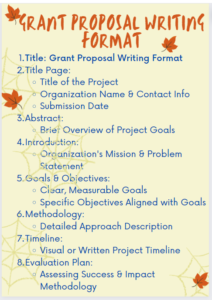
While there is no single format for writing a grant proposal, most proposals follow a similar structure and include the following sections:
Cover Letter: This briefly introduces your organisation and the proposed project. It should be addressed to the funder, who should provide a proposal summary.
Executive Summary: This is a concise overview of the proposal, including the problem or need that the project addresses, the goals and objectives, and the expected outcomes. It should be no more than one or two pages.
Introduction: This section provides background information on the problem or need that the project addresses and explains why it is essential to address this issue.
Project Description: This section outlines the details of the proposed project, including the goals and objectives, methods, and expected outcomes. It should also include a timeline and a detailed budget.
Evaluation: This section describes how the project will be evaluated and measured to determine its effectiveness.
Sustainability: This section outlines how the project will be sustained over time and how it will continue to impact beyond the grant period.
Conclusion: This is a summary of the proposal and a restatement of the organisation’s commitment to addressing the problem or need.
Appendices: This section includes any supporting documents relevant to the proposal, such as letters of support, resumes of key personnel, or financial statements.
Below is another form of a grant proposal format.
Qualities of Successful Grant Proposals
There are several key qualities that successful grant proposals tend to have in common. Let us look at the qualities of a good grant proposal.
Clear and compelling need: Successful grant proposals clearly and convincingly articulate the need for the proposed project or program. The proposal should demonstrate that the project addresses an important issue or problem relevant to the funder’s priorities and mission.
Specific and measurable goals and objectives: A successful grant proposal should have clear, specific, quantifiable goals and objectives that align with the funder’s priorities. The goals and objectives should be achievable within the proposed timeline and budget.
Strong methodology: The proposal should describe a sound and feasible approach to achieving the proposed goals and objectives. The methodology should be well-researched and evidence-based, including specific activities and strategies to achieve the proposed outcomes.
Experienced and capable team: A successful grant proposal should demonstrate that the organisation and key personnel have the experience, skills, and resources necessary to implement the proposed project or program. This includes having a track record of success in similar projects and the required qualifications and expertise.
Realistic budget: The budget should be realistic and well-justified, with clear and detailed cost estimates for all aspects of the project or program. The budget should align with the proposed goals and objectives, consistent with the funder’s guidelines and requirements.
Evaluation plan: A successful grant proposal should include a detailed plan for evaluating the effectiveness of the proposed project or program. The evaluation plan should consist of specific metrics and methods for measuring progress and outcomes, and a strategy for disseminating the results.
Clear and concise writing: A successful grant proposal should be well-written and error-free. The proposal should be clear, concise, and easy to understand, and should follow the funder’s guidelines for format and structure.
Writing a grant proposal letter is an essential first step in securing funding for your project. Here are some general steps to follow when writing a grant proposal letter,
Research the Funding Opportunity: Before you start writing your grant proposal letter, research the opportunity thoroughly to ensure that it aligns with your project and organisation’s goals and objectives. Identify the specific requirements of the funding agency or foundation, including the application deadline, the maximum grant amount, and any particular focus areas.
Introduce Your Organisation: Begin your grant proposal letter by describing your organisation’s mission, history, and accomplishments. Be sure to highlight any relevant experience or expertise your organisation brings to the project.
Describe the Project: In the next section of your letter, provide a detailed description of your project, including the goals, objectives, and anticipated outcomes. Use clear, concise language and provide specific examples to support your proposal.
Explain the Need: In this section, explain why your project is needed and how it will benefit the target audience or community. Be sure to provide evidence and data to support your claims.
Provide a Plan of Action: Describe the activities and strategies you plan to use to achieve your project goals and objectives. Be sure to provide a detailed timeline and identify the resources required for your plan.
Describe the Budget: Provide a detailed budget for your project, including all costs associated with personnel, equipment, supplies, travel, and other expenses. Justify all costs and align your budget with the funding agency’s requirements.
Conclude Your Letter: In the final section of your letter, summarise your proposal’s key points and thank the funding agency or foundation for considering your request. Be sure to provide contact information and offer additional information or answer any questions they may have.
How to Write a Grant Proposal: A Step-by-Step Guide
Writing a grant proposal requires more than just filling out forms. It is about telling a clear, compelling story about your project—why it matters, how it will work, and how it aligns with the funder’s goals. This guide breaks down the process into manageable, detailed steps to help you write a winning proposal.
Step 1: Begin with Strategic Preparation
Before writing begins, take time to understand the full context of the grant opportunity. This step will ensure that your proposal is aligned with the funder’s priorities and requirements.
Review the Request for Proposal (RFP): Examine eligibility criteria, deadlines, formatting instructions, and required components.
Study the funder’s mission and past grants: Funders usually have a preferred focus. Ensure your project clearly fits within their goals.
Clarify your project idea: Define what you want to achieve, who will benefit, and how the results will be measured. Begin outlining your project’s purpose and impact.
Organise supporting documents early: These may include financial statements, letters of support, or IRS nonprofit status documents.
Being thorough in the early stages saves time later and significantly improves the strength of your application.
Step 2: Write a Customised Cover Letter (If Required)
A cover letter introduces your proposal to the funder and should be personalized for each application.
Briefly introduce your organization and its mission.
State the amount of funding requested and the purpose of the grant.
Express gratitude for the opportunity and highlight why your project aligns with the funder’s interests.
This letter should be professional and concise—ideally no longer than one page.
Step 3: Create a Clear and Persuasive Executive Summary
The executive summary serves as the proposal’s overview. Although it appears at the beginning, it is often written last to capture the essence of the entire document.
Summarize the problem you aim to address.
Present your proposed solution and the key activities involved.
Include anticipated outcomes and the total amount of funding requested.
Convey why your organization is well-positioned to deliver this project effectively.
This section should be compelling enough to interest the reader in the full proposal.
Step 4: Define the Problem or Needs Statement
This section explains why the proposed project is necessary. It should demonstrate a deep understanding of the issue and provide context.
Clearly define the problem or need your project addresses.
Support your statements with relevant statistics, research findings, and community input.
Describe who is affected by the problem and the consequences of inaction.
Ensure that the problem aligns with the funder’s mission.
Avoid vague generalizations. A well-argued needs statement helps justify your request and builds urgency around the issue.
Step 5: Establish Project Goals and SMART Objectives
Goals describe your project’s broader purpose, while objectives specify measurable outcomes.
Goals should reflect the overarching mission of the project.
Objectives should be SMART: Specific, Measurable, Achievable, Relevant, and Time-bound.
For example: “To provide coding workshops for 100 high school students within 12 months, resulting in a 75% improvement in programming proficiency.”
Each objective should directly relate to resolving the problem identified in the previous section.
Step 6: Describe the Project Design and Methods
This is the heart of the proposal—where you explain how your project will be implemented.
Detail the activities, timeline, and resources required.
Identify who will be responsible for each task.
Describe how participants will be recruited and supported.
Explain how your organization will manage the project effectively.
Include a timeline or work plan, and ensure the methods are practical, evidence-based, and aligned with your objectives.
Step 7: Present a Sound Evaluation Plan
Funders need to see that their investment will have measurable results.
Outline how you will track progress and evaluate outcomes.
Specify data collection methods, tools, and responsibilities.
Indicate whether the evaluation will be conducted internally or by a third party.
Describe how findings will be reported and used to improve the program.
An effective evaluation plan shows a commitment to accountability and learning.
Step 8: Prepare a Transparent and Justifiable Budget
A clear and realistic budget is critical to gaining funder trust.
Include detailed line items for all expenses: personnel, materials, travel, equipment, indirect costs, etc.
Provide a budget narrative explaining the rationale behind each cost.
Ensure all numbers align with your project timeline and goals.
Avoid inflating or underestimating costs. Funders value honesty and careful planning.
Step 9: Provide Organizational Information
This section builds the funder’s confidence in your organization’s ability to execute the project.
Summarize your organization’s history, mission, and major achievements.
Describe staff qualifications and leadership structure.
Highlight relevant past projects or partnerships.
Include information about governance, financial stability, and community impact.
If your organization is new, emphasize passion, innovation, and any advisors or collaborators involved.
Step 10: Include Attachments and Supporting Materials
Most funders will request or allow supplemental documents to strengthen your proposal. These may include:
Letters of support or commitment
Résumés or bios of project staff
Organizational chart
IRS tax-exempt letter (for nonprofits)
Project timeline or Gantt chart
Financial statements or audit reports
Ensure all attachments are clearly labeled and referenced in the main proposal.
Step 11: Review, Edit, and Submit
Before submission:
Review the proposal for completeness, clarity, and consistency.
Ensure the proposal adheres to the funder’s formatting and submission guidelines.
Edit for grammar, tone, and structure.
Ask a colleague or advisor to review it with fresh eyes.
Submit ahead of the deadline when possible to avoid technical issues.
Small errors can negatively impact your credibility, so this final step is crucial.
Purpose of Providing Our Custom Grant proposal Writing help
Various grant proposal writing services can help you write. At Elite academic brokers, we provide excellent custom grant proposal services for educational and for business purposes. If you are willing to be guided, we offer a free grant proposal writing guide and a free writing sample.
We do not offer grant proposal writing classes, but we can recommend where to get better training. Some schools we can recommend where you can learn from the comfort of your home are the YOUNG AFRICAN LEADERS INITIATIVE, Coursera, etc. What we do is only a guide, or just in case you need help with a custom grant proposal writing. We are there for you. We provide just the best.
There are many resources available online that offer free sample grant proposals. Some of them provide tutoring services. We only write grant proposals for our clients but do not provide tutoring. Here are a few places you can look,
The Foundation Centre – The Foundation Centre provides a searchable database of grant proposals and grantmakers. You can search for sample proposals by keyword, location, or organisation type.
Grants.gov – Grants.gov is a government website providing information about grants from various federal agencies. You can search for grants and view sample proposals for each grant opportunity.
Nonprofit Works – Nonprofit Works offers a variety of resources for nonprofits, including sample grant proposals. You can browse by topic or search for specific keywords to find proposals that match your needs.
The Grantmanship Centre – The Grantmanship Centre offers a variety of resources for grant seekers, including sample proposals. You can download proposals for different types of grants and use them as templates for your proposals.
The National Science Foundation provides examples of successful grant proposals on its website. You can view these examples to understand what a successful proposal looks like and how it is structured.
Grant Proposal Example
Check the brief example of a grant proposal for a hypothetical project: grant proposal example PDF.
Project Title: Empowering Youth through Mentorship and Job Training
Introduction: Our organisation, Youth Empowerment, is committed to helping young people achieve their full potential through mentorship and job training.
We have identified a critical need in our community for programs that support at-risk youth and help them develop the skills and confidence needed to succeed in today’s job market.
We seek funding to launch a new program to provide mentorship and job training to 50 young people ages 16-24 over one year.
Project Description: Our program will consist of three main components:
Mentorship: Each participant will be paired with a mentor who will provide guidance, support, and advice on various topics, including career development, personal finance, and social skills.
Job Training:Participants will receive hands-on training in various job skills, including resume writing, job search strategies, and interview skills. We will also partner with local businesses to provide job shadowing and internship opportunities.
Personal Development: Participants will attend weekly workshops on conflict resolution, time management, and goal setting. Experts will lead these field workshops and provide a supportive and engaging environment for young people to learn and grow.
Anticipated Outcomes: Our program is designed to help young people develop the skills and confidence needed to succeed in today’s job market. We anticipate the following outcomes:
90% of participants will report an increase in confidence and self-esteem.
80% of participants will complete job training and secure employment within six months of program completion.
75% of participants will report a decrease in negative behaviors such as drug use and criminal activity.
Budget: Our program budget is $100,000, which will cover the costs of personnel, equipment, supplies, and travel. We have identified several potential funding sources, including private foundations and corporate sponsors, and will actively pursue additional funding opportunities.
Conclusion: We believe that our program will make a significant impact in the lives of young people in our community, and we are committed to ensuring its success. We are grateful for the opportunity to submit this proposal and look forward to the possibility of partnering with you to make a difference in the lives of young people.
Recap
Custom grant proposal writing is crucial for any organisation seeking funding for impactful projects. A well-written proposal communicating the project’s objectives, methods, outcomes, and sustainability plan can significantly increase the chances of securing the necessary funding.
Working with our experienced grant writers who understand the grant guidelines and criteria can also help your organisation stand out and increase its chances of success.
Grant funding can provide the necessary resources for organisations to create positive change in their communities and beyond. Custom grant proposal writing service is an investment in the future of any organisation and the impact they can make. Try our services and you will never regret. Our writers have written more than 1000 grant proposals.









 Evan John