Nursing school is one of the most demanding academic journeys a student can undertake. Between anatomy lectures, pharmacology modules, and clinical rotations, the sheer volume of information can feel overwhelming. One skill that separates students who thrive from those who merely survive is knowing how to take effective notes in nursing school.
Effective note-taking is not just about writing things down, it is about processing, organizing, and retaining information in a way that prepares you for both exams and real-world patient care. In this comprehensive guide, you will learn the best note-taking strategies, tools, and habits that nursing students can use to study smarter, not harder.
Why Effective Note-Taking Matters in Nursing School
Nursing programs cover an enormous breadth of content. From pathophysiology to nursing interventions, medications to lab values, the curriculum demands that you retain critical information quickly and accurately. Poor note-taking can mean missing key concepts that show up on the NCLEX or, worse, in clinical settings.
Studies in health education consistently show that students who use structured note-taking methods demonstrate better long-term retention, perform better on assessments, and feel more confident during clinical placements. The goal is not to transcribe everything your professor says, it is to capture the most clinically relevant information in a format you can review and recall efficiently.
1. Master the Cornell Note-Taking Method
The Cornell Method is arguably the most popular note-taking system among high-performing nursing students, and for good reason. It organizes your notes into three clearly defined sections that work together to reinforce learning.
How the Cornell Method Works
- Cue Column (left, ~2.5 inches wide): After class, write keywords, questions, or triggers here.
- Note-Taking Column (right, ~6 inches wide): During class, record the main content definitions, processes, nursing interventions.
- Summary Section (bottom, ~2 inches): After the lecture, write a 3–5 sentence summary of the entire page in your own words.
The real power of Cornell notes comes from the review process. Cover the right column and use your cue questions to test yourself. This active recall technique dramatically improves long-term retention.
💡 Pro Tip: After each nursing lecture, spend 10 minutes completing your cue column and summary before moving on. This single habit can double your retention without adding extra study hours.
2. Use Concept Maps to Connect Clinical Information
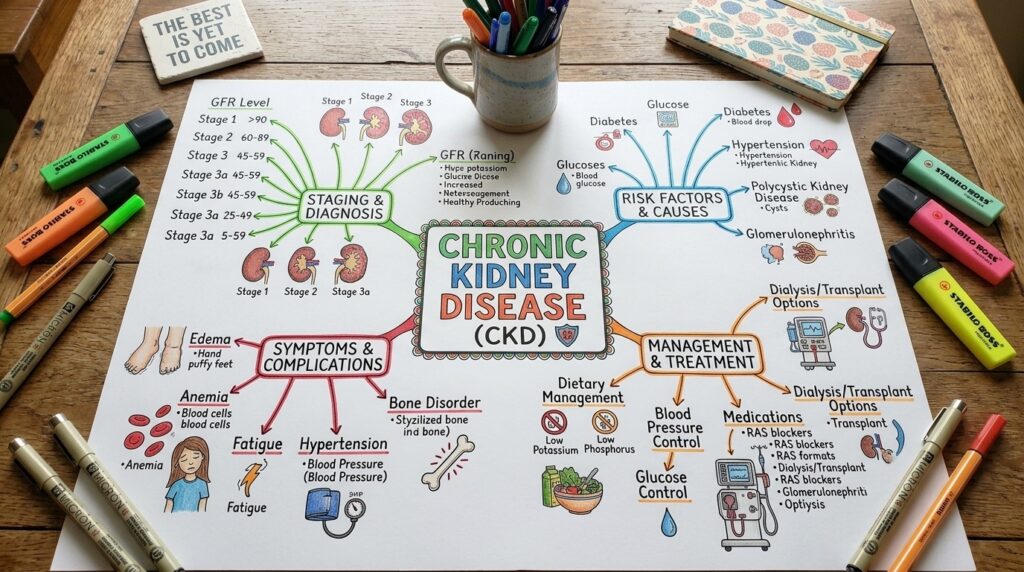
Nursing is not a subject where isolated memorization works well. Patient conditions involve interconnected systems — a patient with heart failure also has fluid and electrolyte imbalances, potential renal complications, and a complex medication regimen. Concept maps help you visualize these relationships.
Building a Nursing Concept Map
- Start with the central diagnosis or topic in the middle of the page (e.g., Type 2 Diabetes).
- Branch out with related categories: pathophysiology, signs and symptoms, nursing assessments, interventions, medications, and patient education.
- Draw arrows to show cause-and-effect relationships and connections between concepts.
- Color-code branches by category for faster visual processing during review.
Concept maps are especially useful when preparing for clinical rotations or care plan assignments. They mirror the clinical reasoning process nurses use at the bedside assessing, diagnosing, planning, and evaluating.
Read more on Common Nursing Diagnoses and Interventions List: A Complete Clinical Reference
3. Apply the SQ3R Reading and Note-Taking Strategy
Most nursing students spend significant time taking notes from textbooks, not just lectures. The SQ3R method — Survey, Question, Read, Recite, Review, transforms passive reading into active learning.
- Survey: Skim the chapter before reading. Review headings, bold terms, diagrams, and end-of-chapter summaries.
- Question: Turn each heading into a question. For example, ‘Fluid and Electrolyte Balance’ becomes ‘What are the signs of fluid imbalance and how does a nurse assess for them?’
- Read: Read actively to answer your questions. Do not highlight everything, only mark information that directly answers a question.
- Recite: Close the book and answer your questions out loud or in writing from memory.
- Review: At the end of the chapter, revisit your questions and self-test once more.
💡 Pro Tip: Write your SQ3R questions in the margin of your notes or in a separate column. These become the foundation of your self-quizzing sessions before exams.
4. Leverage Digital Tools Strategically
Technology offers powerful options for nursing note-taking, but only when used intentionally. The key is to avoid the trap of passive digital note-taking, where students type everything the professor says without processing it.
Best Digital Tools for Nursing Students
- Notion or OneNote: Great for organizing notes by body system, course, or clinical rotation. Tag notes with keywords for fast searching.
- Anki (Spaced Repetition Flashcards): Turn your Cornell cue questions directly into Anki cards. The spaced repetition algorithm shows you cards just before you are about to forget them ideal for pharmacology and lab values.
- Goodnotes or Notability (iPad): Combine the flexibility of handwriting with the searchability of digital tools. These apps are popular in nursing programs that allow tablets in class.
- Quizlet: Useful for building shared flashcard sets with classmates for specific topics like NCLEX priority questions or medication classes.
Research suggests that handwriting notes leads to better conceptual understanding compared to typing, because it forces you to paraphrase and process information rather than transcribe it verbatim. A hybrid approach handwriting key concepts and organizing them digitally after class offers the best of both worlds.
5. Develop a Note-Taking System for Pharmacology
Pharmacology is one of the most information-dense subjects in any nursing program. Without a consistent system, drug facts blend together. Creating a standardized template for every medication note you take keeps information organized and scannable.
The APAT Medication Note Template
- Action: What does the drug do? What receptor or pathway does it affect?
- Purpose (Indications): What conditions is it used to treat?
- Adverse Effects & Nursing Considerations: What should the nurse monitor? What are the contraindications? What patient education is required?
- Teaching Points: What does the patient need to know before discharge?
Use this template consistently for every drug class you study. Over time, recognizing patterns across drug classes (e.g., all beta-blockers share certain adverse effects) becomes second nature a skill that is directly tested on the NCLEX.
💡 Pro Tip: Group medications by class rather than memorizing individual drugs in isolation. If you understand how ACE inhibitors work as a class, individual drug names become much easier to recall.
6. Take Active Notes During Clinical Rotations
Note-taking does not stop in the classroom. Clinical rotations offer a wealth of real-world learning that supplements your academic content. However, clinical note-taking comes with important considerations around patient privacy and HIPAA compliance.
What to Document in Your Clinical Journal
- New procedures or assessments you observed or performed for the first time.
- Clinical reasoning your preceptor or supervising nurse demonstrated (e.g., how they prioritized interventions for a complex patient).
- Medications you administered and the nursing assessments required before and after.
- Questions that arose during the shift that you need to research further.
- Connections between what you observed clinically and what you studied in lecture.
Never include patient-identifying information in your personal notes. Use general descriptors such as ‘patient with CHF exacerbation’ rather than names, room numbers, or dates of birth. Debrief your clinical experiences the same evening while the details are fresh.
7. Review and Revise Notes Regularly
Taking notes is only half the equation review is where learning is consolidated. Many nursing students make the mistake of waiting until the week before an exam to revisit their notes. By then, forgetting has already set in.
A Weekly Note Review Routine
- Same-day review (10–15 minutes): Complete your Cornell summaries and cue column immediately after class.
- 48-hour review (20–30 minutes): Re-read your notes two days after the lecture. Add any missed information from the textbook.
- Weekly review (30–45 minutes): Every weekend, review all notes from that week using active recall — cover the content and quiz yourself using your cue questions.
- Pre-exam review: Use your summary sections and concept maps as your primary review materials rather than re-reading all your notes from scratch.
This spaced review schedule aligns with the science of memory consolidation. Each time you retrieve a memory, you strengthen the neural pathway associated with it, making future recall faster and more reliable.
Also read on Nursing Care Plan Examples for Beginners: A Complete Step-by-Step Guide
8. Collaborate with Study Groups Strategically
Note-taking does not have to be a solitary activity. Study groups can dramatically enhance the quality of your notes when structured effectively. Assign different classmates to focus on different sections of a lecture, then compare and combine notes afterward.
Group review sessions work best when each member teaches a portion of the material to the others. Teaching forces you to articulate concepts clearly, revealing gaps in your understanding. This is known as the Protégé Effect — you learn more effectively when you expect to teach the material.
💡 Pro Tip: Create a shared digital note repository with your study group using Notion or Google Docs. Organize it by unit or body system so that everyone contributes and benefits from a collective knowledge base.
9. Align Your Notes with NCLEX-Style Thinking
Everything you study in nursing school ultimately leads to one major milestone: the NCLEX. The most effective note-takers keep this in mind from day one. As you write your notes, ask yourself: ‘How would this concept appear as an NCLEX question?’
NCLEX-Aligned Note-Taking Tips
- Always note nursing priorities: Which intervention comes first? What is the nurse’s initial action?
- Highlight safety considerations, contraindications, and high-alert medications.
- Note expected versus unexpected findings. NCLEX loves to test whether you know when something requires immediate action.
- Flag delegation and scope of practice content: What can be delegated to a nursing assistant? What must the RN perform?
By embedding NCLEX thinking into your note-taking from the start, you are not just studying for school — you are building the clinical reasoning skills that define a competent, safe, and effective nurse.
Conclusion: Build Your Note-Taking System Today
Learning how to take effective notes in nursing school is one of the highest-return investments you can make in your academic and professional future. Whether you adopt the Cornell Method, build concept maps, use a pharmacology template, or develop a spaced review routine, the key is consistency.
Start with one strategy from this guide. Apply it to your next lecture or textbook reading. Refine it over time, incorporate what works for your learning style, and discard what does not. The students who succeed in nursing school are not necessarily the smartest in the room, they are the most organized, the most disciplined, and the most strategic in how they process information.
Your notes are more than a study tool. They are the foundation of the clinical knowledge base you will carry with you throughout your nursing career. Build them well.









 Evan John