Writing a critical response essay involves more than just sharing your opinion; it requires careful reading, thoughtful analysis, and clear, structured writing. This type of essay challenges students to engage deeply with a text by summarizing the author’s main points, evaluating the effectiveness of their argument, and offering a well-supported personal response. In this article, Read More
Chat with our experts to get the best quote. Make the payment via online banking, debit/credit cards or through paypal. Recieve an order confirmation number.
Sit back and relax. Your well written, properly referenced research paper will be mailed to your inbox, before deadline. Download the paper. Revise and Submit.
Writing a critical response essay involves more than just sharing your opinion; it requires careful reading, thoughtful analysis, and clear, structured writing. This type of essay challenges students to engage deeply with a text by summarizing the author’s main points, evaluating the effectiveness of their argument, and offering a well-supported personal response. In this article, we’ll break down the essential steps to writing a strong critical response essay, from understanding the text to writing a compelling conclusion.
What is a Critical Response Essay
A critical response essay is a type of academic writing that summarizes, analyzes, and evaluates another author’s work while presenting the writer’s own reasoned opinion. It begins with a brief summary of the original text to demonstrate understanding, followed by an analysis of the author’s arguments, evidence, and rhetorical techniques. The writer then offers a personal response, either agreeing or disagreeing with the author’s perspective, supported by logical reasoning and relevant examples. The goal is to critique and engage thoughtfully with the material, highlighting strengths and weaknesses in a structured and persuasive manner.
How to Write a Critical Response
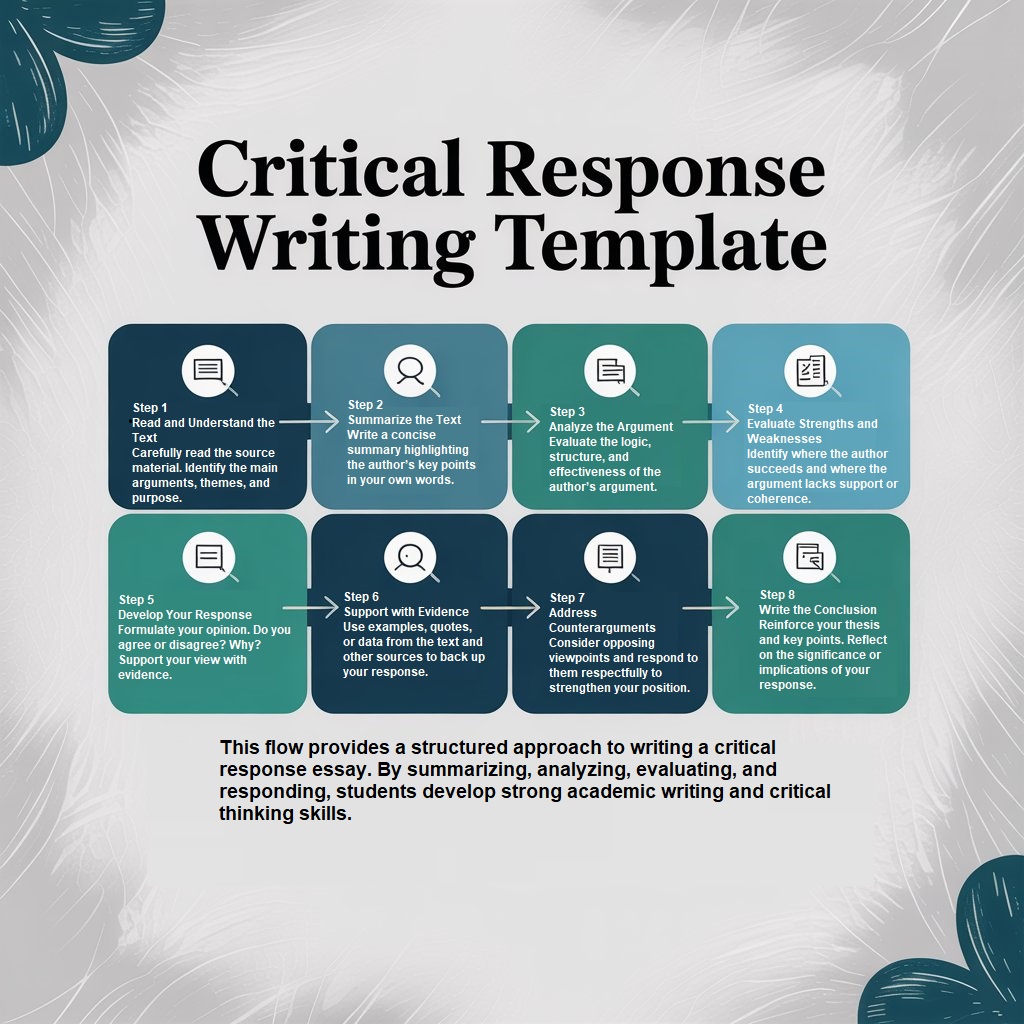
Writing a critical response involves analyzing, evaluating, and responding to a text, idea, or concept. Here are some steps to follow when writing a critical response essay:
Read and analyze the text carefully, noting its main arguments, themes, and evidence. Consider the author’s purpose and intended audience.
Identify the strengths and weaknesses: Evaluate the strengths and weaknesses of the text. Identify any inconsistencies, contradictions, or gaps in the author’s argument.
Develop your response: Formulate your response to the text. This could involve agreeing or disagreeing with the author’s argument or providing a nuanced perspective considering the text’s strengths and weaknesses.
Support your arguments: Use evidence and examples from the text to support your arguments. This could involve quoting specific passages, citing statistics or other sources, or referring to relevant theories or concepts.
Address potential counterarguments: Anticipate potential counterarguments and address them in your essay. This shows that you have considered multiple perspectives and strengthens your overall argument.
Use clear and concise language: Use clear and concise language to convey your arguments and ideas. Avoid jargon or overly complicated language that may confuse the reader.
Edit and revise: Edit and revise your essay for grammar, punctuation, and clarity. Ensure that your arguments are well-supported and your essay flows logically from one point to the next.
Writing a critical response essay involves engaging with a text thoughtfully and analytically and presenting your ideas clearly and persuasively. By following these steps, you can develop a well-structured and effective critical response essay.
Features of a Critical Response Essay
Summary Briefly outlines the central ideas or arguments of the text being analyzed to show understanding of the content.
Analysis Examines how effectively the author presents their points, examining logic, evidence, tone, and rhetorical strategies.
Evaluation Judges the strength of the author’s argument. Are the claims well-supported? Are there biases, gaps, or logical flaws?
Personal Response Offer your perspective. You may agree or disagree with the author, but your viewpoint must be reasoned and supported with examples.
Conclusion Restates your evaluation and overall response, tying together your critique and reflections.
Structure of a Critical Response Essay
Section
Purpose
Introduction
Identify the text, author, and main argument. State your thesis (your overall response or evaluation).
Summary
Briefly explain what the author is saying—main ideas only, in your own words.
Critical Analysis
Assess the strengths and weaknesses of the argument. Use evidence.
Personal Response
Give your reasoned opinion. Connect it to your experiences, other texts, or real-world issues.
Conclusion
Wrap up by reinforcing your main points and stating the significance of your response.
Critical Response Writing Examples
Here are some crucial response essay examples:
Example 1: In a critical response essay on Harper Lee’s novel To Kill a Mockingbird, the writer analyzes the novel’s portrayal of race relations in the Deep South during the 1930s. The writer argues that while the story is a powerful critique of racism and prejudice, it also reflects the limitations of the white liberal perspective that it represents. The writer uses specific examples from the novel to support their argument and engages with counterarguments that may challenge their perspective.
Example 2: The writer evaluates the article’s methodology and findings in a critical response essay on a scholarly article about climate change. The writer argues that while the article provides valuable insights into the potential impacts of climate change, it also has certain limitations and assumptions that should be considered. The writer uses data and evidence from other sources to support their critiques and offers suggestions for future research that could address these limitations.
Example 3: In a critical response essay on a political speech, the writer evaluates the speaker’s arguments and rhetorical strategies. The writer argues that while the speaker may have effectively appealed to certain emotions or values, they also relied on logical fallacies or misrepresentations of facts. The writer uses examples from the speech and other sources to support their arguments and offers a more nuanced perspective on the discussed issue.
Critical Response Writing Template
Are you struggling to write critical response essays that meet the high academic standards of your course? Do you need a template to guide you through the writing process and help you achieve top grades? Look no further than Elite Academic Brokers’ Critical Response Writing Template!
We understand the challenges of writing critical response essays at Elite Academic Brokers. These essays require you to analyze a text, evaluate its strengths and weaknesses, and present your perspective clearly and convincingly. It can be daunting, especially if you are new to this type of writing.
That’s why we created the Critical Response Writing Template – a comprehensive and customizable guide to help you write effective and well-structured critical response essays. With this template, you can streamline your writing process and focus on developing your critical thinking and writing skills.
Our Critical Response Writing Template includes
A clear and concise introduction that outlines the purpose of your essay and provides a strong thesis statement.
A summary section that highlights the main arguments and evidence presented in the text you are analyzing.
This analysis section critically evaluates the text’s strengths and weaknesses, considers the context and intended audience, and identifies inconsistencies or gaps in the argument.
A response section that presents your perspective on the text, including any agreements or disagreements with the author’s argument, and supporting evidence.
A counterargument section that addresses potential opposing views and strengthens your overall argument.
A conclusion section that summarizes your main arguments and restates your thesis statement.
Our Critical Response Writing Template is designed to be flexible and adaptable to the specific requirements of your course and assignment. It is also customizable to fit your writing style and preferences.
At Elite Academic Brokers, we believe everyone can improve their critical response writing skills with the proper guidance and support. That’s why we offer personalized writing coaching, feedback, and comprehensive editing and proofreading services to help you achieve your academic goals.
So why wait? Get our Critical Response Writing Template today and take the first step towards writing winning critical response essays that impress your professors and earn you top grades!
Samples of a critical response essay template
While there is no one-size-fits-all template for writing a critical response, here is an example of a structure that can be used as a guide:
Introduction
Provide a brief overview of the text or idea being analyzed.
State the purpose of your critical response essay.
Provide a thesis statement that reflects your overall perspective on the text or idea.
Summary
Briefly summarize the main arguments, themes, and evidence presented in the text.
This section should be concise and focused on the most critical points.
Analysis
Analyze the strengths and weaknesses of the text or idea.
Evaluate the evidence and arguments presented by the author or proponent.
Identify any inconsistencies, contradictions, or gaps in the argument.
Consider the context and intended audience of the text or idea.
Response
Develop your reaction to the text or idea.
This could involve agreeing or disagreeing with the author’s argument, or providing a nuanced perspective that considers both the strengths and weaknesses of the text or idea.
Use evidence and examples to support your arguments.
Counterarguments
Address potential counterarguments or opposing views.
Show that you have considered multiple perspectives and strengthen your overall argument.
Conclusion
Summarize your main arguments and perspectives.
Reiterate your thesis statement.
Provide some final thoughts or suggestions for further research or exploration.
Essential Resources for Critical Response Writing
Are you struggling to find the right resources to improve your critical response writing skills? Do you need expert guidance to help you succeed in your critical response writing assignments? Look no further than Elite Academic Brokers’ Essential Resources for writing a critical response!
At Elite Academic Brokers, we understand the importance of having access to the right resources to develop your writing and critical response skills. These skills are essential for success in many courses and are highly valued by employers.
That’s why we have compiled a list of essential resources to help you improve your writing and critical response skills and achieve academic success. Our resources include:
Writing Guides and Templates
Our comprehensive writing guides and templates can help you understand the critical response writing process and provide a roadmap for organizing your thoughts and ideas.
Academic Databases and Journals
Access to academic databases and journals can help you find relevant sources to support your critical response arguments and provide a deeper understanding of the topic you are analyzing.
Writing Workshops and Coaching
Our personalized writing workshops and coaching services provide expert guidance and feedback to help you improve your critical response writing skills and achieve your academic goals.
Editing and Proofreading Services
Our editing and proofreading services can help ensure that your critical response essays are error-free, well-structured, coherent, and persuasive.
Peer Review Groups
Joining a peer review group can help you receive feedback on your critical response writing from other students and learn from their perspectives and experiences.
At Elite Academic Brokers, we believe that everyone can improve their critical response writing skills with the right resources and guidance. That’s why we offer a range of resources and services to help you achieve your academic goals.
So why wait? Visit our website today and access our Essential Resources for a critical response essay to take your critical response writing skills to the next level and achieve academic success!
Here are some crucial response essay topics that you could consider:
Analyze the portrayal of mental illness in a contemporary film.
Critically evaluate the impact of social media on modern communication.
Assess the effectiveness of a recent government policy on climate change.
Examine the representation of gender in a popular TV series.
Evaluate the cultural significance of a recent art exhibition.
Analyze the themes of power and corruption in a classic novel.
Critique a recent academic article on a topic of your choice.
Assess the effectiveness of a recent public health campaign.
Examine the impact of globalization on local cultures.
Analyze the representation of race in a recent TV advertisement.
Critically evaluate the effectiveness of a recent educational reform policy.
Analyze the role of technology in modern society.
Examine the representation of mental illness in a popular novel.
Assess the impact of social media on mental health.
Evaluate the effectiveness of a recent anti-racism campaign.
Analyze the portrayal of gender in a recent music video.
Critique a recent scientific study on a topic of your choice.
Examine the cultural significance of a recent sports event.
Assess the effectiveness of a recent economic policy.
Analyze the representation of LGBTQ+ characters in a recent TV series.
Final Thoughts
Writing a critical response essay is valuable in developing your analytical thinking, reading comprehension, and persuasive writing skills. It goes beyond mere agreement or disagreement; it invites you to engage thoughtfully with a text, evaluate its arguments, and present a clear, evidence-based response. Students can approach critical response writing with confidence and clarity by mastering the structure, understanding the purpose behind each section, and using resources like templates, examples, and writing support. Whether you’re analyzing a novel, speech, film, or scholarly article, a strong critical response demonstrates what you think and why and how you believe it. With practice and guidance, this form of writing becomes not just an academic requirement but a tool for deeper intellectual engagement.









 Evan John