The Next Generation NCLEX (NGN) changed how the nursing licensure exam measures readiness for practice. Rather than asking whether a candidate can recall a single fact, NGN items ask whether a candidate can reason through a clinical situation as a practicing nurse does: noticing which findings matter, weighing competing explanations, and choosing an action that fits the whole picture rather than a single isolated detail.
For many nursing students, this shift feels less familiar than a traditional multiple-choice question because there often isn’t a single memorized fact to retrieve. This article explains what clinical judgment means on the NGN, the framework the National Council of State Boards of Nursing (NCSBN) uses to build and score these items, the newer item types you will encounter, and a practical way to build the reasoning skills these questions test useful whether you’re reviewing for boards, working on a clinical-reasoning assignment, or applying the same skills during a clinical placement.

What “Clinical Judgment” Means on the NGN
The NGN launched on April 1, 2023, following NCSBN research, including its 2013–2014 Strategic Practice Analysis, which found that newly licensed nurses were expected to make increasingly complex decisions early in their careers, often with incomplete information and competing priorities. Traditional item formats were good at testing knowledge but less effective at capturing how a nurse moves from a set of findings to a safe, defensible decision.
On the NGN, “clinical judgment” refers to that reasoning process: recognizing which patient data matters, interpreting what it suggests, ranking competing concerns, choosing and carrying out an appropriate action, and then checking whether it worked. This is closely related to, but not identical to, the ADPIE nursing process (Assessment, Diagnosis, Planning, Implementation, Evaluation) that most programs teach from the first semester onward.
The NCSBN Clinical Judgment Measurement Model (NCJMM)
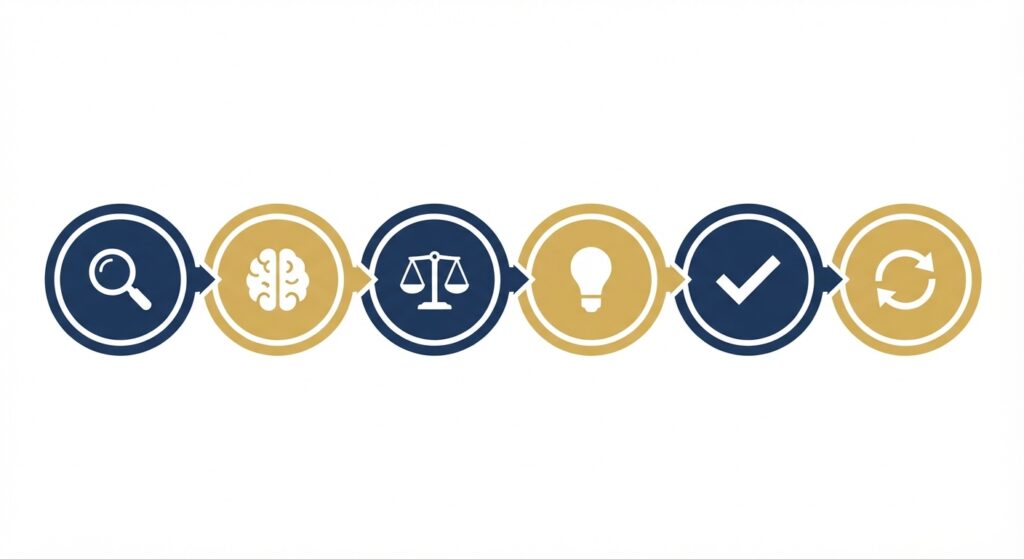
The NCJMM is the framework that NCSBN developed to build and score NGN items in a standardized, defensible way. It breaks clinical judgment into six layers. Unlike a strictly linear process, a nurse (and a test item) may move back and forth between these layers as new information appears.
| NCJMM Layer |
What It Asks |
Roughly Parallels |
| Recognize Cues |
Which findings in the data are relevant to this patient’s situation? |
Assessment |
| Analyze Cues |
What do these findings mean together, and how urgent are they? |
Assessment / Diagnosis |
| Prioritize Hypotheses |
Which explanation or problem is most likely or most urgent right now? |
Diagnosis |
| Generate Solutions |
What are the appropriate, safe options for addressing the priority problem? |
Planning |
| Take Actions |
Which intervention(s) should be implemented, and how? |
Implementation |
| Evaluate Outcomes |
Did the action work? What does the patient’s response indicate next? |
Evaluation |
Understanding this model matters beyond exam day. Framing a nursing care plan, a clinical post-conference discussion, or a case study assignment around these same layers tends to produce clearer, more defensible clinical reasoning, which is exactly what clinical instructors and NCLEX items are both trying to see.
New NGN Item Types You’ll Encounter
Traditional formats, multiple choice, and select-all-that-apply are still part of the exam. The NGN adds several item types designed to capture reasoning that a single correct answer can’t show.
| Item Type |
What It Looks Like |
NCJMM Layer(s) Often Targeted |
| Extended Multiple Response |
Select all that apply with partial-credit scoring rather than all-or-nothing |
Recognize/Analyze Cues |
| Extended Drag and Drop |
Arrange or sort options (e.g., priority order, matching actions to findings) |
Prioritize Hypotheses; Generate Solutions |
| Cloze (Drop-Down) |
Complete a sentence, table, or rationale by choosing from drop-down word lists |
Analyze Cues; Take Actions |
| Enhanced Hot Spot |
Highlight relevant words or phrases within a passage, such as a nurse’s note |
Recognize Cues |
| Matrix / Grid |
Mark whether each option is indicated, contraindicated, or unrelated across a grid |
Analyze Cues; Generate Solutions |
| Bowtie |
Select a condition plus its supporting actions and expected outcomes in a bowtie-shaped diagram |
Spans multiple NCJMM layers at once |
Case study items are also scored using different rubrics, depending on the format; some are all-or-nothing, others award partial credit for a partially correct response. NCSBN’s own NGN and test-plan resources are the authoritative sources for how a given format is scored, and instructors and students should check them directly rather than relying on secondhand summaries, since exam specifications can be updated.
How NGN Case Studies Are Structured
Many NGN items appear in an unfolding case study: a patient scenario presented across several screens, with new information, vital signs, lab results, a nurse’s note, and an update from another clinician, all revealed progressively. Each screen typically asks the candidate to work through one or more NCJMM layers based on the data revealed so far, and later screens build on earlier ones.
Not every clinical judgment item is part of a full case study. Stand-alone items can also test a single NCJMM layer in isolation, such as a single Recognize Cues question about which finding is most concerning. Because information accumulates over the course of an unfolding case, a common source of errors is treating each screen as if it exists in isolation rather than in the context of everything already revealed.
A Practical Framework: Working Through a Clinical Judgment Item
Clinical Scenario (educational example, not an actual patient): A nursing student is reviewing a case study describing a postoperative adult patient whose vital signs and reported pain level are presented across several unfolding screens. The student notices the data changing between screens and has to decide what matters and what to do next.

Walking this through the NCJMM layers, rather than jumping straight to an intervention, might look like:
- Recognize Cues — List which specific data points (not general impressions) actually changed or stand out from the patient’s baseline.
- Analyze Cues — Consider what those specific changes could indicate together, and how time-sensitive each possibility is.
- Prioritize Hypotheses — Decide which concern needs attention first, based on safety and likelihood, not just on which was mentioned last.
- Generate Solutions — Identify the range of appropriate nursing actions for that priority concern, including when to notify a provider.
- Take Actions — Select and sequence the appropriate action(s) for this specific patient and setting, within the nurse’s scope of practice and facility policy.
- Evaluate Outcomes — Identify what reassessment or finding would tell the nurse whether the action worked.
This is a study framework, not a substitute for a specific patient’s clinical presentation, an instructor’s guidance, or institutional protocols. Working through it slowly with practice cases, rather than reading the scenario once and guessing, is what builds the pattern of thinking these items are designed to measure.
Also read on 5 Nursing Care Plan Templates Every Student Should Have
Common Mistakes Nursing Students Make with Clinical Judgment Questions
- Treating the item as a recall question and searching for a single fact instead of reasoning through the full scenario.
- Reacting to the newest piece of information in an unfolding case without re-checking it against everything revealed earlier.
- Jumping to an intervention (Take Actions) before actually analyzing what the cues mean (Analyze Cues, Prioritize Hypotheses).
- Selecting the option that sounds most “textbook” without weighing the specific patient’s context and priorities.
- Confusing prioritization with urgency alone, not every priority problem is the most dramatic-sounding one.
- Skipping practice with the newer formats (bowtie, matrix, cloze) because they feel unfamiliar, rather than practicing them deliberately.
How to Study for Clinical Judgment Questions
Because the NGN measures a way of thinking rather than a fixed set of facts, effective preparation tends to combine content review with deliberate reasoning practice:
- Practice with NGN-format questions specifically, including the newer item types, rather than assuming multiple-choice practice alone will transfer.
- After each practice item, review the rationale for every option, including the ones you didn’t choose, rather than only checking if you got it right.
- Use the NCJMM layers explicitly when working through care plans, case studies, and clinical post-conference discussions, so the framework becomes familiar before exam day.
- Talk through borderline or unclear cases with clinical instructors or preceptors, since scope-of-practice and prioritization questions often benefit from an experienced perspective.
- Review NCSBN’s own free NGN resources and sample items, since these reflect the actual exam specifications rather than a third party’s interpretation of them.
- Pace unfolding case studies deliberately, rereading the cumulative data before answering each screen, rather than treating screens as isolated questions.
Key Points for Nursing Students
- The NGN measures clinical judgment using the six-layer NCJMM: Recognize Cues, Analyze Cues, Prioritize Hypotheses, Generate Solutions, Take Actions, Evaluate Outcomes.
- Newer item types, extended multiple response, extended drag and drop, cloze, enhanced hot spot, matrix, and bowtie, are designed to capture reasoning rather than a single correct fact.
- Unfolding case studies builds information across screens; each answer should account for everything revealed so far, not just the latest detail.
- Practicing the NCJMM framework in coursework and clinical placements reinforces the same reasoning that the exam measures.
- NCSBN’s own materials are the authoritative source for current exam specifications and scoring.
Frequently Asked Questions
What is the difference between the NGN and the classic NCLEX?
The classic NCLEX relied mainly on multiple-choice and select-all-that-apply items testing knowledge and application. The NGN adds case-study-based items and new formats built around the NCJMM to more directly measure clinical judgment and decision-making, alongside the traditional item types, which remain part of the exam.
Do I need to memorize the NCJMM layers for the exam?
You aren’t tested on naming the model itself, but understanding the six layers helps you recognize what a given item is actually asking, for example, whether it wants you to identify a relevant finding (Recognize Cues) or choose an intervention (Take Actions).
Are bowtie and matrix questions scored all-or-nothing?
Scoring approaches vary by item type, and some formats use partial-credit rubrics rather than all-or-nothing scoring. Because these details can be updated, check NCSBN’s current official guidance for the specifics that apply to your exam administration.
How is an unfolding case study different from a stand-alone item?
An unfolding case study reveals a patient scenario across multiple linked screens, with each screen typically adding new data. A stand-alone item presents a single scenario and question testing one NCJMM layer without that multi-screen structure.
What’s the best way to practice for clinical judgment items?
Practicing with NGN-format questions, reviewing full rationales (not just correct answers), and deliberately applying the NCJMM layers to classroom case studies and clinical placements together build the pattern of reasoning these items measure.
Does strong clinical judgment on the NCLEX guarantee good clinical performance?
The NGN is designed to better reflect the reasoning nurses use in practice, but it is a single standardized measurement taken at a single point in time. Clinical competence also depends on supervised experience, institutional orientation, and ongoing professional development after licensure.
Also read on What Is a Nursing Care Plan? A Beginner’s Guide
Conclusion
The Next Generation NCLEX asks nursing students to demonstrate a way of thinking, not just a store of memorized facts. Understanding the NCJMM’s six layers, getting comfortable with the newer item formats, and practicing the discipline of working through cues, hypotheses, and actions in order all make clinical judgment questions less intimidating and more approachable. The same reasoning pattern that helps on exam day, recognizing what matters, analyzing it, prioritizing, acting, and evaluating the result, is the same pattern that supports safe, confident practice at the bedside.








 Evan John