“I don’t have enough experience.” “Every internship posting wants someone who already has one.” “My résumé looks empty.” “I don’t even know where to start looking.” “I’ve applied to a dozen internships and heard nothing back.”
If any of that sounds familiar, you’re not doing anything wrong this is one of the most common frustrations students run into. But landing an internship isn’t only about prior professional experience. Employers also look at relevant skills, academic projects, initiative, communication, problem-solving, willingness to learn, reliability, and genuine interest in the field.
This guide walks through the internship search as a process rather than a guessing game: how to figure out what you’re looking for, build a résumé worth reading, find opportunities beyond job boards, and prepare for the interview once you land one.
Student Deals Store
Decide What Kind of Internship You Want
Before you start applying anywhere, it helps to get specific about what you’re actually looking for. That means thinking through the industry, the job function, the skills you want to develop, the type of organization, the location, whether you want remote, hybrid, or in-person work, and roughly how long you want the internship to run.
Compare these two statements:
Weak: “I want any internship.”
Stronger: “I want a digital marketing internship where I can develop content creation, SEO, and social media skills.”
The second version gives you something to actually search for, and it makes your résumé and cover letter far easier to write, because you know which of your experiences are relevant.
Start Your Internship Search Early
Internship deadlines vary a lot by industry and employer some large organizations recruit for summer internships six to nine months in advance, while smaller organizations may post openings only a few weeks before they need someone. Waiting until you’re ready to start immediately often means missing the earlier, more competitive opportunities.
It helps to check university career fairs, company career pages, internship platforms, and alumni networks on a regular schedule rather than sporadically. Here’s an example of what a simple weekly rhythm might look like:
| Activity |
Suggested Frequency |
| Search internship listings |
2–3 times per week |
| Check company career pages |
Weekly |
| Network with professionals |
Weekly |
| Submit targeted applications |
Several per week |
| Practice interviews |
Weekly |
| Update résumé |
As needed |
These are suggestions, not rigid rules adjust the frequency to fit your own schedule and the point you’re at in the search.
Build a Résumé Even If You Have Little Experience
You don’t need years of employment history to write a strong résumé. Relevant material includes your education, relevant coursework, academic projects, volunteer experience, student organizations, leadership roles, part-time or freelance work, certifications, technical skills, and relevant extracurricular activities.
The key is turning that experience into specific, evidence-based descriptions rather than vague summaries. Compare these two lines:
Weak: “Completed a group project.”
Stronger: “Collaborated with four students to research, analyze, and present findings on [topic], completing the project within a four-week deadline.”
The second version shows collaboration, research skills, and the ability to meet a deadline all things an employer can actually picture. Wherever possible, make your descriptions measurable and specific.
Tailor Your Résumé for Each Internship
A single generic résumé sent to every internship is rarely the strongest approach. It’s worth comparing your résumé against each internship description and noting the required skills, preferred skills, responsibilities, relevant keywords, and educational requirements listed.
From there, highlight the experiences on your résumé that genuinely match what the role is asking for. This isn’t about keyword-stuffing your résumé or misrepresenting your background it’s about making sure the most relevant parts of your real experience are easy for the employer to see.

Create a Portfolio
A portfolio lets you demonstrate practical skills even without formal work experience, and you can build one yourself using academic or personal projects. What it looks like depends on your field:
Marketing
- Mock campaigns
- Social media content
- SEO projects
- Marketing plans
Design
- Graphic designs
- Branding projects
- UI/UX work
Technology
- Coding projects
- Websites
- Apps
- GitHub projects
Writing
- Articles
- Research writing
- Blog posts
- Editing samples
Business
- Case studies
- Presentations
- Business analysis
Get the Internship Ebook
If you don’t have professional experience yet, you can create these projects yourself — a mock campaign or a small coding project is a legitimate way to show what you can do.
Use LinkedIn and Professional Networking
Networking doesn’t mean messaging strangers and asking for a job. It’s closer to building a genuine professional presence and gradually expanding who you’re connected to and aware of.
That can include building a clear, professional LinkedIn profile, following organizations you’re interested in, connecting with alumni from your university, joining professional communities, attending career events, participating in industry events, asking thoughtful questions when you do connect with someone, and maintaining those relationships over time.
Networking can increase your awareness of opportunities you wouldn’t find through an ordinary job search, but it isn’t a shortcut that guarantees an internship, it’s one part of a broader strategy.
Look Beyond Job Boards
Job boards are only one source among several. It’s worth also checking company career pages, your university career center, alumni networks, career fairs, professional associations, industry events, LinkedIn, dedicated internship platforms, and connections through faculty or lecturers.
A useful exercise is building a list of 20–30 organizations you’re genuinely interested in and monitoring their career pages directly, rather than relying only on general internship search sites.
Write a Strong Internship Cover Letter
A cover letter’s job is to connect your experience and skills to the specific internship, not to repeat your résumé in paragraph form. A useful way to think about it is to answer three questions: Why this organization? Why this internship? Why are you a good candidate?
A simple structure to follow: Opening → Relevant skills → Why the organization → Why the internship → Closing. Keep each part focused and specific to the role rather than generic.
Apply Strategically
Submitting a large number of generic applications is usually less effective than applying carefully to fewer, better-matched roles. A useful checklist before hitting submit:
- Read the internship description carefully.
- Check eligibility requirements.
- Customize your résumé.
- Write a relevant cover letter when required.
- Check application instructions.
- Proofread everything.
- Submit before the deadline.
- Track the application.
A simple tracker prevents you from losing track of what you’ve applied to and when to follow up:
| Organization |
Role |
Date Applied |
Deadline |
Status |
Follow-Up |
|
|
|
|
|
|
Prepare for the Internship Interview
Preparation makes a noticeable difference in how an interview goes. Before the interview, research the organization, revisit the internship description, prepare a few concrete examples from your own experience, practice answers to common questions, and prepare a few thoughtful questions of your own for the interviewer. If it’s virtual, test your technology beforehand; if it’s in person, plan to arrive early and dress professionally.
Some of the most common internship interview questions include:
- Tell me about yourself.
- Why do you want this internship?
- Why are you interested in our organization?
- What skills would you bring?
- Tell me about a challenge you faced.
- Tell me about a time you worked in a team.
- What do you hope to learn?
- Where do you see yourself developing professionally?
Use the STAR Method
The STAR method is a simple way to structure answers to behavioral interview questions:
| S — Situation |
What was happening? |
| T — Task |
What were you responsible for? |
| A — Action |
What did you do? |
| R — Result |
What happened? |
You can draw STAR examples from coursework, group projects, volunteering, part-time jobs, student organizations, or personal projects — this is particularly useful if you don’t yet have extensive professional experience to pull from.

What If You Keep Getting Rejected?
Rejection is common during a competitive internship search, and it doesn’t necessarily mean something is fundamentally wrong with you as a candidate. Instead of simply reapplying the same way, it’s worth reviewing your résumé, cover letters, targeting, interview performance, skills, portfolio, networking, and application timing.
A useful question to ask after each rejection is simply: “What can I improve before my next application?” There’s no fixed number of applications that guarantees an internship, but consistently refining your approach tends to improve your results over time.
10 Ways to Increase Your Chances of Landing an Internship
- Start early: Give yourself time before competitive deadlines pass.
- Target specific roles: A focused search is easier to act on than a vague one.
- Tailor your résumé: Match your experience to what each role is actually asking for.
- Build relevant skills: Close obvious gaps between what you have and what’s required.
- Create projects: Build evidence of your abilities if you lack formal experience.
- Build a portfolio: Give employers something concrete to look at.
- Network professionally: Increase your awareness of opportunities beyond job boards.
- Apply consistently: Steady effort beats sporadic bursts of applications.
- Practice interviews: Preparation reduces nerves and improves your answers.
- Learn from rejection: Use each outcome to refine your approach.
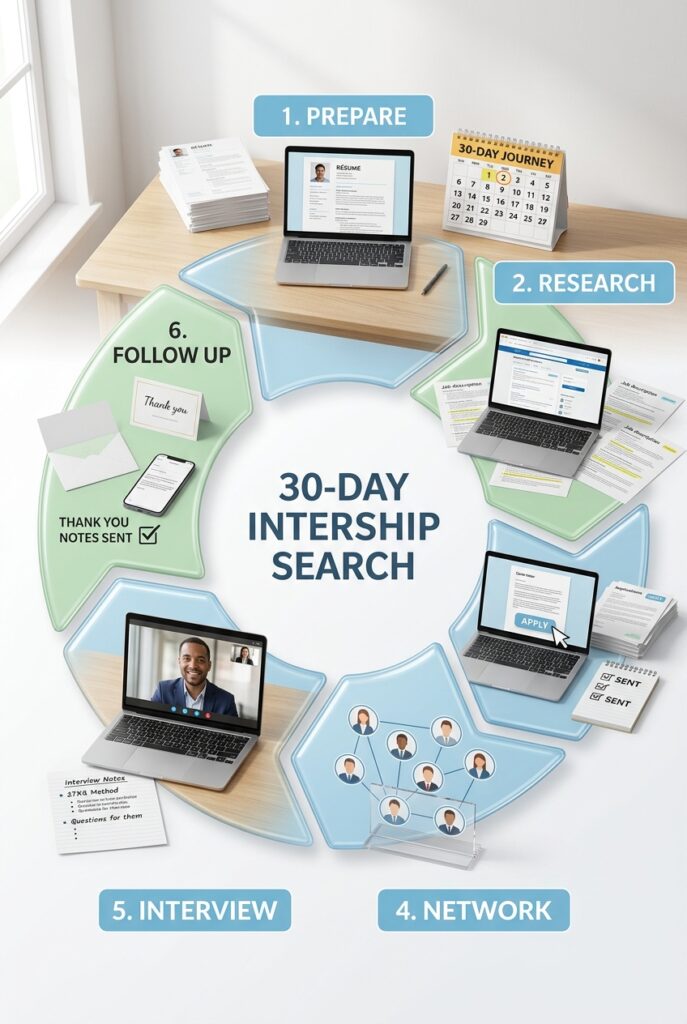
Create a 30-Day Internship Search Plan
Week 1 — Preparation
- Identify target careers.
- Update résumé.
- Build/update LinkedIn.
- Identify skills gaps.
Week 2 — Research
- Find target organizations.
- Research internship opportunities.
- Build an application tracker.
- Identify networking opportunities.
Week 3 — Applications
- Submit targeted applications.
- Contact relevant professional connections.
- Attend career events where available.
Week 4 — Interview Preparation
You can repeat and adapt this cycle for as long as your search continues each round should get a little more targeted than the last.
Common Internship Mistakes to Avoid
1. Applying without reading the job description
Better approach: Read the full listing carefully before applying, so your application actually matches what’s being asked for.
2. Sending the same résumé everywhere
Better approach: Tailor your résumé to highlight the experience most relevant to each specific role.
3. Ignoring application instructions
Better approach: Follow the stated instructions exactly, they’re often used to filter candidates.
4. Waiting until the deadline
Better approach: Submit with time to spare in case of technical issues or last-minute edits.
5. Having an unprofessional email address
Better approach: Use a simple, professional email address for all applications.
6. Not preparing for interviews
Better approach: Research the organization and practice answers before every interview.
7. Failing to proofread applications
Better approach: Read everything carefully, and consider asking someone else to review it too.
8. Giving up after several rejections
Better approach: Treat each rejection as information and adjust your approach for the next round.
What Employers Want From Interns
Employers generally understand that interns are still learning, so the bar isn’t perfection. Many employers look for qualities such as reliability, communication, curiosity, initiative, teamwork, adaptability, organization, professionalism, willingness to learn, and problem-solving.
Not every employer prioritizes the same qualities in the same order, so it’s worth paying attention to what a specific internship description emphasizes rather than assuming one universal checklist applies everywhere.
Final Takeaway
The internship search process, in short: Choose a target → Build your résumé → Develop skills → Create a portfolio → Search strategically → Network → Apply → Prepare for interviews → Learn from rejection → Repeat.
You don’t need to be a perfect candidate before you start applying. The goal is to become a stronger candidate with each application refining your résumé, your targeting, and your interview skills as you go.
Get the Internship Ebook
Frequently Asked Questions
How do I land an internship with no experience?
Focus on what you do have: relevant coursework, academic projects, volunteer work, student organizations, and any personal projects you’ve built. Present these clearly and specifically, and consider building a small portfolio to demonstrate practical skills.
When should I start applying for internships?
As early as possible. Deadlines vary widely by industry and employer, and some larger organizations recruit many months in advance, so starting early gives you access to more opportunities.
How can a student find an internship?
Look beyond general job boards — check company career pages, your university career center, alumni networks, career fairs, professional associations, and LinkedIn, and consider building a list of target organizations to monitor directly.
What should I put on my résumé if I have no work experience?
Include relevant coursework, academic projects, volunteer experience, student organizations, leadership roles, certifications, and technical skills, described as specifically and measurably as possible.
Do I need a cover letter for an internship?
When one is requested, yes, use it to explain why you’re interested in the organization and the role, rather than simply repeating your résumé.
How can I prepare for an internship interview?
Research the organization, review the internship description, prepare specific examples using the STAR method, practice common questions, and prepare a few thoughtful questions of your own.
How many internships should I apply for?
There’s no fixed number that guarantees a result. It’s generally more effective to apply to a reasonable number of well-matched roles with tailored applications than to submit the same résumé everywhere.
What skills do employers look for in interns?
Many employers look for reliability, communication, curiosity, initiative, teamwork, adaptability, and a genuine willingness to learn, though priorities vary by organization and role.
Also read on









 Evan John