Correct referencing is one of the most important academic skills every student needs to develop.
Whether you’re writing an essay, research paper, dissertation, literature review, thesis, or university assignment, accurately citing your sources demonstrates academic integrity, strengthens your arguments, and helps you avoid plagiarism.
Yet for many students, Harvard referencing feels confusing.
Questions such as “Where do I put the author’s name?”, “Do I need page numbers?”, “How do I reference websites?”, and “What’s the difference between an in-text citation and a reference list?” are incredibly common.
The good news is that Harvard referencing isn’t difficult once you understand the rules.
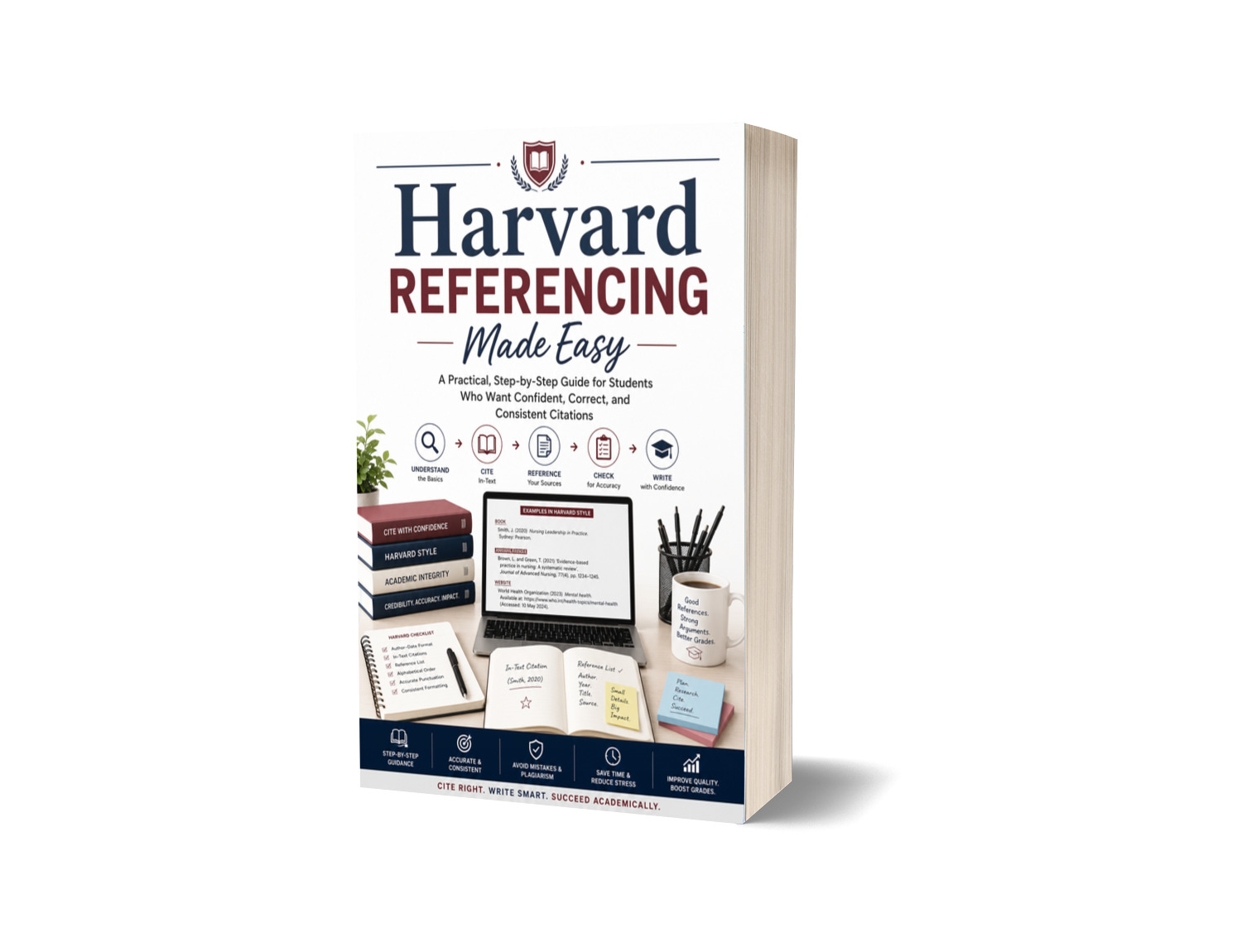
The Harvard Referencing Guide was created to simplify the entire process. Instead of memorising complicated formatting rules, you’ll learn a practical, step-by-step system that you can confidently apply to every assignment throughout your academic journey.
Whether you’re a first-year undergraduate, postgraduate student, researcher, or returning adult learner, this handbook provides everything you need to reference accurately, write confidently, and maintain academic integrity.
Why Harvard Referencing Matters
Referencing is far more than simply adding citations to an assignment.
It demonstrates that you have:
- Conducted credible research
- Used reliable academic sources
- Supported your arguments with evidence
- Acknowledged the work of other researchers
- Avoided plagiarism
- Followed university academic standards
Universities across the world use Harvard Referencing because it creates consistency, improves transparency, and allows readers to locate the original sources you used.
Mastering Harvard referencing early will save countless hours during essays, dissertations, and research projects while improving the overall quality of your academic writing.
What Makes This Harvard Referencing Guide Different?
Unlike many referencing manuals that overwhelm students with technical rules, this handbook explains Harvard referencing in clear, straightforward language.
Every chapter follows a practical learning format, making it easy to understand not only how to reference but also why each rule exists.
Each chapter includes:
- Learning objectives
- Simple explanations
- Practical examples
- Real-life academic scenarios
- Expert tips
- Common mistakes
- Reflection questions
- Mini exercises
- Chapter summaries
- Key takeaways
Rather than simply reading about referencing, you’ll practise each skill until it becomes second nature.
What You’ll Learn Inside the Harvard Referencing Guide
Build a Strong Foundation in Harvard Referencing
The handbook begins by introducing the fundamentals of Harvard referencing and explaining why accurate citation is essential for academic success.
Chapter 1 – What Is Harvard Referencing and Why It Matters?
Start with the basics.
This chapter explains:
- What Harvard referencing actually is
- Why universities require referencing
- The two-part structure of Harvard style
- The difference between referencing errors and plagiarism
- Why proper citations strengthen academic credibility
Practical examples and real-life scenarios help students understand the importance of referencing from day one.
Understand the Two Essential Parts of Every Reference
Chapter 2 – In-Text Citations vs Reference Lists
Many students confuse citations with reference lists.
This chapter clearly explains:
- What in-text citations are
- How reference lists work
- Why both sections must match perfectly
- The difference between a bibliography and a reference list
- Correct formatting rules
Understanding this distinction removes one of the biggest sources of referencing confusion.
Master In-Text Citations
Correct in-text citations are essential for avoiding plagiarism.
Chapter 3 – In-Text Citation Basics
Learn the standard Harvard citation format, including:
- Author-date citations
- Adding page numbers
- Punctuation rules
- Citation placement
- Direct quotations
- Paraphrased information
Simple examples demonstrate exactly how citations should appear within academic writing.
Chapter 4 – Handling Special Citation Situations
Academic sources aren’t always straightforward.
Learn how to cite:
- Two authors
- Three or more authors
- Corporate authors
- Government publications
- Organisations
- Sources with no author
- Sources with no publication date
- Multiple sources supporting one statement
- Multiple works by the same author
These special cases often cause students the most difficulty, but this chapter makes them easy to understand.
Build Perfect Reference Lists
Reference lists require consistency and attention to detail.
Chapter 5 – General Rules for Reference Lists
Discover the universal structure used across Harvard referencing.
Topics include:
- Correct order of information
- Author formatting
- Editors and translators
- Titles and italics
- Editions
- Publishers
- Volume and issue numbers
- Page ranges
- Punctuation rules
Once these core principles are mastered, referencing any source becomes much easier.
Learn How to Reference Every Source Correctly
The handbook provides dedicated chapters for the most common academic sources.
Chapter 6 – Books and eBooks
Learn how to reference:
- Print books
- eBooks
- Edited books
- Book chapters
- Multiple editions
Complete examples show the correct formatting for each type.
Chapter 7 – Journal Articles
Journal articles form the foundation of academic research.
Learn how to reference:
- Print journals
- Online journals
- Articles with DOIs
- Ahead-of-print publications
- Electronic databases
You’ll also understand why journal articles are often considered stronger evidence than many websites.
Chapter 8 – Websites and Online Sources
Online information must be referenced carefully.
This chapter explains how to cite:
- Websites
- Web pages
- Online reports
- Government websites
- Educational websites
- News articles
You’ll also learn how to evaluate website credibility before using it in academic work.
Chapter 9 – Reports, Theses & Grey Literature
Some academic sources don’t fit standard formats.
Learn how to reference:
- Government reports
- Organisational publications
- Conference papers
- Theses
- Dissertations
- Technical reports
- Grey literature
This chapter also explains why these sources require careful evaluation before citation.
Chapter 10 – Multimedia and Digital Sources
Modern academic work often uses digital media.
Discover how to reference:
- YouTube videos
- Podcasts
- Images
- Figures
- Infographics
- Lecture slides
- Social media posts
These increasingly common sources are explained using practical examples.
Avoid Plagiarism with Confidence
One of the biggest fears students have is accidental plagiarism.
Chapter 11 – Quoting, Paraphrasing & Academic Integrity
Learn when to:
- Quote directly
- Paraphrase effectively
- Summarise research
- Include page numbers
- Format short quotations
- Format long quotations
The chapter also explains the most common causes of accidental plagiarism and how to avoid them.
Master Advanced Referencing Techniques
Chapter 12 – Secondary Referencing
Sometimes you need to reference material discussed in another source.
Learn:
- What secondary referencing is
- When it should be used
- When it should be avoided
- Correct citation formats
This chapter helps students understand one of the most misunderstood aspects of Harvard referencing.
Chapter 13 – Common Harvard Referencing Mistakes
Even experienced students make referencing mistakes.
Discover the ten most common errors, including:
- Missing references
- Incorrect punctuation
- Formatting inconsistencies
- Incorrect author names
- Mismatched citations
- Poor paraphrasing
Each mistake is accompanied by practical correction strategies.
Chapter 14 – Reference Management Software
Technology can simplify referencing.
Learn how tools such as reference managers help students:
- Organise sources
- Store PDFs
- Generate citations
- Build reference lists
- Save time during research
You’ll also learn why understanding referencing rules remains essential, even when using software.
Chapter 15 – Your Complete Assignment Referencing Workflow
The final chapter brings everything together into one practical process.
You’ll learn a complete workflow covering:
- Collecting sources
- Recording reference details
- Writing assignments
- Adding citations
- Building reference lists
- Proofreading
- Final submission checks
Following this workflow dramatically reduces referencing errors.
Practical Learning Resources Included
The Harvard Referencing Guide goes beyond explanations by providing practical resources that reinforce learning.
Case Studies
Apply your knowledge through realistic academic scenarios, including:
- Dissertation referencing challenges
- Building good referencing habits from your first semester
These case studies demonstrate how accurate referencing contributes to academic success.
Worksheets
Develop your referencing skills using practical worksheets, including:
- Source Capture Sheet
- Paraphrasing Practice Sheet
- Reference List Self-Audit
These activities help students actively practise what they’ve learned.
Ready-to-Use Templates
Save time with practical templates such as:
- Fill-in-the-Blank Reference Formats
- In-Text Citation Builder
These templates simplify referencing for common academic sources.
Printable Checklists
Never miss a referencing detail again.
Included checklists cover:
- Before submitting assignments
- Evaluating website credibility
- Weekly research habits
These resources help students develop consistent referencing routines.
Quick Reference Guides
Perfect for revision before assignments.
Includes:
- Capitalisation and italics guide
- Author formatting guide
- Harvard punctuation cheat sheet
These quick-reference pages provide instant support while writing.
Bonus Resources
To support long-term academic success, the handbook also includes:
- Frequently Asked Questions
- Common mistakes recap
- Recommended books
- Useful academic websites
- Study apps
- Reference management tools
- AI tools for responsible academic use
- Productivity resources
- A 30-Day Referencing Confidence Plan
- Weekly goals
- Daily habits checklist
- Progress tracker
- Success tracker
- Top 50 Expert Tips
These additional resources help students develop referencing confidence that lasts throughout university.
Perfect for Every Student
The Harvard Referencing Guide is ideal for:
- College students
- University students
- Postgraduate students
- Master’s students
- PhD candidates
- Nursing students
- Medical students
- Business students
- Education students
- Social science students
- Law students
- Adult learners
- Researchers
- Anyone using Harvard referencing
Whether you’re writing your first essay or completing a dissertation, this handbook provides practical support at every stage.
Why You’ll Love This Guide
✔ Explains Harvard referencing in simple language
✔ Covers every major source type
✔ Includes hundreds of practical examples
✔ Helps prevent plagiarism
✔ Improves academic writing confidence
✔ Features worksheets, templates, and checklists
✔ Includes assignment workflows and proofreading tools
✔ Suitable for beginners and advanced students alike
✔ Supports essays, reports, dissertations, and research projects
Start Referencing with Confidence
Accurate referencing is one of the easiest ways to improve the quality of your academic work.
The Harvard Referencing Guide gives you the practical knowledge, examples, templates, and tools needed to reference confidently, avoid plagiarism, and meet university academic standards.
Instead of second-guessing every citation or worrying about formatting errors, you’ll develop a reliable system that makes Harvard referencing clear, consistent, and stress-free.
Build stronger assignments, protect your academic integrity, and master Harvard referencing with confidence—one citation at a time.









 Evan John