Every day, nurses make dozens of clinical decisions that directly affect patient safety and health outcomes. The question is: are those decisions guided by tradition, habit, or the best available evidence?
Evidence-based practice (EBP) in nursing is the gold standard approach to clinical decision-making. It integrates the best research evidence, clinical expertise, and patient preferences to deliver safe, effective, and individualized care. For nursing students completing assignments or practitioners seeking to improve care quality, understanding the steps of EBP is not optional, it is essential.
This will breaks down the core steps of evidence-based practice in nursing, provides clinical examples, and offers practical tools to apply EBP in both academic assignments and real-world healthcare settings.
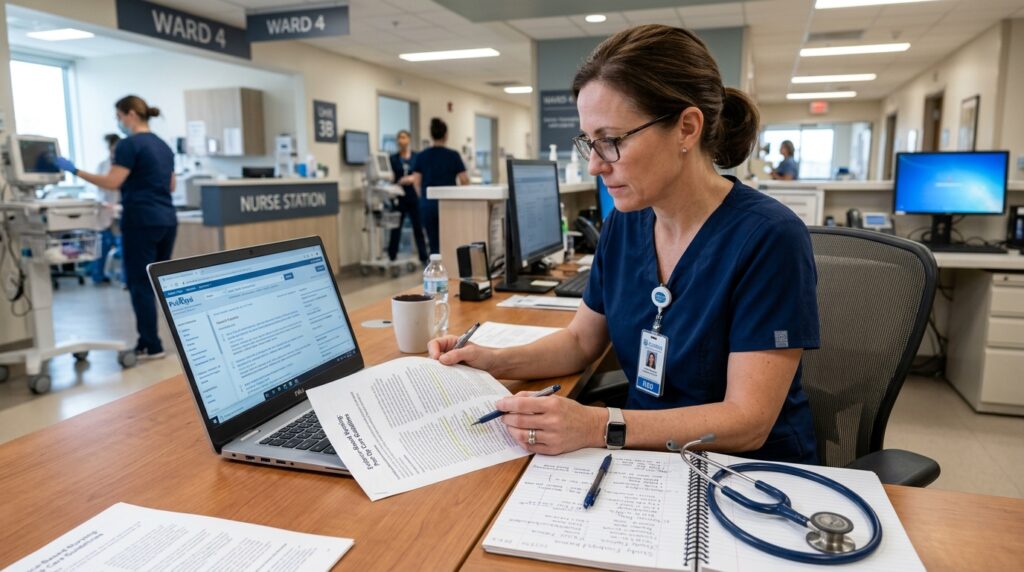
What Is Evidence-Based Practice in Nursing?
Evidence-based practice is a problem-solving approach to clinical care that incorporates three key elements:
- The best available scientific evidence
- The nurse’s clinical expertise and judgment
- The patient’s individual values, preferences, and circumstances
First introduced to nursing practice through the work of Florence Nightingale, EBP has since been formalized by researchers and organizations including the Institute of Medicine, the Joanna Briggs Institute, and the American Nurses Association (ANA).
EBP is not about replacing clinical instinct. It is about reinforcing clinical decisions with evidence so that patient care is consistently safer, more effective, and more equitable.
Why Are the Steps of Evidence-Based Practice in Nursing Important?
Without a structured EBP process, clinical decisions risk being influenced by outdated guidelines, personal bias, or anecdotal experience. The consequences can include:
- Preventable patient harm
- Unnecessary procedures or medications
- Increased healthcare costs
- Reduced patient satisfaction
Nursing programs require students to demonstrate EBP competency in assignments because it builds the critical thinking skills needed at the bedside. Mastering the steps of evidence-based practice in nursing prepares students for real clinical challenges and supports lifelong professional development.
Also read on How to Write Nursing Care Plans Step-by-Step
The 7 Steps of Evidence-Based Practice in Nursing
Several EBP models exist, including the Iowa Model and the Johns Hopkins Nursing EBP Model. The most widely referenced framework outlines seven core steps.
Step 1 — Cultivate a Spirit of Inquiry
EBP begins with curiosity. Nurses who question current practice and ask “Is there a better way?” create the foundation for meaningful clinical improvement.
In practice, this means staying current with nursing literature, attending continuing education sessions, and fostering a workplace culture that welcomes clinical questions.
Example: A ward nurse notices that patients frequently develop pressure injuries despite routine repositioning every two hours. She begins to wonder whether repositioning schedules based on individual risk assessments might produce better outcomes.
Step 2 : Ask a Clinical Question Using the PICO Framework
Once a clinical problem is identified, it must be translated into a structured, searchable question. The PICO framework is the most widely used tool for this purpose.
PICO stands for:
- P — Population or Patient (Who is affected?)
- I — Intervention (What is being considered?)
- C — Comparison (What is the alternative?)
- O — Outcome (What is the desired result?)
Some versions extend this to PICOT, adding:
- T — Time (Over what period?)
Example PICO question: In adult patients admitted to the medical-surgical ward (P), does individualized pressure injury risk-based repositioning (I) compared to standard two-hourly repositioning (C) reduce the incidence of hospital-acquired pressure injuries (O) within a 30-day admission period (T)?
A well-formed PICO question is critical in nursing assignments and guides every subsequent step of the EBP process.
Step 3 :Search for the Best Available Evidence
With a clear clinical question, the next step is a systematic literature search. Nurses and nursing students should prioritize high-quality, peer-reviewed sources.
Recommended databases include:
- PubMed / MEDLINE
- CINAHL (Cumulative Index to Nursing and Allied Health Literature)
- Cochrane Library
- EMBASE
- Joanna Briggs Institute EBP Database
When searching, use keywords derived from your PICO components. Apply filters such as publication date (last five to ten years), study design, and language to refine results.
Evidence is ranked by strength. The hierarchy of evidence, from strongest to weakest, typically includes:
- Systematic reviews and meta-analyses
- Randomized controlled trials (RCTs)
- Cohort studies
- Case-control studies
- Expert opinion and clinical guidelines
For nursing assignments, demonstrating a structured search strategy using Boolean operators (AND, OR, NOT) will strengthen academic credibility.
Step 4 : Critically Appraise the Evidence
Finding evidence is only half the work. Nurses must evaluate the quality, validity, and applicability of each study before drawing clinical conclusions.
Critical appraisal involves asking:
- Is the study design appropriate for the clinical question?
- Are the results statistically significant and clinically meaningful?
- Was the sample size adequate?
- Are there potential biases or conflicts of interest?
- Can the findings be applied to the specific patient population?
Tools commonly used for critical appraisal include:
- The CASP (Critical Appraisal Skills Programme) checklists
- The Joanna Briggs Institute Critical Appraisal Tools
- GRADE (Grading of Recommendations, Assessment, Development, and Evaluations) framework
In nursing assignments, critical appraisal demonstrates higher-order thinking. Avoid simply summarizing studies — analyze their strengths, limitations, and relevance to your clinical question.
Step 5 : Integrate the Evidence with Clinical Expertise and Patient Preferences
Evidence alone does not dictate clinical decisions. The EBP process requires nurses to integrate research findings with their professional judgment and the patient’s unique values and circumstances.
This step involves:
- Reviewing organizational policies and available resources
- Consulting with multidisciplinary team members
- Discussing options, risks, and benefits with the patient
- Considering cultural, social, and individual factors
Example: Research supports the use of individualized repositioning schedules. However, a patient with severe dementia and an unpredictable behavioral pattern may require modifications to that protocol for both safety and comfort. Clinical expertise guides how evidence is translated into personalized care.
Patient-centered care is a cornerstone of professional nursing ethics and is supported by major frameworks including the WHO patient safety guidelines and the Nursing and Midwifery Council (NMC) Code of Conduct.
Step 6 : Implement the Practice Change
Once evidence has been appraised and integrated with clinical expertise and patient preferences, the change is implemented. Successful implementation requires:
- Clear communication with all staff involved
- Education and training where necessary
- Documentation and monitoring protocols
- Support from unit leadership and management
Change can be implemented at the individual patient care level or as a broader unit or organizational quality improvement initiative. Tools such as Plan-Do-Study-Act (PDSA) cycles are commonly used in healthcare settings to structure small-scale implementation and test outcomes before wider adoption.
Step 7 :Evaluate the Outcomes and Disseminate Results
The final step closes the EBP cycle. Nurses evaluate whether the implemented change achieved the desired patient or organizational outcomes.
Evaluation questions include:
- Did the intervention reduce pressure injury rates?
- Were patient satisfaction scores maintained or improved?
- What were the barriers to implementation?
- Were there unintended consequences?
Findings should be documented and, where appropriate, shared with colleagues through case presentations, unit meetings, or published nursing reports. Dissemination drives a culture of continuous improvement and supports other nurses facing similar clinical challenges.
Common EBP Models Used in Nursing Practice
Several established models guide the EBP process in clinical and academic settings:
- Iowa Model of Evidence-Based Practice — widely used in hospital systems; focuses on triggering questions and organizational change
- Johns Hopkins Nursing EBP Model — emphasizes three pillars: practice questions, evidence, and translation
- Stetler Model — focuses on individual practitioner use of research
- ARCC Model (Advancing Research and Clinical Practice through Close Collaboration) — designed to sustain EBP in healthcare organizations
For nursing assignments, identifying and applying a named EBP model adds academic rigor and demonstrates alignment with professional nursing standards.
Clinical Example :Applying EBP Steps in a Nursing Assignment
Consider this scenario: A nursing student on a pediatric placement notices that nurses routinely administer oral sucrose to neonates during heel lance procedures without a standardized protocol.
Applying the EBP steps:
- Step 1: The student questions whether current practice is consistent and evidence-based.
- Step 2: PICO — In neonates undergoing heel lance (P), does oral sucrose (I) compared to no intervention (C) reduce procedural pain scores (O)?
- Step 3: A CINAHL and PubMed search retrieves systematic reviews and RCTs on neonatal pain management.
- Step 4: The student appraises three high-quality RCTs using CASP checklists and identifies consistent evidence supporting sucrose use.
- Step 5: Evidence is considered alongside ward protocols, neonatal weight, gestational age, and parental preferences.
- Step 6: The student proposes a standardized sucrose administration protocol to the clinical educator.
- Step 7: Pain scores using the NIPS (Neonatal Infant Pain Scale) are monitored pre- and post-implementation.
This structured approach demonstrates all steps of evidence-based practice in nursing within a single, clearly defined assignment scenario.
Patient Safety and EBP
EBP is fundamentally a patient safety strategy. Implementing practices without evidence increases exposure to preventable harm, medication errors, and suboptimal outcomes.
Organizations including the Agency for Healthcare Research and Quality (AHRQ) and the World Health Organization (WHO) recognize EBP as a foundational component of safe, high-quality healthcare systems. Nurses at every level of practice are accountable for engaging with evidence-based guidelines.
Frequently Asked Questions (FAQs)
What are the steps of evidence-based practice in nursing?
The seven steps are: cultivating a spirit of inquiry, asking a PICO clinical question, searching for evidence, critically appraising the evidence, integrating evidence with clinical expertise and patient preferences, implementing the change, and evaluating outcomes.
What is the PICO framework in EBP nursing assignments?
PICO stands for Population, Intervention, Comparison, and Outcome. It is a structured tool used to formulate a focused clinical question that can be searched in nursing and medical databases.
Which databases should nursing students use for EBP assignments?
The most commonly used databases include PubMed, CINAHL, the Cochrane Library, and the Joanna Briggs Institute EBP Database. University library portals also provide access to EMBASE and other peer-reviewed resources.
How long does EBP implementation take in a clinical setting?
The timeline varies depending on the complexity of the practice change, available resources, and organizational readiness. Individual patient-level changes may be implemented immediately, while unit-wide policy changes may take weeks to months using structured quality improvement frameworks.
Is evidence-based practice the same as research?
No. EBP uses research as one of its key components, but it also integrates clinical expertise and patient preferences. Research generates new knowledge; EBP applies existing knowledge to improve clinical decisions and patient outcomes.
Conclusion
Mastering the steps of evidence-based practice in nursing is one of the most important skills a nurse or nursing student can develop. EBP bridges the gap between research and clinical reality, ensuring that every patient receives care grounded in the best available evidence, professional expertise, and individual values.
Whether you are completing a nursing assignment or implementing a change on the ward, following the structured EBP process leads to better clinical decisions, safer patient outcomes, and a stronger professional nursing identity.
Continue developing your EBP skills by exploring systematic reviews on PubMed, engaging with your institution’s clinical librarian, and applying the PICO framework to every clinical question you encounter. Evidence-based nursing is not a task to complete, it is a professional habit to build.









 Evan John