If you have ever wondered what separates a great nurse from a good one, the answer often lies in how clearly and accurately they identify their patients’ problems. That process starts with one foundational skill: the nursing diagnosis. But what is a nursing diagnosis, exactly? And why does it matter so much in everyday clinical practice?
A nursing diagnosis is not the same as a medical diagnosis, and that distinction is one of the most important concepts in all of nursing education. While a physician diagnoses the disease, the nurse diagnoses the patient’s human response to that disease. This difference defines the unique value nurses bring to the healthcare team and to patient outcomes.
This guide answers the question what is a nursing diagnosis completely and clearly. You will learn its definition, purpose, types, format, real-world examples, and how it connects to the nursing process and care plan writing. Whether you are a first-semester nursing student or an experienced clinician refreshing your knowledge, this guide gives you everything you need.
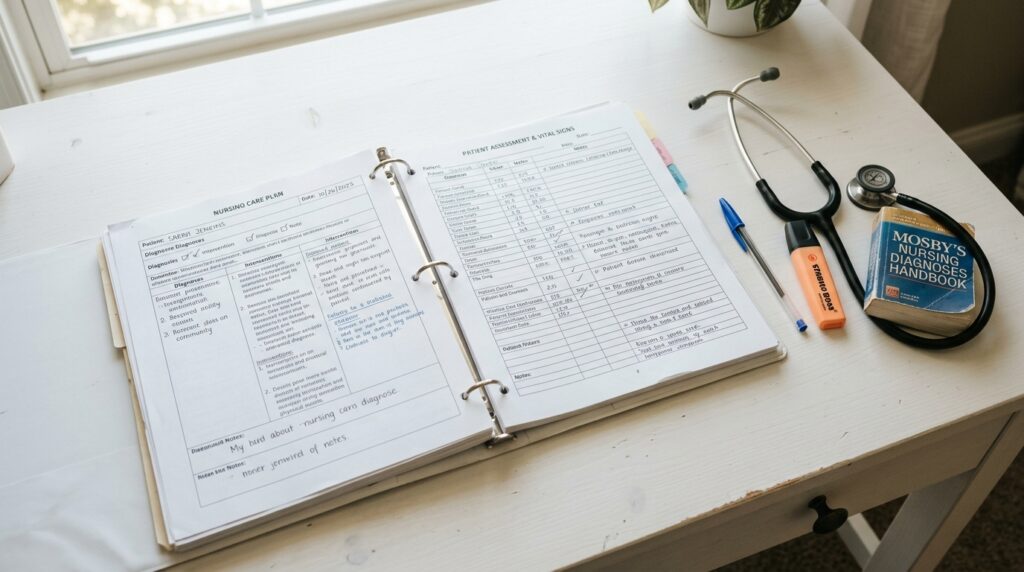
What Is a Nursing Diagnosis? The Core Definition
A nursing diagnosis is a clinical judgment made by a registered nurse about an individual, family, or community’s response to actual or potential health conditions and life processes. It is a formal statement that identifies a health problem or area of vulnerability that falls within the nurse’s scope of practice to identify and address independently.
The most widely accepted and standardized source for nursing diagnosis terminology is NANDA International, formerly the North American Nursing Diagnosis Association. NANDA-I publishes and maintains the official list of approved nursing diagnoses, which currently contains over 260 diagnostic labels organized within a structured taxonomy. When nurses and nursing students refer to nursing diagnoses in clinical and academic settings, they are almost always drawing from the NANDA-I approved list.
At its simplest, a nursing diagnosis answers this clinical question: Based on my nursing assessment findings, what is this patient experiencing, and what nursing actions are needed to address it? The answer to that question is the nursing diagnosis.
Why the Nursing Diagnosis Matters in Clinical Practice
Understanding what a nursing diagnosis is requires understanding why it exists in the first place. Before standardized nursing diagnoses were developed, nurses documented patient problems using inconsistent, informal language that varied from hospital to hospital and nurse to nurse. There was no shared vocabulary for nursing problems, which made communication, continuity of care, and research nearly impossible.
NANDA-I changed that by creating a standardized taxonomy of nursing diagnoses that is recognized internationally. Today, the nursing diagnosis serves several critical functions in clinical practice.
First, it provides a shared professional language. When a nurse documents a nursing diagnosis, any other nurse reading that care plan immediately understands the patient’s problem, its underlying cause, and the evidence supporting the diagnosis. This clarity improves communication and reduces the risk of errors during shift handoffs and care transitions.
Second, it guides individualized nursing care. The nursing diagnosis is the anchor point of the entire care plan. It determines which goals are set, which interventions are implemented, and how outcomes are evaluated. Without a clearly articulated nursing diagnosis, the care plan lacks direction and purpose.
Third, it establishes nursing’s professional accountability. When nurses document nursing diagnoses, they are formally claiming clinical ownership of a patient problem within their scope of practice. This documentation demonstrates that nursing contributes distinct, measurable value to patient care, beyond simply carrying out physician orders.
Nursing Diagnosis vs Medical Diagnosis: A Critical Comparison
One of the most important concepts for any nurse or nursing student to master is the difference between a nursing diagnosis and a medical diagnosis. These two types of diagnoses serve different purposes, are made by different professionals, and address different dimensions of the patient’s health experience.
A medical diagnosis is made by a physician or advanced practice provider and identifies a specific disease, injury, or pathological condition. Examples include acute appendicitis, Type 2 diabetes mellitus, community-acquired pneumonia, and congestive heart failure. Medical diagnoses typically remain stable once established and focus on the pathophysiology of the condition.
A nursing diagnosis, by contrast, identifies the patient’s human response to that medical condition or to life processes. It describes what the patient is experiencing as a result of their health situation, not what disease they have. Nursing diagnoses change as the patient’s condition and responses evolve, and they reflect the nurse’s independent clinical judgment rather than a physician’s determination.
Consider a patient admitted with congestive heart failure. The medical diagnosis is congestive heart failure. Based on the nursing assessment, the nurse might identify several concurrent nursing diagnoses: Excess Fluid Volume, Decreased Cardiac Output, Activity Intolerance, Anxiety, and Deficient Knowledge related to managing heart failure at home. Each of these nursing diagnoses represents a different dimension of the patient’s experience and requires specific nursing interventions. None of them require a physician’s order to identify or address.
Nursing Diagnosis vs Medical Diagnosis at a Glance
| Feature |
Medical Diagnosis |
Nursing Diagnosis |
| Made by |
Physician or advanced practice provider |
Registered nurse |
| Identifies |
Disease, pathology, or medical condition |
Patient’s response to condition or life process |
| Stability |
Relatively stable once established |
Changes as patient’s responses change |
| Examples |
Pneumonia, Type 2 Diabetes, CHF |
Impaired Gas Exchange, Deficient Knowledge, Anxiety |
| Scope |
Medical scope of practice |
Nursing scope of practice |
| Guides |
Medical treatment and pharmacotherapy |
Nursing care plan, goals, and interventions |
| Documentation |
Medical record diagnosis section |
Nursing care plan and nursing notes |
| Framework used |
ICD-10 classification system |
NANDA-I taxonomy II |
The Four Types of Nursing Diagnoses Explained
When exploring what is a nursing diagnosis in full depth, it is essential to understand that not all nursing diagnoses are the same type. NANDA-I recognizes four distinct categories, each with a different clinical purpose, a different documentation format, and a different set of criteria.
1. Problem-Focused Nursing Diagnosis
A problem-focused nursing diagnosis, sometimes called an actual nursing diagnosis, describes a health problem that is currently present and has been identified through assessment findings. It is the most commonly used type in clinical settings and requires the most evidence to support it.
Problem-focused diagnoses are documented using the three-part PES format, standing for Problem, Etiology, and Signs and Symptoms. The complete statement reads: Nursing Diagnosis related to Etiology as evidenced by Signs and Symptoms.
Example: Acute Pain related to tissue injury from abdominal surgery as evidenced by patient rating pain 8 out of 10, guarding of the surgical site, and facial grimacing on movement.
2. Risk Nursing Diagnosis
A risk nursing diagnosis describes a clinical judgment that a patient is vulnerable to developing a specific health problem. The problem has not yet occurred, but assessment findings indicate that the patient faces elevated risk compared to other individuals in similar situations.
Because the problem does not yet exist, there are no defining characteristics or signs and symptoms to document. Risk diagnoses are written in a two-part format: Risk for Nursing Diagnosis related to Risk Factors.
Example: Risk for Infection related to presence of central venous catheter, immunosuppressive therapy, and compromised skin integrity.
3. Health Promotion Nursing Diagnosis
A health promotion nursing diagnosis reflects a clinical judgment about a patient’s motivation, desire, and readiness to increase their well-being and enhance their health behaviors. These diagnoses are used when a patient is not experiencing a current problem but is actively seeking to improve their health status in a specific area.
Health promotion diagnoses begin with the phrase ‘Readiness for Enhanced’ and are supported by the patient’s expressed desire to improve. They use a two-part format: Readiness for Enhanced (area) as evidenced by (patient statements or behaviors indicating readiness).
Example: Readiness for Enhanced Nutrition as evidenced by patient expressing desire to improve eating habits and requesting a dietary consultation.
4. Syndrome Nursing Diagnosis
A syndrome nursing diagnosis is a clinical judgment that a cluster of nursing diagnoses is predicted to appear together in a specific situation or event. Rather than documenting each diagnosis separately, the syndrome label captures the entire pattern with a single, comprehensive diagnostic label.
Example: Frail Elderly Syndrome related to advanced age, chronic illness, nutritional deficits, and physical deconditioning.
Four Types of Nursing Diagnoses with Format and Examples
| Type |
When to Use |
Documentation Format |
Clinical Example |
| Problem-Focused |
Problem exists now, supported by evidence |
Problem + Etiology + Defining Characteristics |
Acute Pain r/t surgery AEB pain rating 8/10 |
| Risk Diagnosis |
Problem does not exist but risk is present |
Risk for + Risk Factors only |
Risk for Infection r/t IV catheter |
| Health Promotion |
Patient ready to enhance their health |
Readiness for Enhanced + Evidence of motivation |
Readiness for Enhanced Nutrition AEB stated desire |
| Syndrome |
Cluster of diagnoses in one situation |
Syndrome label + Etiology only |
Frail Elderly Syndrome r/t chronic illness |
The Three Components of a Problem-Focused Nursing Diagnosis
Now that we have answered what is a nursing diagnosis at a conceptual level, it is time to get specific about how a problem-focused nursing diagnosis is structured. Since this type is the most commonly used in clinical and academic settings, mastering its three-part format is essential.
Component 1: The Diagnostic Label (Problem)
The diagnostic label is the NANDA-I approved name for the nursing diagnosis. It must be selected from the current approved list, as the language is standardized and clinically validated. Using terminology that is not on the approved list produces an invalid nursing diagnosis.
Examples of NANDA-I diagnostic labels: Impaired Gas Exchange, Deficient Fluid Volume, Disturbed Sleep Pattern, Chronic Pain, Impaired Skin Integrity, Social Isolation.
Component 2: The Etiology (Related to…)
The etiology identifies the underlying cause or contributing factor that is producing or maintaining the health problem. In the nursing diagnosis statement, the etiology follows the phrase ‘related to.’ The etiology guides which nursing interventions will be most effective, because addressing the root cause of a problem is far more effective than addressing its symptoms alone.
The etiology can be a pathophysiological process, a situational factor, a treatment-related cause, a maturational factor, or a personal behavioral factor. It is always patient-specific and drawn from the nurse’s assessment findings.
Component 3: Defining Characteristics (As Evidenced by…)
The defining characteristics are the observable signs and symptoms that support and validate the nursing diagnosis. They follow the phrase ‘as evidenced by’ and include both subjective data, which is what the patient reports, and objective data, which is what the nurse observes and measures.
Specific, patient-centered defining characteristics are the mark of a high-quality nursing diagnosis. Generic or vague evidence weakens the clinical defensibility of the diagnosis and reduces the quality of the care plan that follows from it.
How Nursing Diagnosis Fits into the Nursing Process
Understanding what is a nursing diagnosis becomes much clearer when you see where it fits within the broader nursing process. The nursing process is a systematic, evidence-based framework that guides all nursing clinical decision-making. It consists of five steps, often represented by the acronym ADPIE.
- Assessment: The nurse collects comprehensive subjective and objective data about the patient through interview, physical examination, observation, and review of health records.
- Diagnosis: Based on the assessment data, the nurse analyzes the information and formulates nursing diagnoses that identify the patient’s health problems, risks, and areas of strength.
- Planning: The nurse establishes measurable, time-bound goals and expected outcomes for each nursing diagnosis and selects evidence-based nursing interventions to achieve them.
- Implementation: The nurse carries out the planned interventions, which may be independent nursing actions, physician-ordered actions, or collaborative actions with the interdisciplinary team.
- Evaluation: The nurse assesses whether the patient has met the stated goals and outcomes, determines if diagnoses remain accurate, and revises the plan of care as needed.
The nursing diagnosis sits at the center of this process. It is the bridge between the assessment data collected in step one and the care plan developed in step three. Without an accurate nursing diagnosis, the care plan has no clinical foundation, and nursing interventions risk being irrelevant to the patient’s actual needs.
Real-World Examples of Nursing Diagnoses Across Specialties
Seeing nursing diagnosis examples in context is one of the most effective ways to internalize what is a nursing diagnosis and how it is applied in real clinical settings. The following examples demonstrate how nursing diagnoses are formulated across different patient populations and clinical specialties.
Medical-Surgical Nursing
Problem-Focused: Impaired Skin Integrity related to immobility and prolonged pressure over bony prominences as evidenced by a 2cm x 2cm Stage 2 pressure injury on the sacrum with wound bed redness and serous drainage.
Pediatric Nursing
Risk Diagnosis: Risk for Aspiration related to decreased level of consciousness, absent gag reflex, and nasogastric tube placement.
Obstetric and Postpartum Nursing
Health Promotion: Readiness for Enhanced Breastfeeding as evidenced by mother expressing strong desire to breastfeed and asking for guidance on proper latch technique.
Psychiatric and Mental Health Nursing
Problem-Focused: Social Isolation related to disturbed thought processes and fear of others as evidenced by patient refusing to leave room, reporting that others intend to harm them, and absence of meaningful social interaction for 14 days.
Geriatric and Long-Term Care Nursing
Syndrome: Frail Elderly Syndrome related to advanced age, malnutrition, sarcopenia, and three falls in the past 90 days.
Common Mistakes Nurses and Students Make with Nursing Diagnoses
Knowing what is a nursing diagnosis is not enough. Knowing what to avoid when writing one is equally important. These are the most common errors that cost nursing students points on assignments and weaken care plan quality in clinical settings.
Mistake 1: Using Medical Diagnoses as Nursing Diagnoses
The most frequent error is writing a medical condition as the nursing diagnosis. For example, writing ‘Pneumonia’ as a nursing diagnosis is incorrect. Pneumonia is a medical diagnosis. The correct approach is to identify the patient’s response to pneumonia, such as Impaired Gas Exchange or Ineffective Airway Clearance.
Mistake 2: Being Too Generic
Writing vague nursing diagnoses without patient-specific data produces care plans that could apply to any patient and therefore guide care for none effectively. ‘Acute Pain related to pain as evidenced by pain’ is not a clinically meaningful nursing diagnosis. Specificity in etiology and defining characteristics is what makes a nursing diagnosis clinically valuable.
Mistake 3: Using Non-NANDA Terminology
The diagnostic label must come from the current NANDA-I approved list. Invented, informal, or outdated diagnostic labels produce invalid nursing diagnoses that do not meet professional documentation standards.
Mistake 4: Including Medical Interventions in the Etiology
The etiology of a nursing diagnosis should reflect factors within the nurse’s purview to address or influence. Writing ‘related to the physician’s failure to order adequate pain medication’ is inappropriate. The etiology should reflect factors such as tissue damage, knowledge deficit, or physiological changes.
Mistake 5: Mismatching Problem Type and Format
Using the full three-part PES format for a risk diagnosis is an error. Risk diagnoses do not have defining characteristics because the problem has not occurred. Using ‘as evidenced by’ for a risk diagnosis confuses the diagnosis type and weakens clinical accuracy.
Common Nursing Diagnosis Errors and How to Fix Them
| Common Error |
Example of the Error |
Correct Approach |
| Using a medical diagnosis |
Nursing Dx: Pneumonia |
Use: Impaired Gas Exchange r/t alveolar changes AEB SpO2 89% |
| Too vague or generic |
Acute Pain r/t pain AEB patient reports pain |
Be specific: r/t surgical incision AEB pain 8/10, guarding |
| Non-NANDA terminology |
Oxygen Deficiency Syndrome |
Use NANDA-approved label: Impaired Gas Exchange (00030) |
| Wrong format for type |
Risk for Falls r/t weakness AEB patient fell |
Risk diagnoses have no AEB. Remove defining characteristics |
| Medical intervention etiology |
r/t insufficient physician pain orders |
r/t tissue damage from surgical incision |
FAQ SECTION
Q1: What is a nursing diagnosis in simple terms?
A nursing diagnosis is a clinical statement made by a registered nurse that identifies a patient’s response to a health condition or life process. It is different from a medical diagnosis, which identifies the disease itself. The nursing diagnosis identifies how the patient is experiencing that disease, such as pain, anxiety, difficulty breathing, or lack of knowledge, and forms the basis of the nursing care plan. It is drawn from the NANDA-I approved taxonomy and is supported by the nurse’s assessment findings.
Q2: What is the difference between a nursing diagnosis and a medical diagnosis?
A medical diagnosis is made by a physician and identifies a specific disease or pathological condition, such as pneumonia or Type 2 diabetes. A nursing diagnosis is made by a registered nurse and identifies the patient’s human response to that condition, such as Impaired Gas Exchange or Deficient Knowledge. Medical diagnoses stay relatively stable; nursing diagnoses change as the patient’s condition and responses evolve. Nursing diagnoses are within the nurse’s independent scope of practice to identify and address without a physician’s order.
Q3: What are the four types of nursing diagnoses?
NANDA-I recognizes four types of nursing diagnoses. A problem-focused diagnosis describes an existing health problem supported by assessment evidence, written in the three-part PES format. A risk diagnosis describes vulnerability to a problem that has not yet occurred, written without defining characteristics. A health promotion diagnosis describes a patient’s readiness to improve their well-being, beginning with the phrase Readiness for Enhanced. A syndrome diagnosis captures a cluster of nursing diagnoses that predictably occur together in a specific clinical situation.
Q4: How do you write a nursing diagnosis correctly?
A problem-focused nursing diagnosis is written in three parts using the PES format. First, write the NANDA-I approved diagnostic label. Second, write ‘related to’ followed by the etiology, which is the underlying cause of the problem. Third, write ‘as evidenced by’ followed by the defining characteristics, which are the objective and subjective signs and symptoms your assessment identified. For example: Acute Pain related to tissue injury from surgical incision as evidenced by patient rating pain 8 out of 10, guarding behavior, and elevated heart rate. Risk diagnoses use only the first two parts, with no ‘as evidenced by’ component.
Q5: Why is a nursing diagnosis important in patient care?
A nursing diagnosis is important because it provides the clinical foundation for the entire nursing care plan. It tells the healthcare team what the patient is experiencing, why it is happening, and what evidence supports that conclusion. It guides which goals are set, which interventions are selected, and how outcomes are measured. It also establishes nursing’s professional accountability for specific patient problems and contributes to continuity of care by using standardized language that any nurse can understand and act on.
Q6: What is the NANDA-I nursing diagnosis taxonomy?
The NANDA-I nursing diagnosis taxonomy is the internationally recognized classification system that organizes all approved nursing diagnoses. Taxonomy II, the current version, arranges over 260 nursing diagnoses within 13 broad domains and 47 classes, ranging from Nutrition and Safety to Coping and Self-Perception. Each diagnosis entry includes the diagnostic label, a definition, defining characteristics, related factors, at-risk populations, and associated conditions. The taxonomy is updated regularly to reflect new clinical research and evolving nursing practice.
Q7: Can a nurse make a nursing diagnosis without a physician’s order?
Yes. Making a nursing diagnosis is within the independent scope of practice of a registered nurse and does not require a physician’s order. This is one of the defining features of a nursing diagnosis: it reflects a clinical judgment that nurses are professionally and legally authorized to make on their own. Nursing diagnoses identify problems and needs that nurses address using independent nursing interventions. Physician-ordered treatments address the medical diagnosis, while nursing diagnoses and care plans address the patient’s responses to that diagnosis, which is the nurse’s domain.
CONCLUSION
Conclusion: Why Every Nurse Must Master the Nursing Diagnosis
Understanding what is a nursing diagnosis is not simply an academic requirement for passing a clinical assignment. It is a foundational professional competency that shapes the quality of care every nurse provides throughout their career. The nursing diagnosis is the bridge between what you observe during assessment and what you do during patient care. Get it right, and everything else in the care planning process becomes clearer, more purposeful, and more effective.
From the four types recognized by NANDA-I to the three-part PES format for problem-focused diagnoses, from the critical distinction between nursing and medical diagnoses to the common documentation errors that weaken clinical reasoning, every concept covered in this guide serves a single purpose: helping you identify your patients’ needs with greater precision and care for them with greater confidence.
The nursing diagnosis is not a formality. It is the professional claim every nurse makes when they say: I see what this patient is experiencing. I understand why it is happening. And I know what nursing actions will help. That clarity is what distinguishes excellent nursing care from average care, and it begins with answering the foundational question that this entire guide has been built around: what is a nursing diagnosis?
Save this guide for your next care plan assignment or clinical rotation. Share it with your study group or nursing cohort. And when you are ready to go deeper, explore our related articles on NANDA nursing diagnoses, the full ADPIE nursing process, and specialty-specific nursing care plan examples. Your patients benefit every time your clinical documentation improves.









 Evan John