
You have earned your nursing degree, passed the NCLEX, and now you are sitting across from a hiring manager who holds the key to your first nursing role. The clinical skills are there, but are you ready for the questions they are about to ask?
Nursing interviews are not just about what you know. They are about how you think, how you communicate under pressure, and whether you will fit the culture of their unit. Hiring managers use specific questions to assess your clinical judgment, your professionalism, and your ability to keep patients safe.
This guide covers the top nursing interview questions you are most likely to face in 2026 from general openers to tough behavioural scenarios, along with expert sample answers, a breakdown of the STAR method, and the insider tips that separate candidates who get called back from those who do not.
QUICK ANSWER: The most common nursing interview questions fall into four categories: personal/background questions, clinical scenario questions, behavioural questions (STAR format), and situational/ethics questions. Prepare at least two solid answers for each category before your interview.
What Nursing Hiring Managers Actually Look For
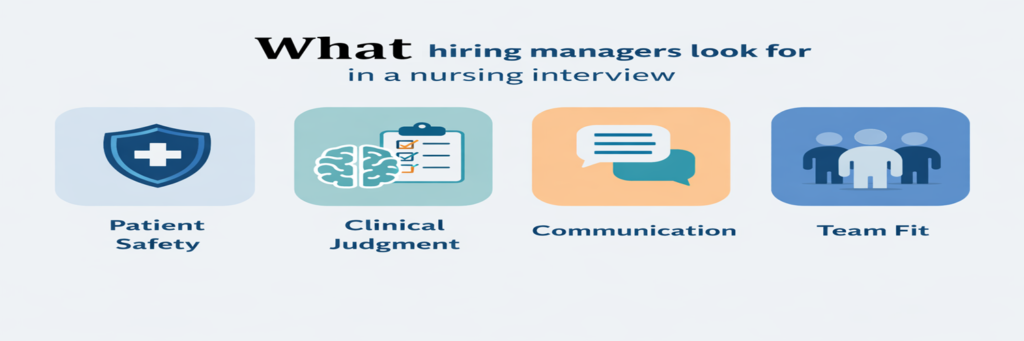
Before diving into the questions, understand the lens through which every answer is evaluated. Nurse managers and HR teams are not just assessing your technical knowledge, they are screening for four non-negotiable qualities.
What Every Nursing Hiring Manager Evaluates in Every Answer
1. Patient Safety First — Does every answer prioritise the wellbeing of the patient above all else?
2. Clinical Judgment — Can you think critically and act appropriately under pressure?
3. Communication — Are you clear, professional, and composed even in difficult situations?
4. Team Fit — Will you collaborate, support colleagues, and contribute positively to the unit culture?
Keep these four pillars in mind as you write every answer. The best responses always circle back to at least one of them, ideally two or three at once.
The STAR Method: Your Secret Weapon for Behavioural Questions
Most nursing interviews include behavioural questions questions that start with “Tell me about a time when…” These are designed to assess how you have handled real situations in the past. The STAR method gives you a clean, confident framework for answering every single one.
STAR What It Means and What to Say
S — Situation Set the scene briefly. Where were you? What was the context? Keep it to 1–2 sentences.
T — Task Describe your specific role or responsibility in that situation. What were you accountable for?
A — Action This is the most important part. Explain exactly what YOU did — not what the team did. Use ‘I’ not ‘we’.
R — Result Share the outcome. What happened because of your actions? Quantify if possible (e.g. patient stabilised within 10 minutes).
Also read on Best Nursing Notes Templates (SOAP, SBAR & Head-to-Toe Assessment)
Practice the STAR method out loud before your interview, not just in your head. The structure only becomes natural with repetition.
Top 10 Nursing Interview Questions, With Sample Answers

General & Background Questions
Q1: Tell me about yourself.
Why Asked This is an icebreaker and a confidence check. Interviewers want a concise, professional summary, not your life story. They are also listening for clarity and composure.
Sample Answer I am a registered nurse with [X years] of experience in [specialty, e.g. medical-surgical nursing]. I completed my Bachelor of Science in Nursing at [University] and have spent the past [timeframe] developing my skills in patient assessment, care planning, and inter-professional collaboration. I am particularly passionate about [specific area, e.g. post-operative care] and I am drawn to this role because of [specific reason related to the hospital/unit].
Keep your answer to 90 seconds. End with why you want THIS role at THIS facility, it shows you have done your research.
Q2: Why did you choose nursing as a career?
Why Asked Interviewers want to see genuine motivation, not a rehearsed answer. They are assessing whether you are in nursing for the right reasons — and whether you are likely to stay.
Sample Answer Nursing was a deliberate choice for me. I was drawn to a career where I could make a direct, measurable difference in someone’s life during their most vulnerable moments. What keeps me committed to nursing is the combination of clinical challenge and human connection, no two patients or days are ever the same. I find that combination deeply meaningful.
Avoid clichés like ‘I have always wanted to help people.’ Be specific. Reference a real experience or moment that confirmed your choice.
Q3 What are your greatest strengths as a nurse?
Why Asked This tests self-awareness and professional confidence. Interviewers want specific, nursing-relevant strengths — not generic answers.
Sample Answer My strongest skills are clinical assessment and patient communication. I am able to identify subtle changes in a patient’s condition quickly and escalate appropriately — something that has been particularly valuable in fast-paced environments. I also prioritise clear communication with patients and their families during stressful periods, which I have found significantly reduces anxiety and improves adherence to care plans.
Choose two strengths maximum. For each one, give a brief clinical example that proves it. Never say ‘I work too hard’ as a strength disguised as a weakness.
Behavioural Questions : Use the STAR Method
Q4: Tell me about a time you made a mistake. How did you handle it?
Why Asked This is one of the most important questions in any nursing interview. It tests honesty, accountability, and your ability to learn and improve under pressure.
Sample Answer During my second year on the ward, I administered a medication at the wrong time due to a miscommunication during handover. I identified the error within 20 minutes, immediately notified the charge nurse and attending physician, completed a full incident report, and monitored the patient closely for the next four hours. There were no adverse effects. I then worked with the unit to propose a clearer handover checklist to prevent recurrence.
PRO TIP Never say you have never made a mistake. Every nurse has. Choose a real example, show full accountability, and emphasise what you learned and changed as a result.
Q5: Describe a time you disagreed with a doctor’s order. What did you do?
Why Asked This tests your ability to advocate for patients professionally and your confidence in clinical communication without being confrontational.
Sample Answer During a night shift, I was concerned about a pain management order that I felt was too high for a patient’s renal function based on their latest labs. I reviewed the chart, confirmed my concern was clinically valid, and called the physician using SBAR format — Situation, Background, Assessment, Recommendation. The physician appreciated the structured communication, reviewed the labs, and adjusted the dose. The patient remained stable throughout.
PRO TIP Never say you simply followed the order without question. Show that you advocated safely, used evidence, and communicated professionally. Mention SBAR — it signals clinical sophistication.
Q6: Tell me about a time you had to manage multiple critically ill patients at once.
Why Asked Prioritisation is a core nursing competency. This question tests whether you can triage, delegate, and remain composed under pressure — all at once.
Sample Answer During a particularly heavy shift, I had four patients including one post-operative patient who began showing signs of internal bleeding and another who was due for a complex dressing change. I immediately triaged by acuity — escalated the post-op patient to the charge nurse and rapid response team while delegating the dressing change to an enrolled nurse I trusted to complete it safely. I documented everything in real time and debriefed with the team at end of shift.
Use the ABCs and Maslow as your framework when describing your prioritisation logic. Show that you delegate safely — never abandon any patient.
Situational & Ethics Questions
Q7: What would you do if you witnessed a colleague behaving unsafely with a patient?
Why Asked This tests your ethics, your courage to act, and your understanding of professional accountability. Interviewers are watching to see if you prioritise the patient or the colleague.
Sample Answer Patient safety is non-negotiable for me. If I witnessed unsafe behaviour, I would intervene calmly and directly in the moment if it was safe to do so — for example, stopping an incorrect procedure. Then I would report the incident to the charge nurse or nurse manager immediately and complete the required incident documentation. I would not ignore it or handle it informally, because the patient’s right to safe care comes before any sense of loyalty to a colleague.
PRO TIP Be direct and firm without sounding aggressive. Make it clear patient safety comes first — always. Reference reporting structures to show you know the correct process.
Q8: How do you handle stress and avoid burnout?
Why Asked Burnout is a major concern in nursing. This question tests whether you have genuine self-awareness and practical strategies — not just textbook answers.
Sample Answer I have intentionally developed habits that protect my resilience over time. During shifts, I use clinical handovers and team debriefs to process difficult cases before I leave the floor. Outside work, I maintain a consistent exercise routine and protect my days off as genuine recovery time — I do not check work messages. I also recognise the warning signs of compassion fatigue early and speak to my supervisor before it compounds. Nursing is a marathon, and I take my sustainability as seriously as I take my clinical skills.
Be specific about your actual habits. Avoid vague answers like ‘I just take a breath.’ Show that you understand burnout as a professional responsibility, not just a personal one.
Q9: Where do you see yourself in five years?
Why Asked Interviewers want to assess ambition, commitment, and whether investing in you is worthwhile. They also want to know if your goals align with their unit.
Sample Answer In five years I see myself as a clinical leader in [specialty area]. I am committed to ongoing professional development, I plan to complete [specific certification, e.g. Critical Care Registered Nurse certification] within the next two years. I am also interested in eventually moving into a senior clinical role where I can mentor new graduate nurses. I want to grow with an organisation that values professional development, which is part of why I am excited about this opportunity.
PRO TIP Never say ‘I have no idea’ or give a completely unrelated goal. Show ambition that is grounded in nursing — certifications, specialisation, leadership, or education.
Q10: Do you have any questions for us?
Why Asked This is not optional. Asking nothing signals disinterest. The questions you ask reveal your priorities, your professionalism, and your preparation.
Sample Answer Yes — I have a few. First, what does the orientation process look like for this role, and how long is the supervised period for new staff? Second, how does this unit support ongoing professional development and continuing education? And third, how would you describe the culture of the team and how conflict is typically resolved?
Prepare at least three questions in advance. Avoid asking about salary or holidays in the first interview. Ask about development, team culture, and expectations — it shows you are thinking long-term.
5 Smart Questions to Ask at the End of Your Nursing Interview
The questions you ask matter just as much as the answers you give. Here are five that signal preparation, professionalism, and long-term thinking.
1. What does the typical orientation and preceptorship look like for this role?
2. How does this unit support nurses who want to pursue specialty certifications?
3. What are the biggest challenges currently facing this team, and how are they being addressed?
4. How is performance feedback delivered — and how often?
5. What does a typical shift look like in terms of patient ratios and team structure?
Key Takeaways : Nursing Interview Quick-Reference
Summary: What You Need to Walk Into Your Nursing Interview Ready
Prepare answers across four categories: General, Behavioural (STAR), Situational, and Ethics
Use the STAR method for every behavioural question: Situation, Task, Action, Result
Every answer should circle back to patient safety, clinical judgment, communication, or team fit
Never say you have never made a mistake — own it, explain what you changed, move forward
When asked about disagreeing with a doctor, always mention SBAR and professional escalation
Prepare at least 3 questions to ask at the end — asking nothing signals disinterest
Research the facility, unit, and role before the interview — interviewers can tell who prepared
Practice your answers OUT LOUD at least three times before interview day

Frequently Asked Questions : Nursing Interviews
Add each Q&A below using the RankMath FAQ Block in WordPress (not plain text) to trigger FAQPage schema and earn rich results in Google Search.
Q: What are the most common nursing interview questions?
The most common nursing interview questions cover four areas: personal background (‘tell me about yourself’), clinical judgment (‘how do you prioritise patients?’), behavioural scenarios (‘tell me about a time you made a mistake’), and situational ethics (‘what would you do if a colleague was behaving unsafely?’). Preparing structured answers in the STAR format for each category significantly improves your performance.
Q: How do I answer nursing interview questions with no experience?
If you are a new graduate nurse, draw on your clinical placement experiences, simulation labs, and academic projects. Use the STAR method and frame your experiences from nursing school: ‘During my final placement at [hospital], I…’ Interviewers hiring new grads know you have limited work experience, they are assessing your attitude, your clinical reasoning, and your eagerness to learn.
Q: What is the STAR method and how do I use it in a nursing interview?
STAR stands for Situation, Task, Action, Result. It is a structured way to answer behavioural interview questions. Describe the situation briefly, explain your specific task or responsibility, detail the actions YOU took, and share the measurable result. For nursing interviews, always anchor your result to patient outcomes or safety.
Q: What should I wear to a nursing interview?
Business professional or smart business casual is the standard for nursing interviews. For women, this means a blazer with dress pants or a knee-length skirt. For men, a button-down shirt with dress trousers and dress shoes. Avoid scrubs unless explicitly told the interview is on the floor. First impressions matter — dress as if you already work there in a leadership capacity.
Q: What questions should I ask at the end of a nursing interview?
Ask about orientation and preceptorship length, opportunities for specialty certification support, current challenges facing the unit, how performance feedback is delivered, and what the typical patient ratio looks like. Avoid asking about salary or vacation time in the first interview — focus on the role, the team, and your professional development.
Q: How do I prepare for a nursing interview the night before?
Review your prepared STAR answers out loud one final time. Research the hospital’s mission statement, values, and any recent news about the facility. Prepare your questions to ask. Lay out your outfit, identification, and copies of your resume and certifications. Go to bed at a reasonable time, showing up rested and composed matters more than any last-minute cramming.
Final Thoughts
A nursing interview is your opportunity to show that you are exactly the kind of nurse every unit needs: competent, composed, compassionate, and coachable. The questions in this guide are not designed to trick you, they are designed to reveal how you think, how you act under pressure, and how you treat people.
Prepare your STAR answers. Research the facility. Walk in with three questions ready. And remember ,you have already done the hard work to get to this room. Now it is simply about letting that preparation show.
Good luck. The unit you are about to join is lucky to have you applying.









 Evan John