Theory of Knowledge | IB Diploma Programme
A Complete Guide for IB Students
The November 2026 TOK essay titles present IB students with six rich and challenging questions about the nature, production, and limits of knowledge. Drawing on areas of knowledge (AOKs) including history, the arts, the natural sciences, mathematics, and the human sciences, each title rewards careful argument, honest reflection, and well-chosen examples. Below is a concise analysis of each title to help you choose confidently and plan your essay effectively.
November 2026 TOK Essay Titles
| # |
Essay Title |
| 1 |
Is the advice to “study the historian before you begin to study their work” (adapted from E.H. Carr) good advice? Explore with reference to history and one other area of knowledge. |
| 2 |
To what extent do you agree that failure is an essential part of the production of knowledge? Answer with reference to two areas of knowledge. |
| 3 |
In the production of knowledge, why is it that ideas are so often more alluring than facts? Discuss with reference to the human sciences and one other area of knowledge. |
| 4 |
To what extent do you agree that the artist and the natural scientist should be equally concerned with ethical questions? Discuss with reference to the arts and the natural sciences. |
| 5 |
Does the need to share knowledge pose challenges in the production of knowledge? Discuss with reference to two areas of knowledge. |
| 6 |
Given that it lacks evidence, how is it that intuition is so valuable in the production of knowledge? Discuss with reference to mathematics and one other area of knowledge. |
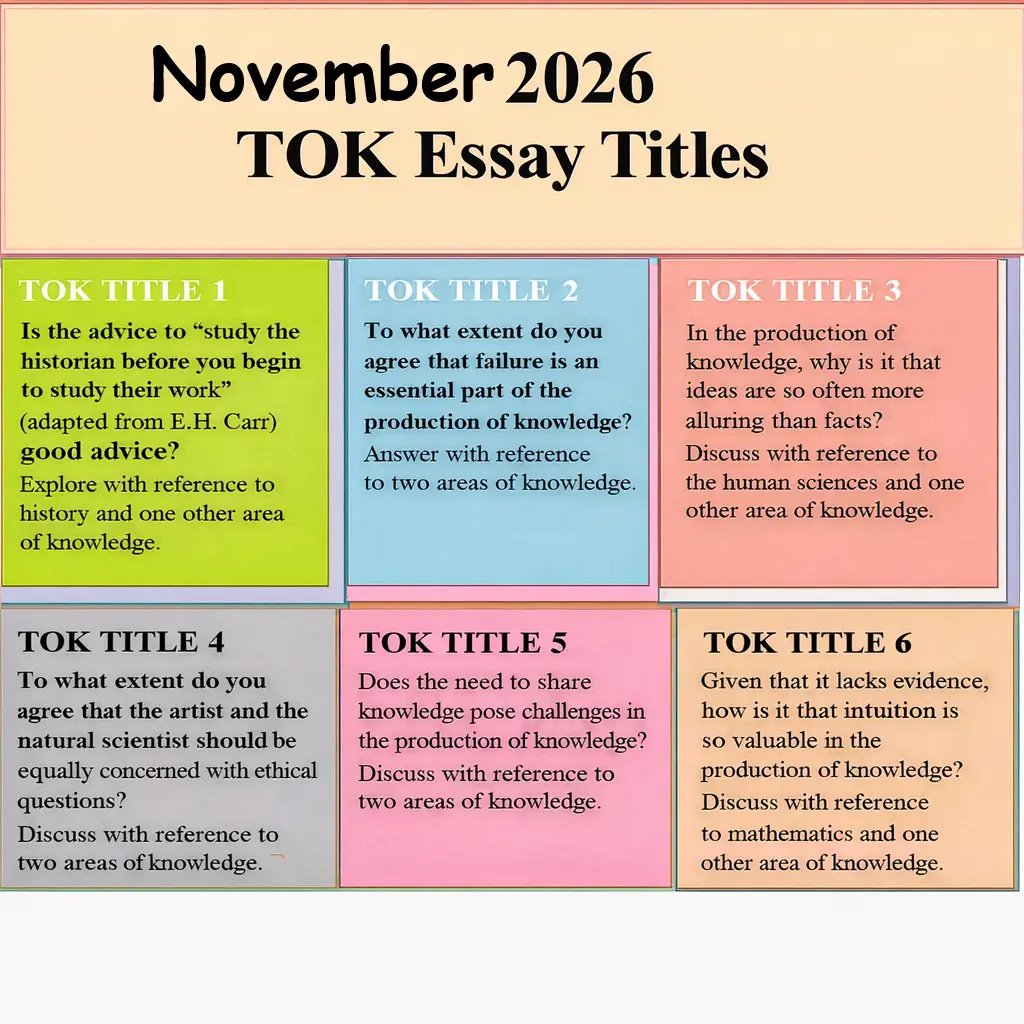
TOK Essay Titles for November 2026 : Descriptions
Title 1: “Study the Historian Before You Study Their Work” (E.H. Carr)
| Is the advice to “study the historian before you begin to study their work” (adapted from E.H. Carr) good advice? Explore with reference to history and one other area of knowledge. |
E.H. Carr’s famous provocation that before reading a history book you should first ask “what kind of man is this historian?” captures the insight that all knowledge production is shaped by the knower. This title asks students to evaluate whether understanding the producer of knowledge is a precondition for evaluating the knowledge itself.
In history, the argument for Carr’s advice is compelling. Historians do not simply report the past; they select, interpret, and frame it. A Victorian imperial historian writing about colonialism will construct a fundamentally different account from a postcolonial scholar examining the same events. Understanding the historian’s nationality, class, political commitments, and historical moment helps the reader identify what might have been emphasised, downplayed, or omitted. This is not to say that biased history is worthless, but that its perspective must be factored into how it is read and used.
Students might apply the same principle to a second AOK such as the natural sciences or the human sciences. In science, the biography and institutional affiliations of researchers can matter: who funded a study, what paradigm a researcher was trained in, and what results they were hoping to find can all influence methodology and interpretation. The sociology of science from Thomas Kuhn to recent debates about replication crises has shown that scientific knowledge is not produced in a vacuum free of human influence.
The essay should also address the limits of the advice. Does attending too closely to the knower risk an ad hominem fallacy dismissing knowledge on the basis of who produced it rather than evaluating its content on its merits? The best essays will strike a balance: knowing the historian (or scientist) enriches understanding, but cannot substitute for evaluating the work itself.
Title 2: Failure as an Essential Part of the Production of Knowledge
| To what extent do you agree that failure is an essential part of the production of knowledge? Answer with reference to two areas of knowledge. |
This title invites students to reframe failure typically seen as something to be avoided as a potentially indispensable feature of how knowledge grows. The history of knowledge across every discipline is, in large part, a history of failed attempts, false starts, and productive dead ends.
In the natural sciences, failure is deeply embedded in the scientific method. Experiments are designed to be falsifiable precisely so they can fail, and a failed hypothesis, properly documented, advances knowledge by ruling out possibilities. The Michelson-Morley experiment of 1887, which failed to detect the expected luminiferous aether, is one of the most consequential failures in scientific history: it cleared the ground for Einstein’s special theory of relativity. Without that productive failure, the edifice of modern physics might have taken a very different shape.
In the arts, failure operates differently but is no less instructive. Artists speak of the importance of producing bad work as a necessary step toward good work of the sketchbook filled with abandoned ideas that nevertheless train the eye and the hand. Samuel Beckett’s injunction to ‘fail better’ captures the idea that artistic knowledge is refined through iterative failure rather than achieved in a single successful act. The history of artistic movements is also a history of deliberate violation of received conventions — failures, by the standards of the time, that opened new possibilities.
Students might also explore mathematics, where failed proofs often illuminate the structure of a problem even when they do not solve it, or history, where historians learn from poorly evidenced or subsequently refuted interpretations. The essay should engage seriously with the counter-argument: some failures are simply wasteful, and not all failure is productive the key is what conditions make failure generative rather than merely costly.
Title 3: Why Ideas Are More Alluring Than Facts
| In the production of knowledge, why is it that ideas are so often more alluring than facts? Discuss with reference to the human sciences and one other area of knowledge. |
This title raises a question that cuts to the heart of how human beings engage with knowledge. Facts verified, empirically grounded data points are the building blocks of reliable knowledge. Yet ideas, theories, and narratives consistently prove more psychologically compelling and intellectually influential than bare facts. Why should this be so, and what does it mean for the production of knowledge?
In the human sciences, this tension is acutely felt. Economic theories, psychological models, and sociological frameworks shape how researchers collect and interpret data and sometimes the theory proves so alluring that contradictory facts are resisted, explained away, or simply ignored. The persistence of discredited theories in popular psychology (such as certain oversimplified models of learning styles or left-brain/right-brain thinking) illustrates how a compelling idea can outlast the evidence base that once supported it. Conversely, the power of a good theoretical framework such as Darwinian evolution, or attachment theory in developmental psychology can organise and illuminate vast bodies of otherwise disconnected facts.
In history, ideas have similarly shaped which facts get recorded, preserved, and deemed significant. The grand narrative of inevitable progress that dominated 19th-century historiography caused historians to select and interpret facts that confirmed the story of linear civilisational advancement, while downplaying or ignoring evidence of regression, cyclicality, or non-Western historical trajectories.
A productive second AOK is the natural sciences, where the allure of elegant theories (such as supersymmetry in theoretical physics) has sometimes driven research programmes long after empirical support has stalled. The essay should explore whether the allure of ideas is a cognitive weakness to be overcome, or whether it reflects something true about the structure of knowledge itself, that facts only become meaningful when woven into explanatory frameworks.
Title 4: Artists and Natural Scientists: Equally Concerned with Ethics?
| To what extent do you agree that the artist and the natural scientist should be equally concerned with ethical questions? Discuss with reference to the arts and the natural sciences. |
This title raises important questions about responsibility, power, and the ethical obligations that come with producing and disseminating knowledge. Both artists and natural scientists wield significant influence over how people understand the world, over what gets built or created, and over the values and ideas that circulate in society. But are their ethical responsibilities equivalent?
The case for equal ethical concern is strong. Natural scientists whose research informs weapons development, surveillance technology, genetic engineering, or climate modelling bear obvious ethical responsibilities: the knowledge they produce has direct and potentially catastrophic real-world consequences. The post-Hiroshima reflections of physicists such as J. Robert Oppenheimer are a canonical example of a scientist confronting the ethical weight of their work. More recently, debates around gain-of-function research in virology, the ethics of AI development, and the responsibilities of climate scientists to communicate their findings to the public all demonstrate that scientific practice is ethically charged at every stage.
Artists, too, operate in an ethically loaded domain. Art shapes cultural attitudes, represents (or misrepresents) communities, and can reinforce or challenge power structures. Questions about cultural appropriation, the ethics of depicting real people or traumatic events, and the responsibilities of artists whose work is used for propaganda all illustrate that artistic practice is not ethically neutral. The Romantic notion of the artist as a figure above moral accountability has been widely challenged.
However, the nature and immediacy of ethical concerns differ. A natural scientist developing a pathogen faces more direct and foreseeable ethical stakes than a novelist exploring morally complex themes. The essay should explore whether ‘equally concerned’ means the same kinds of ethical questions, or simply an equivalent depth of ethical responsibility and whether the differences in their practice warrant different ethical frameworks.
Title 5: Does the Need to Share Knowledge Pose Challenges?
| Does the need to share knowledge pose challenges in the production of knowledge? Discuss with reference to two areas of knowledge. |
Knowledge that cannot be shared is, in an important sense, incomplete: it remains private, unverified, and unable to build on itself. Sharing is not merely a secondary activity that follows knowledge production it is integral to it. Peer review, publication, teaching, and public communication are all part of how knowledge is validated and developed. Yet the requirement to share can also distort, constrain, or compromise the knowledge being produced.
In the natural sciences, the pressure to publish has well-documented consequences. The ‘publish or perish’ culture in academic science incentivises the reporting of positive, novel, and statistically significant results which contributes to the replication crisis, where many published findings have proven impossible to reproduce. Sharing norms that reward novelty over rigour can damage the integrity of the knowledge base. At the same time, open-access movements and pre-print culture have demonstrated that more sharing, not less, can accelerate knowledge production and catch errors more quickly.
In history, sharing poses different challenges. Historians must communicate complex, nuanced, and often uncomfortable findings to multiple audiences: academic peers, policy-makers, educators, and the general public. Simplification for accessibility risks distorting the knowledge; failure to communicate risks irrelevance. The ethics of sharing sensitive historical findings about living communities, about national myths, about crimes for which there has been no accountability adds further complexity.
Students might also explore the arts (where sharing a work exposes it to interpretations the artist cannot control) or the human sciences (where sharing data about individuals raises privacy concerns). The essay should consider whether the challenges of sharing are incidental problems to be managed, or whether they reveal something fundamental about the social nature of knowledge itself.
Title 6: The Value of Intuition Despite Its Lack of Evidence
| Given that it lacks evidence, how is it that intuition is so valuable in the production of knowledge? Discuss with reference to mathematics and one other area of knowledge. |
Intuition occupies an uneasy position in epistemology. It is not the same as guesswork, yet it cannot be directly verified or justified by evidence. It seems to bypass the careful, step-by-step reasoning that underpins most accounts of reliable knowledge production. And yet, across disciplines, practitioners consistently report that intuition plays a crucial and often irreplaceable role in how new knowledge is discovered and developed.
In mathematics, intuition is a well-recognised feature of mathematical practice, even though mathematics is the paradigm of a discipline built on rigorous proof. Mathematicians speak of ‘seeing’ a result before they can prove it of having a strong intuitive sense that a conjecture is true long before they possess a formal demonstration. The great mathematician Srinivasa Ramanujan produced an extraordinary body of results, many of which he reported came to him through intuition and which took other mathematicians decades to verify. Mathematical intuition is not random: it is trained through deep familiarity with patterns and structures, making it a form of highly compressed expertise rather than mere feeling.
In the natural sciences, intuition also plays a role in hypothesis formation and experimental design. Scientists develop a ‘feel’ for which experimental approaches are likely to be productive, which anomalous results deserve further investigation, and which theoretical directions are promising well before any formal evidence is available. This intuitive judgement is part of what distinguishes an outstanding scientist from a merely competent one.
Students might alternatively explore history, where historians develop an intuitive sense for whether a source is authentic or a narrative rings true, or the arts, where artistic intuition guides creative decisions that cannot always be rationally justified after the fact. The essay should address the epistemological puzzle directly: if intuition lacks evidence, what is its status as a knowledge-producing tool? Is it a shortcut that sometimes works, or evidence of a form of tacit knowledge that exceeds what can be made explicit?
Conclusion
The November 2026 TOK essay titles collectively probe the conditions, tools, and challenges of knowledge production with unusual depth and sophistication. Whether examining the role of the knower’s identity (Title 1), the generative power of failure (Title 2), the psychology of belief (Title 3), ethical responsibility (Title 4), the social demands of sharing (Title 5), or the epistemological puzzle of intuition (Title 6), each title invites students to move beyond surface-level observation toward genuine philosophical inquiry.
Successful TOK essays share a common approach: they define key terms carefully, develop a genuine and defensible argument rather than simply listing perspectives, anchor abstract claims in specific and well-chosen real-world knowledge examples, and take counter-arguments seriously rather than dismissing them. Most importantly, they reflect the student’s own thinking — a marker examiner is looking for an authentic intellectual voice, not a rehearsed template.
Whichever title you choose, remember that the goal of TOK is not to reach a definitive answer but to demonstrate that you can think with rigour, honesty, and genuine curiosity about how knowledge is made, justified, and contested.
| © International Baccalaureate Organization 2026. All prescribed titles are copyright of the IBO. Students must use the exact title wording as provided by their school. |
Check also: May 2026 TOK Essay Titles









 Evan John